Key Takeaways
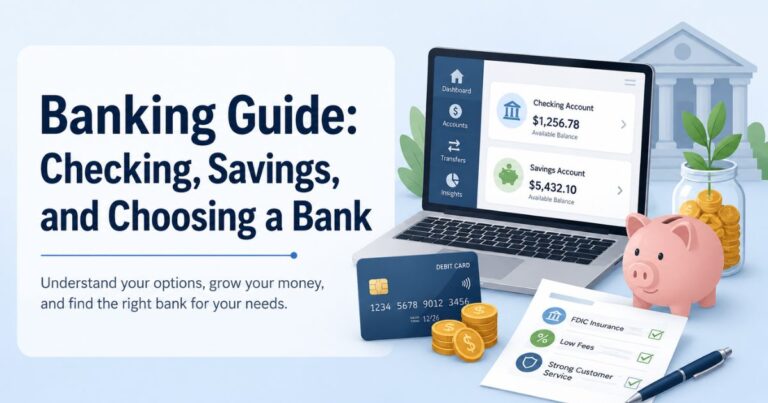
- Two-account foundation: checking for spending and bills; savings for goals and the emergency fund — keep them separate.
- Your money is protected: the FDIC insures up to $250,000 per depositor, per bank, per ownership category; the NCUA does the same for credit unions.
- Rates vary enormously: the national average savings rate is just 0.38% APY, while high-yield savings accounts pay roughly 4% — about 10x more, for the same insurance.
- Fees are optional: plenty of accounts charge $0 monthly fees; never pay $10–$15/month for basic checking without a waiver you’ll actually meet.
- Best first step: keep 1–2 months of expenses in a no-fee checking account and move the rest to a high-yield savings account.
Banking is the foundation every other money decision sits on — yet most people pick a bank once, by default, and quietly lose hundreds of dollars a year to fees and near-zero interest. This guide explains how banking works, the difference between checking and savings, how to choose a bank, whether your money is safe (FDIC insurance explained), the main account types, how to open an account in five steps, banks vs credit unions, online vs traditional banks, and the best banking options for Floridians. It’s part of our broader Personal Finance complete guide.
Everything here is educational, not financial advice, and rates quoted are current as of June 2026 — interest rates change, so verify current figures before opening any account.
Table of Contents
- 1 How does banking work?
- 2 What is the difference between checking and savings accounts?
- 3 How do you choose a bank?
- 4 Are banks safe? FDIC insurance explained
- 5 What are the types of bank accounts?
- 6 How to open a bank account in 5 steps
- 7 Banks vs credit unions
- 8 Online banks vs traditional banks
- 9 Banking tools and account offers
- 10 Best banks in Florida for everyday banking
- 11 Frequently Asked Questions About Banking
How does banking work?
Banking works on a simple exchange: you deposit money with a bank for safekeeping and convenience, and the bank uses those pooled deposits to make loans — mortgages, car loans, business loans — earning interest on the difference. In return, the bank gives you payment tools (debit cards, checks, transfers, bill pay), pays you interest on some accounts, and keeps your money protected by federal deposit insurance.
That’s the whole model: banks profit on the spread between what they pay depositors and what they charge borrowers, plus fees. Understanding it explains almost everything about choosing a bank well. Big branch networks are expensive, which is why large traditional banks tend to pay the lowest interest and charge the most fees; online banks skip the branches and pass the savings on as higher rates. It also explains why the banking relationship is worth optimizing: the same $10,000 sitting in savings can earn $38 a year at one institution and roughly $400 at another, with identical federal protection.
What is the difference between checking and savings accounts?
The difference between checking and savings accounts is purpose: a checking account is built for spending — unlimited transactions, a debit card, bill pay, direct deposit — while a savings account is built for storing money and earning interest. Checking accounts typically pay little or no interest; savings accounts pay interest but may limit certain withdrawal types and don’t come with checks or a spending card.
The practical setup most people need is both, working together: your paycheck lands in checking, your bills and daily spending run from checking, and everything beyond a small buffer moves to savings — ideally automatically, on payday. That separation does two jobs at once: it keeps your spending money organized, and it puts your reserve somewhere it earns real interest and is one small step removed from impulse purchases. The single most common banking mistake is holding thousands of dollars in a checking account earning 0%.
How do you choose a bank?
You choose a bank by comparing five things: fees, interest rates (APY), ATM and branch access, digital experience, and federal insurance. Concretely: look for $0 monthly maintenance fees (or waivers you’ll reliably meet), a competitive savings APY (measured against the ~4% high-yield accounts pay, not the 0.38% average), a fee-free ATM network you’ll actually use, a well-reviewed app with mobile deposit and instant alerts, and confirmation the institution is FDIC-insured (or NCUA-insured for credit unions).
Weight those factors by how you actually bank. If you deposit cash regularly or want in-person service, branch access matters and a regional bank or credit union may win. If you bank entirely by phone, an online bank’s higher rates and lower fees usually win outright. Many people land on a hybrid: a no-fee checking account at a convenient bank plus a high-yield savings account at an online bank. Your bank is also often where you’ll later shop for credit products, so the relationship compounds — see our guide to credit scores and credit cards for that side of the picture.
Are banks safe? FDIC insurance explained
Banks are safe for depositors up to the insurance limits: the FDIC insures deposits up to $250,000 per depositor, per insured bank, per ownership category — automatically, at no cost, covering checking, savings, money market deposit accounts, and CDs. Since the FDIC’s creation in 1933, no depositor has ever lost a penny of insured deposits, even when banks have failed.
Three details matter. First, the limit is per ownership category, so one person can be covered well beyond $250,000 at a single bank — an individual account ($250,000), a joint account ($250,000 per co-owner), and an IRA ($250,000) are insured separately. Second, the limit applies per bank, so spreading large balances across institutions multiplies coverage. Third, insurance covers bank failure only — not investment losses; stocks, bonds, and crypto are never FDIC-insured even if bought through a bank. Credit unions offer the same protection through the NCUA’s Share Insurance Fund, which insures up to $250,000 per member, per credit union, per ownership category, backed by the full faith and credit of the U.S. government. Verify any institution’s coverage with the FDIC’s BankFind tool or the NCUA’s credit union locator before depositing.
What are the types of bank accounts?
The main types of bank accounts are checking accounts, savings accounts, high-yield savings accounts, money market accounts, and certificates of deposit (CDs). Each serves a different job — spending, storing, earning, or locking in a rate. Here’s what each one is and who it fits.
Checking accounts
A checking account is your everyday spending hub: unlimited transactions, a debit card, checks, bill pay, and direct deposit. Interest is minimal or zero, so the goal is convenience at no cost. Watch the fee schedule: monthly maintenance fees ($5–$15 at many big banks, waivable with direct deposit or a minimum balance), overdraft fees, and out-of-network ATM charges are the three that bite. Plenty of banks — especially online ones — offer genuinely free checking with no minimums, so there’s rarely a reason to pay. Best for: everyone; it’s the account your financial life runs through.
Savings accounts
A savings account stores money you’re not spending — the emergency fund, the vacation fund, the down-payment fund — while earning interest and keeping the money one deliberate step away from your debit card. Traditional bank savings rates are low (many big banks pay 0.01%–0.05%), which is fine for organization but poor for growth. The move that matters is pairing the account with an automatic transfer every payday, so saving happens before spending can. For what to do with the account once it exists, see our guide on how to save money. Best for: short-term goals and the emergency fund — though usually in high-yield form, below.
High-yield savings accounts (HYSA)
A high-yield savings account is a savings account that pays several times the national average — currently around 4% APY at top accounts versus the 0.38% national average reported in the FDIC’s national rate data (June 2026). Most are offered by online banks whose lower overhead funds the higher rates, with no monthly fees and low or no minimums, and the same $250,000 FDIC insurance. On a $10,000 emergency fund, the difference is roughly $400 a year versus $38 — for zero extra risk. Rates are variable and move with the Federal Reserve, so today’s ~4% isn’t guaranteed to last. Best for: almost everyone’s emergency fund and short-term savings; it’s the highest-impact five-minute upgrade in personal finance.
Money market accounts
A money market account is a savings-checking hybrid: it pays savings-level (often tiered) interest while adding limited check-writing or a debit card. Rates at competitive institutions run close to high-yield savings, but many money market accounts require higher minimum balances ($1,000–$10,000) to earn the best tier or avoid fees. Note the distinction: a money market deposit account at a bank is FDIC-insured; a money market mutual fund at a brokerage is not. Best for: savers with larger balances who want occasional direct access to the money.
Certificates of deposit (CDs)
A certificate of deposit locks your money in for a fixed term — commonly 3 months to 5 years — in exchange for a fixed interest rate, currently up to roughly 4.3%–4.4% on competitive terms (June 2026). The rate is guaranteed for the term, which protects you if rates fall, but withdrawing early triggers a penalty (often several months of interest). A common strategy is a CD ladder: splitting money across staggered terms so a portion matures regularly. Best for: money with a known future date (tuition next year, a car in 18 months) that you’re certain you won’t need early — not the emergency fund, which needs to stay accessible.
How to open a bank account in 5 steps
You can open a bank account in five steps: decide the account type you need, compare banks, gather your documents, apply online or in person, and fund and set up the account. The whole process typically takes 10–20 minutes online. Here are the steps.
Step 1: Decide the account type you need
Match the account to the job. Everyday money needs a checking account; the emergency fund and short-term goals need a (high-yield) savings account; money with a fixed future date can consider a CD. Most people opening their first account, or rebuilding their setup, want the checking-plus-HYSA pair. Knowing your monthly cash flow makes this easier — if you haven’t mapped it, start with our guide to budgeting basics so the account structure matches how your money actually moves.
Step 2: Compare banks
Compare 2–3 institutions on the five factors from above: monthly fees and waiver terms, APY, ATM/branch access, app quality, and FDIC or NCUA membership. Read the fee schedule (banks must publish it), not just the marketing page — overdraft policy and out-of-network ATM fees hide there. Check that any advertised APY isn’t a short-term promotional rate with a balance cap. Fifteen minutes of comparison here routinely saves $100–$200 a year in fees and earns hundreds more in interest.
Step 3: Gather your documents
Have four things ready: a government-issued photo ID (driver’s license or passport), your Social Security number or ITIN, proof of address (a utility bill or lease if asked), and your opening deposit — many accounts open with $0–$25, though some require $100+. If you’ve had accounts closed for negative balances before, banks may check your ChexSystems report; you’re entitled to a free copy to see what they’ll see.
Step 4: Apply online or in person
Apply on the bank’s website or app (typically 10 minutes) or at a branch. You’ll enter your personal details, verify your identity, accept the account disclosures, and make the opening deposit by linking another account or using a card. Approval is usually instant; your debit card arrives by mail within 5–10 business days, with digital card access often available immediately.
Step 5: Fund and set up your account
Set the account up to run itself: switch your direct deposit at your employer, move autopay for recurring bills, set low-balance and transaction alerts in the app, and — the step that actually builds savings — create an automatic transfer from checking to savings on every payday. If you’re replacing an old account, keep it open for one full billing cycle to catch stragglers, then close it in writing and get confirmation.
Banks vs credit unions
Banks and credit unions differ in ownership and incentives: banks are for-profit companies serving customers, while credit unions are not-for-profit cooperatives owned by their members — which is why credit unions often pay higher deposit rates, charge lower fees, and offer cheaper loans, at the cost of smaller networks and (sometimes) less polished technology. The table compares them.
| Factor | Banks | Credit unions |
|---|---|---|
| Ownership | For-profit, shareholder-owned | Not-for-profit, member-owned |
| Rates & fees | Lower savings rates, higher fees (on average) | Often better rates and lower fees |
| Access | Larger branch/ATM networks, broad availability | Membership required; smaller footprint (many join shared-branch networks) |
| Technology | Generally stronger apps and tools | Varies; improving but often simpler |
| Deposit insurance | FDIC — $250,000 per depositor/bank/category | NCUA — $250,000 per member/credit union/category |
Neither is categorically better — the insurance protection is equivalent, so it comes down to fit. Credit unions shine for personal service and loan rates (auto loans especially); banks shine for reach and technology. Membership requirements are usually easy to meet — living in a county or joining an association often qualifies you. You can verify any credit union’s federal insurance through the NCUA’s MyCreditUnion.gov consumer site.
Online banks vs traditional banks
Online banks and traditional banks differ most in rates, fees, and physical access: online banks pay dramatically higher interest and charge fewer fees because they carry no branch costs, while traditional banks offer in-person service, easy cash deposits, and one-stop convenience. The table compares them.
| Factor | Online banks | Traditional banks |
|---|---|---|
| Savings APY | ~4% at top accounts (Jun 2026) | Often 0.01%–0.5% |
| Monthly fees | Usually $0 | $5–$15, often waivable |
| Branches | None — app/phone only | In-person service, cash deposits |
| ATM access | Fee-free partner networks, often with rebates | Own network + branches |
| Insurance | FDIC (verify the charter bank) | FDIC |
The honest answer for most people is “both”: a traditional or regional bank (or credit union) for checking if you handle cash or want a branch, paired with an online high-yield savings account earning ~10x the average. If you never touch cash, going fully online maximizes rates and minimizes fees with no real downside.
How much money should you keep in checking?
Keep about one to two months of expenses in checking — enough to cover all bills plus a buffer against overdrafts, but no more. Checking earns little or no interest, so anything beyond that buffer works harder in a high-yield savings account. A practical rule: after bills clear each month, sweep the excess to savings automatically.
Can you have multiple bank accounts?
Yes, you can have as many bank accounts as you like, at one institution or several, and there’s no penalty for it. Many people run one checking account plus multiple savings accounts organized by goal — emergency fund, travel, taxes. Multiple banks also multiply FDIC coverage, since the $250,000 limit applies per depositor at each insured bank.
Are online banks safe?
Yes, online banks are as safe as traditional banks when they’re FDIC-insured — the same $250,000 per depositor, per bank, per ownership category protection applies, and no depositor has ever lost insured funds. Verify the institution in the FDIC’s BankFind tool, enable two-factor authentication, and an online account is as protected as any branch account.
Banking tools and account offers
The most useful banking tools are free, and none of the references here are sponsored — this section is purely editorial. The ones worth knowing, by use case:
- Verifying insurance: the FDIC’s BankFind tool confirms any bank’s insured status, and its EDIE calculator computes your exact coverage across accounts; the NCUA’s locator and Share Insurance Estimator do the same for credit unions.
- Comparing rates: the FDIC publishes national average deposit rates monthly — the honest baseline for judging any advertised APY — and independent rate-comparison sites survey hundreds of institutions for current high-yield savings and CD offers.
- Your banking history: ChexSystems provides a free report of the account history banks see when you apply — worth checking if you’ve ever been denied an account.
- Built-in bank tools: balance alerts, automatic transfers, mobile deposit, and card-lock features in your bank’s own app cover most day-to-day needs at no cost.
Be skeptical of “account offers” with cash bonuses: they can be genuinely worthwhile, but read the requirements (direct-deposit minimums, holding periods) and check the account’s ongoing APY and fees — a $200 bonus on an account paying 0.01% loses to a no-bonus HYSA within a couple of years on a decent balance.
Best banks in Florida for everyday banking
The best bank in Florida for everyday banking depends on how you bank: every major national bank operates dense branch networks across the state’s metros, strong regional banks and community banks compete on service, dozens of Florida credit unions offer top rates, and online banks work identically in Florida as anywhere. Floridians genuinely have every option available.
A practical way to decide: if you want branches, the national banks blanket Miami, Orlando, Tampa, and Jacksonville, while Florida-based regionals and community banks offer more personal service in the same metros. If you want rates, Florida’s large credit unions (with easy membership requirements, often just residing in a served county) and online banks typically beat the big branch networks on both savings APY and loan rates. And the hybrid setup — local checking plus online high-yield savings — works as well in Florida as anywhere. If you’re banking for a company rather than a household, the criteria change (transaction volumes, cash handling, merchant services); see our dedicated guide to the best banks in Florida for small business.
Frequently Asked Questions About Banking
Here are quick, standalone answers to the most common banking questions.
What is the difference between checking and savings?
A checking account is for spending: unlimited transactions, a debit card, checks, and bill pay, with little or no interest. A savings account is for storing money and earning interest, with some withdrawal limits and no spending card. Most people need both — checking for monthly cash flow, savings (ideally high-yield) for the emergency fund and goals.
How much does the FDIC insure?
The FDIC insures up to $250,000 per depositor, per insured bank, per ownership category — automatically and at no cost. Different ownership categories (individual, joint, retirement) are insured separately, so one person can have more than $250,000 protected at a single bank, and the limit applies fresh at each separate bank. Credit unions get identical coverage through the NCUA.
Is a credit union better than a bank?
A credit union is often better on rates and fees — as member-owned nonprofits, credit unions typically pay more on savings and charge less on loans — while banks usually win on branch networks, availability, and technology. Deposit insurance is equivalent ($250,000 via NCUA vs FDIC). The right choice depends on whether service and rates or reach and tools matter more to you.
What is a high-yield savings account?
A high-yield savings account is a savings account paying several times the national average — currently around 4% APY versus the 0.38% average, per FDIC data. Usually offered by online banks with no monthly fees and low minimums, it carries the same $250,000 FDIC insurance as any savings account. It’s the standard home for emergency funds and short-term savings.
How many bank accounts should I have?
Most people are well served by two: a checking account for spending and a high-yield savings account for the emergency fund and goals. Beyond that, add accounts by purpose — separate savings for taxes, travel, or a house — if the separation helps you. There’s no limit or penalty, and multiple banks multiply your FDIC coverage.