Key Takeaways
- Compare by APR, not rate: APR includes fees, so it’s the true cost — a lower interest rate with high fees can cost more than a higher rate with none.
- 2026 average rates: ~6.49% 30-yr mortgage (Freddie Mac), ~7.52% new-car and ~11.40% personal loan (Federal Reserve); your credit score can swing these several points.
- Credit matters most: the best rates generally need a score of 720+; below ~580, expect high rates or denials.
- Debt-to-income (DTI): lenders usually want total debt payments under 36–43% of gross income.
- Avoid predatory loans: payday and car-title loans can carry APRs near 400% — use nonprofit and CFPB resources instead.
- Best first step: check your credit, then get pre-qualified (a soft pull) with several lenders to compare real APRs without hurting your score.
Borrowing is one of the biggest financial decisions most people make, and understanding how loans work — before you sign — can save you thousands of dollars. This guide explains what a loan is, how interest and APR work, what credit score and income you need, the main loan types with current 2026 rates, and a six-step process to get the best deal. It’s part of our Personal Finance complete guide.
This content is educational, not financial advice — rates change constantly and terms vary by lender, so confirm current numbers with the lender or a licensed professional, and steer clear of predatory payday and title lenders (more on those below).
Table of Contents
- 1 What is a loan and how do loans work?
- 2 How does loan interest and APR work?
- 3 What credit score do you need for a loan?
- 4 How much can you borrow?
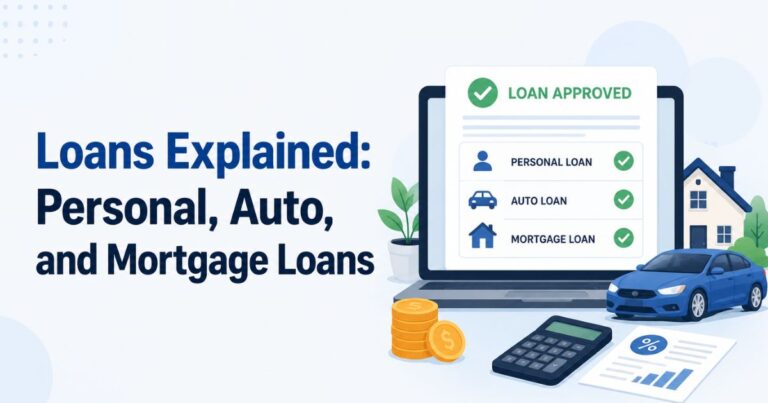
- 5 What are the main types of loans?
- 6 How to get a loan in 6 steps
- 7 Secured vs unsecured loans
- 8 Fixed-rate vs variable-rate loans
- 9 Loan tools and resources
- 10 Loans and mortgages in Florida
- 11 Frequently Asked Questions About Loans
What is a loan and how do loans work?
A loan is a sum of money you borrow from a lender and agree to repay over time, plus interest — the lender’s charge for letting you use their money. Every loan has three core parts: the principal (the amount borrowed), the interest rate (the cost of borrowing, expressed as a percentage), and the term (how long you have to repay). You repay in regular installments, usually monthly, until the balance reaches zero.
Loans fall into two broad structures. Installment loans (mortgages, auto, personal, student) give you a lump sum you repay in fixed payments over a set term. Revolving credit (credit cards, HELOCs) lets you borrow, repay, and re-borrow up to a limit. Loans are also either secured (backed by collateral like a house or car the lender can seize if you default) or unsecured (backed only by your promise to repay, so they carry higher rates). Understanding which structure and security type you’re dealing with is the foundation for everything that follows.
How does loan interest and APR work?
Loan interest is the percentage a lender charges on your principal, while APR (annual percentage rate) is the broader figure that includes the interest rate plus most fees — making APR the number to compare across offers. Two loans can share the same interest rate but have very different APRs once origination fees, points, and other charges are folded in, so APR is the truest measure of what a loan actually costs per year.
Here’s a simplified illustration (illustrative figures): borrow $10,000 at a 10% interest rate over three years and you’d pay roughly $1,616 in interest. Add a $300 origination fee, and the APR rises above the 10% rate even though the interest rate itself hasn’t changed — because the fee is part of your real cost. The Consumer Financial Protection Bureau requires lenders to disclose APR precisely so borrowers can compare offers on equal terms. The practical rule: when shopping, compare APRs, not advertised interest rates, and read what fees are baked in.
What credit score do you need for a loan?
The credit score you need depends on the loan type, but as a general guide: 720+ unlocks the best rates, 660–719 qualifies for good rates, 620–659 is workable with higher rates, and below 580 makes approval difficult and expensive. Your score is the single biggest factor in the rate you’re offered, and the difference between excellent and poor credit can mean several percentage points — thousands of dollars over a loan’s life.
Different loans have different floors. Conventional mortgages typically want 620+ (FHA loans allow lower, sometimes 500–580 with a larger down payment); auto loans are available across the credit spectrum but rates climb steeply as scores fall; personal loans usually want 640+ for reasonable rates. Because your score matters so much, checking and improving it before you apply is the highest-leverage thing you can do — our guide to credit scores and credit cards covers exactly how to raise it.
How much can you borrow?
How much you can borrow is determined mainly by your debt-to-income ratio (DTI) — the share of your gross monthly income that goes to debt payments — along with your income, credit, and the loan type. Most lenders want your total monthly debt payments (including the new loan) to stay under 36–43% of gross income; mortgages often allow up to 43% or a bit higher, while personal-loan lenders are usually stricter.
Here’s how it works in practice (illustrative): if you earn $6,000 a month gross and lenders cap DTI at 43%, your total debt payments can’t exceed about $2,580. If existing debts (car, cards, student loans) already take $1,000, roughly $1,580 remains for a new loan payment — which, combined with rates and term, sets your maximum loan size. The key discipline: the amount a lender will approve is often more than you should borrow. Base your number on what your budget comfortably repays, not on the ceiling the lender offers.
What are the main types of loans?
There are six loan types most people encounter, each suited to a different purpose and carrying different rates, terms, and collateral. Here’s each one: what it is, typical 2026 terms, whether it’s secured or unsecured, and who it’s best for. (Rates below are current national averages from primary sources and move constantly — treat them as benchmarks, not quotes.)
Personal loans
A personal loan is a lump sum you borrow and repay in fixed monthly installments, typically over two to seven years, most often unsecured (no collateral). Because there’s no asset backing them, they carry higher rates than secured loans but fund almost any purpose — debt consolidation, medical bills, home repairs, or major expenses.
Typical 2026 terms: the Federal Reserve’s average rate on a 24-month personal loan is about 11.40%, but real offers range widely (roughly 7% to 36%) based almost entirely on credit score. Secured or unsecured: usually unsecured. Best for: consolidating higher-rate debt (like credit cards) into one fixed payment, or funding a one-time expense when you have solid credit. Avoid using them to paper over an overspending problem.
Auto loans
An auto loan is a secured installment loan used to buy a vehicle, with the car itself as collateral — meaning the lender can repossess it if you stop paying. Terms typically run 36 to 84 months, and because the loan is secured, rates are lower than personal loans.
Typical 2026 terms: the Federal Reserve’s average rate on a 60-month new-car loan is about 7.52% (used-car rates run higher). Secured or unsecured: secured by the vehicle. Best for: financing a vehicle you can’t pay cash for — but keep the term as short as your budget allows, since 72- and 84-month loans lower the payment while dramatically increasing total interest and the time you spend “underwater” (owing more than the car is worth).
Mortgage loans
A mortgage is a secured loan used to buy real estate, with the home as collateral, repaid over a long term — usually 15 or 30 years. It’s the largest debt most households take on, and even small rate differences translate to large dollar amounts over decades.
Typical 2026 terms: as of late June 2026, Freddie Mac reports the average 30-year fixed mortgage at 6.49% and the 15-year fixed at 5.84%. Mortgages come as fixed-rate (locked for the life of the loan) or adjustable-rate (ARM, where the rate can change after an initial fixed period). Secured or unsecured: secured by the home. Best for: buying a home you plan to keep; a 15-year loan saves enormous interest if you can afford the higher payment, while a 30-year loan maximizes affordability and flexibility.
Student loans
A student loan finances higher education and comes in two forms: federal (from the U.S. Department of Education) and private (from banks and lenders). Federal loans are usually the better choice — fixed rates, no credit check for most undergraduate loans, and access to income-driven repayment and forgiveness programs private loans don’t offer.
Typical 2026 terms: for loans first disbursed July 1, 2026–June 30, 2027, federal rates are 6.52% undergraduate, 8.07% graduate, and 9.07% for PLUS loans (fixed for the life of the loan). Note a major change: Grad PLUS loans are eliminated for most new borrowers as of July 1, 2026, and new lifetime borrowing caps apply. Secured or unsecured: unsecured. Best for: covering education costs — exhaust federal options and grants before considering private loans, which set rates by credit like any other private debt.
Business loans
A business loan funds a company’s startup or growth costs, ranging from SBA-backed loans and bank term loans to lines of credit and equipment financing. Rates and terms vary widely by lender, loan type, and the business’s revenue and credit profile, and many require a personal guarantee from the owner.
Typical 2026 terms: highly variable — SBA 7(a) loans and bank term loans generally price off the prime rate plus a margin, while online lenders charge more for speed and flexibility. Secured or unsecured: often secured (by business assets or a personal guarantee). Best for: funding growth, equipment, or working capital when the return justifies the cost. Our guide to funding your business covers the full range of options and when each fits.
Home equity loans and HELOCs
Home equity loans and HELOCs let you borrow against the equity you’ve built in your home, using the home as collateral. A home equity loan gives a lump sum at a fixed rate; a HELOC (home equity line of credit) works like a revolving credit line you draw from as needed, usually at a variable rate. Both are secured, so rates are lower than unsecured debt.
Typical 2026 terms: rates are typically higher than a primary mortgage but well below personal loans or credit cards, since your home secures them. Secured or unsecured: secured by your home — which is the critical risk. Best for: large, planned expenses like major home renovations. The serious caveat: because your house is collateral, defaulting can mean foreclosure, so never use home equity for everyday spending or to consolidate debt you might not repay.
How to get a loan in 6 steps
Getting a loan on good terms is a process, not a single application. Here are the six steps from checking your credit to signing — each with what to do, why it matters, and the mistake to avoid.
Step 1: Check your credit
Checking your credit means pulling your credit reports and score before you apply. Why it matters: your score drives your rate, and errors are common — disputing a mistake can raise your score and lower your rate before you ever apply. How to do it: get free reports from all three bureaus at AnnualCreditReport.com, review them for errors, and check your score (many banks and cards show it free). Common mistake: applying first and discovering credit problems after a hard inquiry has already dinged your score — fix errors and, if time allows, improve your score first.
Step 2: Determine how much you need
Determining how much you need means borrowing the smallest amount that solves your problem — not the largest you can qualify for. Why it matters: every extra dollar borrowed costs interest, and lenders will often approve more than your budget can comfortably carry. How to do it: calculate the exact amount required, then confirm the monthly payment fits your budget with room to spare (keeping total debt under the 36–43% DTI guideline). Common mistake: rounding up “just in case” or letting an auto or mortgage lender’s pre-approval amount become your target instead of your ceiling.
Step 3: Compare lenders and rates
Comparing lenders means getting offers from several sources — banks, credit unions, and online lenders — because rates for identical borrowers vary meaningfully between them. Why it matters: shopping just three or four lenders is one of the easiest ways to save thousands over a loan’s life. How to do it: credit unions often beat banks on consumer-loan rates; online lenders compete on speed and convenience; compare APRs (not just rates) and total cost. Where you bank can shape your options — our banking guide covers choosing between banks, credit unions, and online institutions. Common mistake: taking the first offer, or comparing monthly payments instead of APR and total interest.
Step 4: Get pre-qualified
Getting pre-qualified means requesting estimated rates and terms based on a soft credit pull that doesn’t affect your score. Why it matters: pre-qualification lets you see real, personalized offers from multiple lenders and compare them without the credit-score cost of a formal application. How to do it: most banks, credit unions, and online lenders offer pre-qualification in minutes online; use it to narrow your list to the best two or three. Common mistake: confusing pre-qualification (soft pull, an estimate) with pre-approval or a full application (hard pull) — start with soft-pull pre-qualification to shop safely.
Step 5: Submit your application
Submitting your application means formally applying with your chosen lender, which triggers a hard credit inquiry and requires documentation. Why it matters: this is the binding step where your actual rate and terms are set. How to do it: gather what lenders ask for — proof of income (pay stubs, tax returns), employment, identity, and details on the purchase (for auto or mortgage loans) — and submit to your top choice. Common mistake: applying to many lenders over a long stretch; for auto and mortgage loans, cluster your applications within a short window (typically 14–45 days) so credit-scoring models treat rate-shopping as a single inquiry.
Step 6: Review terms and close
Reviewing terms means reading the full loan agreement — APR, fees, total interest, monthly payment, and any penalties — before you sign. Why it matters: the closing documents are legally binding, and this is your last chance to catch a rate that shifted, a fee you didn’t expect, or a prepayment penalty. How to do it: confirm the APR and monthly payment match what you were quoted, check for prepayment penalties and origination fees, and ask about anything unclear. Common mistake: signing without reading, or ignoring the APR in favor of a comfortable monthly payment that hides a long term and high total cost.
Secured vs unsecured loans
The core difference between secured and unsecured loans is collateral: a secured loan is backed by an asset (home, car, savings) the lender can seize if you default, while an unsecured loan is backed only by your creditworthiness. That single difference drives the rate, the approval odds, and the risk you take on.
| Factor | Secured Loan | Unsecured Loan |
|---|---|---|
| Collateral | Required (home, car, savings) | None — based on credit |
| Interest rates | Lower (less risk to lender) | Higher (more risk to lender) |
| Approval | Easier, even with weaker credit | Harder; needs stronger credit |
| Risk to you | Can lose the asset (foreclosure/repossession) | Credit damage and collections, but no asset seized |
| Examples | Mortgage, auto, home equity, HELOC | Personal loans, student loans, credit cards |
| Best for | Large amounts, lower rates, longer terms | Smaller amounts, no asset to pledge, faster funding |
The bottom line: secured loans offer lower rates and easier approval because the lender’s risk is lower — but you’re putting an asset on the line. Unsecured loans protect your assets but cost more and demand better credit. Match the choice to the situation: secured for large, planned borrowing where you can safely pledge collateral; unsecured for smaller needs or when you’d rather not risk an asset.
Fixed-rate vs variable-rate loans
Fixed-rate and variable-rate loans differ in whether your interest rate stays constant or moves over time. A fixed rate is locked for the life of the loan, so your payment never changes; a variable (or adjustable) rate can rise or fall with market conditions, so your payment can too. The trade-off is predictability versus potential savings.
| Factor | Fixed-Rate Loan | Variable-Rate Loan |
|---|---|---|
| Rate over time | Constant for the full term | Changes with market benchmarks |
| Payment | Predictable, never changes | Can rise or fall |
| Starting rate | Usually higher | Often lower initially |
| Risk | None from rate moves | Payment can climb if rates rise |
| Best for | Budget certainty; long-term loans | Short holding periods or expected rate drops |
The bottom line: fixed-rate loans win on certainty — you know your payment for the entire term, which is why most people choose them for mortgages and long-term borrowing. Variable-rate loans (like most HELOCs and adjustable-rate mortgages) can start lower and save money if rates fall or if you’ll repay quickly, but they carry the risk that rising rates push your payment higher. Choose fixed when you value predictability; choose variable only when you understand and can absorb the potential increase.
Is it better to get a loan from a bank or online lender?
Neither is universally better — it depends on your priorities. Banks and credit unions often offer better rates (especially credit unions) and in-person service, and existing customers may get relationship discounts. Online lenders typically win on speed and convenience, funding loans in days with easy digital applications. Compare APRs from both; pre-qualify with several and let the actual offers decide.
Can you get a loan with bad credit?
Yes, you can get a loan with bad credit, but expect higher rates, lower limits, and fewer options. Secured loans (auto, secured personal loans) and credit-union products are often more attainable than unsecured loans. Critically, avoid payday and car-title lenders that target poor-credit borrowers with APRs that can approach 400% — instead, check credit unions, nonprofit lenders, and CFPB resources, and work on raising your score.
Does applying for a loan hurt your credit?
Applying for a loan causes a small, temporary dip only when it triggers a hard inquiry (a formal application), typically a few points that recover within months. Pre-qualification uses a soft pull that doesn’t affect your score at all. For auto and mortgage loans, credit-scoring models treat multiple applications within a short shopping window (usually 14–45 days) as a single inquiry, so rate-shopping doesn’t compound the impact.
Loan tools and resources
A few free, unbiased tools help you compare loans and borrow safely — no lender referrals needed, just calculators and consumer-protection resources.
- Loan and mortgage calculators — estimate monthly payments, total interest, and amortization before you apply, so you can see the true cost of different terms and amounts.
- APR comparison — line up offers by APR (not advertised rate) and total interest over the full term; a spreadsheet or any free amortization calculator does the job.
- Consumer-protection resources — the Consumer Financial Protection Bureau (CFPB) publishes free, unbiased guides on every loan type, plus a complaint system if a lender treats you unfairly.
- Free credit reports — AnnualCreditReport.com is the official free source for reports from all three bureaus.
One firm warning: avoid payday loans, car-title loans, and “guaranteed approval” or “no credit check” offers. These target people in tight spots and can carry APRs near 400%, trapping borrowers in cycles of debt. If you’re struggling with debt, legitimate nonprofit credit counseling and a structured payoff plan are far safer — our guide to getting out of debt covers the free and low-cost help that actually works.
Loans and mortgages in Florida
Loans in Florida follow the same federal rules as anywhere else, but a few state-specific factors shape borrowing — especially for homebuyers. Florida has no state income tax, which raises take-home pay (helping DTI), though the federal mortgage-interest deduction still applies the same way it does nationally. The bigger Florida-specific factor is homeowners insurance: among the highest in the nation, it raises the total monthly housing cost lenders count toward your DTI, effectively lowering how much home you can afford.
Two features favor Florida homeowners once you buy. The Homestead Exemption reduces the taxable value of a primary residence by up to $50,000, lowering annual property taxes, and the Save Our Homes cap limits how much the assessed value of a homesteaded property can rise each year (3% or the change in inflation, whichever is lower), protecting long-term owners from tax spikes. The practical takeaway for Florida borrowers: budget carefully for insurance and property taxes on top of principal and interest, since those escrow costs can add hundreds to a monthly payment. For a real cost-of-living picture in one market, see our cost of living in Orlando breakdown, and verify current homestead and insurance specifics with the county property appraiser and licensed agents.
Frequently Asked Questions About Loans
Here are quick, sourced answers to the most common questions about loans.
What is the difference between a secured and unsecured loan?
A secured loan is backed by collateral — an asset like a home or car the lender can seize if you default — while an unsecured loan is backed only by your creditworthiness. Secured loans (mortgages, auto loans) carry lower rates and are easier to qualify for; unsecured loans (personal loans, credit cards) charge more and require stronger credit but don’t risk a specific asset.
What credit score do I need for a personal loan?
For a personal loan, you generally need a credit score of at least 640 for reasonable rates, though some lenders approve lower scores at much higher rates. Scores of 720 and above unlock the best terms, while scores below 580 make approval difficult and expensive. Because your score sets your rate, checking and improving it before applying is the highest-impact step you can take.
How is APR different from interest rate?
The interest rate is the cost of borrowing the principal, while APR (annual percentage rate) includes that interest rate plus most fees, like origination charges — making APR the true yearly cost of the loan. Two loans with the same interest rate can have different APRs once fees are added, so always compare offers by APR rather than the advertised interest rate.
How much of a loan can I afford?
How much loan you can afford depends on your debt-to-income ratio and budget. Lenders typically want your total monthly debt payments below 36–43% of gross income, but affordability is stricter than approval: base your amount on the monthly payment your budget comfortably handles with room for savings and emergencies, not the maximum a lender will approve.
Does checking loan rates hurt my credit?
Checking loan rates through pre-qualification does not hurt your credit, because it uses a soft credit pull. Only a formal application triggers a hard inquiry, which causes a small, temporary dip. For auto and mortgage loans, multiple applications within a short window (usually 14–45 days) count as one inquiry, so you can rate-shop without extra damage to your score.