Key Takeaways
- What it is: a regulated marketplace where shares of public companies trade on exchanges, with prices set by supply and demand.
- How you earn: price appreciation plus dividends; the S&P 500’s long-run average is ~10% a year nominal (~6–7% after inflation) — historical, not guaranteed.
- Start small: fractional shares let you begin with $1–$5; investing regularly matters more than the starting amount.
- Risk is real but manageable: diversification (index funds) and a long time horizon reduce — never eliminate — risk; SIPC protects up to $500,000 against broker failure, not market losses.
- Best first step: open a brokerage or retirement account and set up automatic monthly investments into a low-cost index fund — then leave it alone.
The stock market can look intimidating from the outside — tickers, jargon, dramatic headlines — but the mechanics are simpler than they seem, and understanding them is the foundation of building wealth. This guide explains what the stock market is, how it works, how investors actually make money, how much you need to start, whether it’s safe, the main types of investments, a six-step path to getting started, and how Florida’s tax picture treats investors. It’s part of our broader Personal Finance complete guide.
One ground rule throughout: this is educational content, not investment advice. Investing involves risk, including the possible loss of the money you invest, and past performance never guarantees future results. For decisions about your own money, confirm with a licensed financial professional.
Table of Contents
- 1 What is the stock market?
- 2 How does the stock market work?
- 3 How do you make money in the stock market?
- 4 How much money do you need to start investing?
- 5 Is investing in the stock market safe?
- 6 What are the main types of investments?
- 7 How to start investing in stocks in 6 steps
- 8 Stocks vs bonds
- 9 Index funds vs individual stocks
- 10 Investing tools and brokerages
- 11 Investing from Florida: state taxes
- 12 Frequently Asked Questions About the Stock Market
What is the stock market?
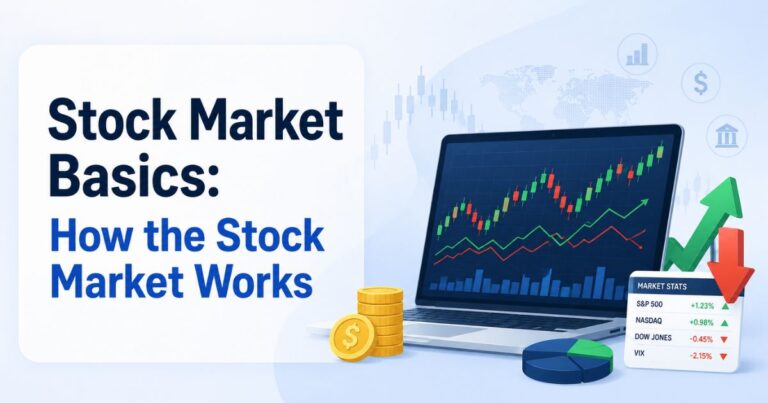
The stock market is a marketplace where investors buy and sell shares of publicly traded companies. A share of stock is a small ownership stake in a real business — the SEC’s Investor.gov defines stocks as securities that give shareholders a share of ownership in a company, which is why stocks are also called “equities.” When you own a share of a company, you own a slice of its profits and its future.
“The stock market” is really a network of exchanges — in the U.S., primarily the New York Stock Exchange (NYSE) and the Nasdaq — where those shares change hands under rules enforced by the Securities and Exchange Commission (SEC). Companies list their shares on an exchange through an initial public offering (IPO) to raise money to grow; after that, investors trade those shares among themselves. When you hear “the market was up today,” it usually refers to an index like the S&P 500 — a basket of roughly 500 large U.S. companies used as shorthand for the whole market.
How does the stock market work?
The stock market works by matching buyers and sellers of shares through exchanges, with prices set by supply and demand. Every stock price you see is simply the last price at which a buyer and a seller agreed to trade. When more investors want to buy a stock than sell it, the price rises; when sellers outnumber buyers, it falls. Company earnings, economic news, interest rates, and investor sentiment all feed into that constant auction.
Individual investors access the market through a brokerage firm, which executes trades on their behalf — as FINRA explains, even when you tap “buy” in an app, it’s your broker-dealer handling the routing, execution, and settlement behind the scenes. Trading happens during market hours (9:30 a.m.–4:00 p.m. Eastern, weekdays), and the whole system is regulated: the SEC oversees the exchanges and public-company disclosures, while FINRA supervises the brokers. The practical takeaway for a beginner: you don’t need to understand market plumbing to invest well — you need a brokerage account, a low-cost diversified fund, and patience.
How do you make money in the stock market?
You make money in the stock market in two ways: price appreciation (selling shares for more than you paid) and dividends (cash payments some companies distribute from profits). Over the long run, the combination has been powerful: the S&P 500’s average annual return has been roughly 10% before inflation — about 6–7% after inflation — measured over nearly a century with dividends reinvested. Investor.gov notes that some experts consider a 7–10% annual rate of return a useful long-term estimate for diversified U.S. stock investments, based on historic averages.
Two crucial caveats keep that number honest. First, the average is not the norm: the market rarely returns 10% in any single year — it might gain 25% one year and lose 20% the next (it fell 37% in 2008 alone), and roughly a quarter of calendar years are negative. Second, past performance doesn’t guarantee future results — the average is history, not a promise. The reason long-term investors still win is compound growth: returns earn returns. As an illustrative example, $10,000 growing at 7% real returns becomes roughly $19,700 in 10 years and about $76,000 in 30 — without adding another dollar. Time in the market, not timing the market, is what does the work.
How much money do you need to start investing?
You need very little money to start investing — many major brokerages have no account minimums, and fractional shares let you buy a slice of a stock or fund for as little as $1–$5. The old barriers (high minimums, per-trade commissions) have largely disappeared: most large U.S. brokers now charge $0 commission on stock and ETF trades.
What matters far more than the starting amount is the habit. Investing $50–$100 a month consistently beats waiting years to invest a lump sum you never quite save up. As an illustrative example, $100 a month at a 7% average annual return grows to roughly $17,300 in 10 years and about $122,000 in 30 years — from $36,000 of total contributions. Start with whatever amount you can invest without touching money you’ll need in the next few years, and automate it. For the full beginner’s path, see our guide to investing for beginners.
Is investing in the stock market safe?
Investing in the stock market is not “safe” in the way a savings account is safe — prices fall as well as rise, and you can lose money — but the risk is manageable, and historically it has rewarded patient, diversified investors. The two tools that tame risk are diversification (owning many companies via index funds instead of betting on a few stocks) and time horizon (money invested for 10+ years can ride out downturns that would wreck a 1-year bet). Neither eliminates risk; both reduce it substantially.
It’s worth separating two different risks. Market risk — your investments losing value — is the risk you accept in exchange for higher expected returns, and no one can insure it away. Custody risk — your brokerage failing — is largely covered: if your broker is a SIPC member and fails, your cash and securities are protected up to $500,000 (including a $250,000 cash limit). SIPC explicitly does not protect against market losses — only against a failed brokerage losing your assets. The practical rule: keep short-term money (emergency fund, next year’s expenses) out of stocks, invest long-term money in diversified funds, and the market’s volatility becomes an inconvenience rather than a catastrophe.
What are the main types of investments?
The main types of investments for everyday investors are stocks, bonds, index funds and ETFs, mutual funds, and dividend stocks. Each carries a different mix of risk, return, and effort. Here’s what each one is, how it works, and who it fits.
Stocks
Stocks are ownership shares in individual companies — the highest-growth-potential, highest-volatility building block. A single stock can multiply in value or collapse, because your outcome depends entirely on one business. Picking individual stocks well requires research, time, and the stomach to watch big swings. Best for: investors who enjoy research and can afford to take concentrated risk with a small slice of their portfolio — not the foundation for most beginners.
Bonds
Bonds are loans you make to a government or company in exchange for regular interest payments and your money back at maturity. They’re the classic lower-risk, lower-return counterweight to stocks: prices fluctuate far less, and income is steadier, but long-run returns have historically trailed stocks by a wide margin. Best for: shortening the risk of a portfolio as goals approach (retirement, a house), or investors who can’t tolerate stock-sized swings.
Index funds and ETFs
Index funds and ETFs are baskets that hold hundreds or thousands of stocks (or bonds) in one purchase, tracking a market index like the S&P 500 at very low cost — expense ratios on major index funds run around 0.03%–0.10% a year ($3–$10 per $10,000 invested). One share buys instant diversification, which is why they’re the standard beginner recommendation and the core of most long-term portfolios. ETFs trade like stocks; index mutual funds price once daily — functionally similar for a long-term investor. Best for: nearly everyone, especially beginners; see our investing for beginners guide for how to use them.
Mutual funds
Mutual funds pool money from many investors into a professionally managed portfolio. The key variable is cost: actively managed funds (a manager picking investments) commonly charge 0.5%–1%+ a year, while index mutual funds charge a fraction of that — and most active funds fail to beat their index over long periods after fees. Fees compound against you exactly the way returns compound for you. Best for: investors in workplace retirement plans (where mutual funds dominate the menu) — favor the low-cost index options.
Dividend stocks
Dividend stocks are shares of established companies that pay out part of their profits in cash, typically quarterly — utilities, consumer staples, and big banks are classic examples. They offer income plus moderate growth, and reinvesting dividends historically accounts for a large share of the market’s total return. The trade-off: dividend payers usually grow slower than the market’s fastest companies, and dividends can be cut in hard times. Best for: income-focused investors and those who like tangible cash returns — though beginners get dividends automatically inside any broad index fund.
How to start investing in stocks in 6 steps
You can start investing in stocks in six steps: set goals and a time horizon, understand your risk tolerance, open a brokerage or retirement account, choose your investments, diversify and set a budget, and invest regularly. The whole process takes an afternoon to set up and a lifetime of mostly leaving it alone. Here are the steps.
Step 1: Set goals and time horizon
Start by naming what the money is for and when you’ll need it, because the timeline drives everything else. Money needed within about five years generally doesn’t belong in stocks — a crash at the wrong moment could force you to sell low. Money for goals 10, 20, or 30 years away (retirement is the classic) can afford to ride out downturns and benefit most from compounding. Write down each goal, its rough cost, and its date; the common mistake is investing with no timeline and panicking at the first dip.
Step 2: Understand your risk tolerance
Match your investments to how much volatility you can genuinely stomach — not how much you think you should. If a 30% temporary drop would make you sell everything, a 100%-stock portfolio will hurt you regardless of what the math says, because the biggest destroyer of returns is selling in a panic. Longer timelines and steadier nerves justify more stocks; shorter timelines and lighter sleep justify more bonds. Be honest now, before the market tests you.
Step 3: Open a brokerage or retirement account
Open the account type that fits the goal. For retirement, tax-advantaged accounts come first: a workplace 401(k) (especially up to any employer match — that’s an instant 50–100% return) and an IRA (traditional or Roth). For goals outside retirement, a standard taxable brokerage account offers full flexibility. Opening either takes about 10 minutes online with your ID and bank details. For how these accounts fit a retirement plan, see our guide to retirement planning.
Step 4: Choose your investments
Choose low-cost, diversified funds as your foundation — for most beginners, a broad index fund (an S&P 500 or total-market fund) is the entire starting portfolio. Check the expense ratio (under ~0.15% is the benchmark for index funds) and skip anything you don’t understand. Individual stocks, if they tempt you, belong in a small “explore” slice — 5–10% of the portfolio — not the core. Mainstream brokerages like Fidelity, Schwab, and Vanguard all offer no-minimum index funds and $0 stock/ETF commissions.
Step 5: Diversify and set a budget
Spread your risk and decide how much to invest each month. Diversification means owning many companies, sectors, and ideally geographies — a total-market index fund does this in one holding — so no single failure can sink you. Your budget should only include money you won’t need for several years: keep an emergency fund (3–6 months of expenses) in savings first, then invest a fixed, sustainable monthly amount. The common mistake is investing the emergency fund and being forced to sell at the bottom.
Step 6: Invest regularly and stay the course
Invest the same amount on a schedule — dollar-cost averaging — and resist tinkering. Automatic monthly investing buys more shares when prices are low and fewer when they’re high, removes emotion from the process, and outperforms the attempts of most investors to time the market. The evidence is blunt: missing just the handful of best market days (which tend to cluster right after the worst ones) devastates long-run returns. Set the transfer to automatic, check in once or twice a year to rebalance, and let compounding work.
Stocks vs bonds
Stocks and bonds differ fundamentally: stocks are ownership with higher risk and higher long-run returns, while bonds are loans with steadier income and lower volatility. Most portfolios hold both, shifting toward bonds as the goal approaches. The table shows the differences.
| Factor | Stocks | Bonds |
|---|---|---|
| What you own | A share of a company | A loan to a government/company |
| How you earn | Price growth + dividends | Interest payments + principal back |
| Long-run return | Higher (~10% nominal historically) | Lower (roughly 3–5% historically) |
| Volatility | High — big swings, incl. 30%+ drops | Low to moderate |
| Role in a portfolio | Growth engine | Stability and income |
A common rule of thumb ties the mix to your timeline: long horizons lean heavily toward stocks (an aggressive young saver might hold 80–100% stocks), while investors near or in retirement shift meaningfully toward bonds. There’s no single right split — it depends on your goals, timeline, and risk tolerance.
Index funds vs individual stocks
Index funds and individual stocks differ in diversification, effort, and odds of success: an index fund guarantees the market’s return at minimal cost and effort, while individual stocks offer the chance to beat the market — and the meaningful likelihood of trailing it. The table compares them.
| Factor | Index funds | Individual stocks |
|---|---|---|
| Diversification | Hundreds–thousands of companies in one share | One company per share |
| Effort required | Minimal — buy and hold | High — ongoing research per company |
| Risk | Market risk only | Market risk + single-company risk |
| Expected outcome | The market’s return, minus ~0.03–0.10% fees | Could beat or badly trail the market |
| Best for | Core of almost any portfolio | A small “explore” slice for enthusiasts |
The honest guidance: even most professional fund managers fail to beat the index over long periods, which is why the standard advice for beginners is index funds first, individual stocks (if at all) as a small satellite. Owning both is perfectly reasonable — the mistake is making stock-picking the foundation.
Can you lose all your money in stocks?
You can lose all your money in a single stock — companies do go bankrupt — but losing everything in a diversified index fund is a different matter: it would require every major company in the index to fail simultaneously. Diversification is what separates concentrated risk from market risk. The realistic risk of a diversified portfolio is temporary declines of 20–40%, not total loss.
Is the stock market gambling?
The stock market is not gambling, though short-term trading can resemble it. Buying a stock means owning a share of a productive business whose profits grow over time — a positive-sum system where long-run investors have historically been rewarded. Gambling is zero-sum chance with a house edge. The distinction is time horizon and diversification: day-trading on hunches gambles; owning diversified funds for decades invests.
Can you start investing with $100?
Yes, you can start investing with $100 — or less. Fractional shares let you buy a $1–$5 slice of an index fund or stock at most major brokerages, with no account minimums and $0 commissions. What matters is continuing: $100 monthly at a 7% average annual return grows to roughly $122,000 over 30 years (illustrative, not guaranteed).
Investing tools and brokerages
The right tools make investing simple and cheap. Here are the categories worth knowing:
- Brokerages: Fidelity, Charles Schwab, and Vanguard — no-minimum accounts, $0 stock/ETF commissions, and low-cost index funds; the standard homes for long-term investors.
- Robo-advisors: Betterment, Wealthfront, or the brokerages’ own robo services — they build and rebalance a diversified portfolio automatically for roughly 0.25% a year; good for investors who want it fully hands-off.
- Research and verification: your broker’s built-in screeners for fund costs, and FINRA’s free BrokerCheck to verify any broker or adviser’s registration before trusting them with money.
Skip anything promising fast profits — day-trading systems, “signals” services, and get-rich courses are where beginners lose money. If you’re curious about digital assets as a separate, far more volatile category, read our guide to how cryptocurrency works before risking a dollar there.
Investing from Florida: state taxes
Investing from Florida comes with a genuine tax advantage: Florida has no state income tax, which means no state tax on capital gains, dividends, or interest — investment income that residents of most states pay an extra 3–13% on. A California investor selling $50,000 of long-term gains can owe five figures in state tax; a Florida investor owes the state nothing on the same sale.
Federal taxes still apply in full: long-term capital gains (assets held over a year) are taxed at 0%, 15%, or 20% depending on income, short-term gains at ordinary rates, and dividends as qualified (capital-gains rates) or ordinary. Tax-advantaged accounts — 401(k)s, IRAs, HSAs — shelter investments from federal tax too, which is why they come first in the order of operations. For how investment income fits into your federal return, see our personal taxes guide. (Educational, not tax advice — confirm your situation with the IRS or a licensed professional.)
Frequently Asked Questions About the Stock Market
Here are quick, standalone answers to the most common stock-market questions. All are educational — not investment advice.
How does the stock market work for beginners?
The stock market works by matching buyers and sellers of company shares through exchanges like the NYSE and Nasdaq, with prices set by supply and demand. As a beginner, you open a brokerage account, deposit money, and buy shares or funds through the broker, which executes the trade. Most beginners start with a low-cost index fund rather than individual stocks.
What is the S&P 500?
The S&P 500 is a stock market index tracking roughly 500 of the largest publicly traded U.S. companies, weighted by market value. It’s the most widely used benchmark for the U.S. stock market — “the market was up” usually means the S&P 500 rose. You can’t buy the index directly, but low-cost index funds and ETFs track it closely.
How much money do I need to start investing?
You can start investing with just a few dollars. Most major brokerages have no account minimums, charge $0 commissions on stocks and ETFs, and offer fractional shares from $1–$5. The amount matters less than the habit: investing a fixed sum every month and leaving it invested is what builds wealth over time through compounding.
Are index funds a good investment?
Index funds are widely considered the best starting point for long-term investors: one purchase diversifies you across hundreds of companies at a cost of roughly 0.03%–0.10% a year, and most actively managed funds fail to beat them over long periods after fees. They still carry full market risk, and nothing is guaranteed — this is educational, not personal advice.
What is the difference between stocks and bonds?
Stocks are ownership stakes in companies; bonds are loans to companies or governments. Stocks offer higher long-run returns (about 10% a year historically, before inflation) with big swings, while bonds pay steadier interest with lower returns and lower volatility. Most portfolios combine both, holding more stocks for long horizons and more bonds as goals approach.