Key Takeaways
- It’s real, but it’s work: legitimate online income takes time and effort — be skeptical of anything promising fast, guaranteed, effortless money.
- Earnings vary hugely by method: freelancing pays fastest (often $15–$100+/hour); content, affiliate, and passive income start small and build over months.
- Start free: the best beginner side hustles (freelancing, tutoring, reselling) need little or no money to start — avoid any “opportunity” that requires an upfront payment.
- Taxes still apply: side-hustle income is taxable even if you don’t get a 1099 — and you’ll owe the 15.3% self-employment tax on net profit.
- Spot scams: per the FTC, never pay to get paid, ignore “guaranteed income” promises, and research any company before you commit.
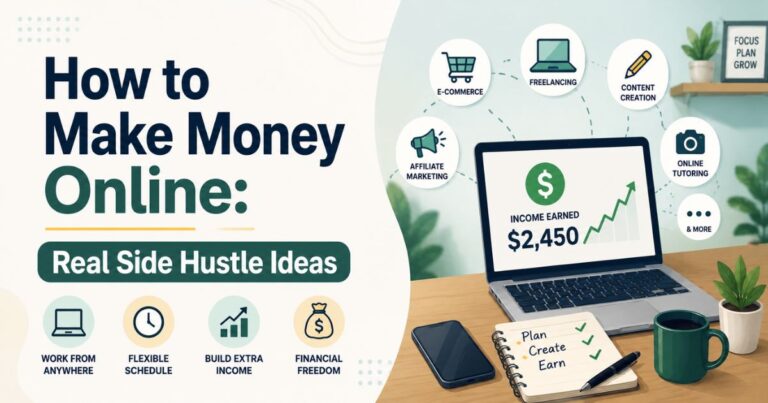
Making money online is one of the most-searched financial goals — and one of the most misunderstood, thanks to a flood of “earn $10,000 a month from your couch” hype. This guide takes the honest approach: yes, you can make real money online, through legitimate methods that thousands of people use, but it takes genuine effort and realistic expectations. Below you’ll find the actual ways to earn — organized by category with realistic earnings ranges, startup costs, and skill levels — plus a step-by-step plan to start, the best options for beginners, and a clear-eyed guide to spotting the scams that target people looking for online income.
This is the hub for making money online at FloridaIndependent. Everything here is framed around what’s real and sustainable, not get-rich-quick promises. You’ll get honest income ranges, a 5-step starter plan, beginner-friendly and no-money-down options, the tax facts (including the current 1099 rules), and FTC-based scam warnings. It’s educational, not financial advice — your results depend on your effort, skills, and market. For the bigger picture of managing the money you earn, see our complete guide to personal finance.
Table of Contents
- 1 Can You Really Make Money Online?
- 2 How Much Money Can You Make Online?
- 3 The Best Ways to Make Money Online
- 3.1 Which Way to Make Money Online Is Right for You?
- 3.2 Freelancing and Online Services
- 3.3 Selling Products Online (E-commerce)
- 3.4 Content Creation (YouTube, Blogging, Podcasting)
- 3.5 Online Teaching, Coaching, and Courses
- 3.6 Gig Economy and Microtasks
- 3.7 Affiliate Marketing and Ads
- 3.8 Passive Income Online
- 4 How to Start Making Money Online in 5 Steps
- 5 What Are the Best Side Hustles for Beginners?
- 5.1 How Can You Make Money Online With No Money to Start?
- 5.2 How Can You Make Money Online Fast?
- 5.3 What Are the Best Passive Income Ideas?
- 5.4 How Do You Make Money With a Blog or YouTube Channel?
- 5.5 How Do You Make Money With Affiliate Marketing?
- 5.6 How Do You Make Money Freelancing?
- 5.7 What Online Money-Making Scams Should You Avoid?
- 5.8 Is Dropshipping Worth It in 2026?
- 5.9 How Do You Price Your Online Work or Products?
- 5.10 What Are Common Mistakes When Trying to Make Money Online?
- 5.11 What Equipment and Skills Do You Need to Start?
- 5.12 How Do You Stay Consistent and Avoid Burnout?
- 5.13 What Are the Highest-Paying Online Skills?
- 5.14 How Long Does It Take to Start Making Money Online?
- 5.15 How Do You Make Money Online on Your Phone?
- 5.16 What Should You Do With the Money You Make Online?
- 6 What Tools and Platforms Do You Need to Make Money Online?
- 7 How Do You Turn a Side Hustle Into a Full-Time Business?
- 8 Frequently Asked Questions About Making Money Online
- 8.1 What Is the Easiest Way to Make Money Online?
- 8.2 How Can a Beginner Make Money Online in 2026?
- 8.3 Can You Make a Living Entirely Online?
- 8.4 How Much Can You Realistically Make Online as a Beginner?
- 8.5 Do You Need a Website to Make Money Online?
- 8.6 What Is the Best Way to Make Money Online in the Long Term?
Can You Really Make Money Online?
Yes, you can really make money online — it’s a legitimate way to earn extra income or even a full-time living, and millions of people do it through freelancing, selling products, content creation, and more. But the honest truth is that it takes real work, skills, and time; the “make thousands overnight with no effort” promises are almost always scams. Realistic online income is built the same way as offline income: by providing something of value that people will pay for.
The key is setting the right expectations. Legitimate online earning is not passive at the start and rarely fast. A freelancer might land their first paying client in a few weeks; a new blog or YouTube channel often takes six months to a year before earning meaningful money; an online store may take months to become profitable. The people genuinely making good money online put in consistent effort over time — and the ones promising you can skip that effort are usually selling you the scam, not the opportunity.
So approach it like building a small business or a skill, not like winning a lottery. The good news is that the barriers are lower than ever: many methods cost little or nothing to start, the tools are widely available, and you can begin alongside a regular job. Pick a realistic method, commit to learning it, and treat early income as a foundation to build on. The sections below show exactly which methods are real, what they actually pay, and how to start.
How Much Money Can You Make Online?
How much you can make online varies enormously by method, skill, and effort — from a few dollars a month doing microtasks to a full-time income (and occasionally far more) from freelancing, a store, or a content business. There’s no single number, and honest ranges matter: most beginners earn modest amounts at first, a smaller group earns a solid side income, and a few build substantial businesses. Anyone quoting a guaranteed high figure is selling hype.
Here’s an honest look at realistic earnings by method, including what it costs to start and how long it typically takes to see meaningful income:
| Method | Realistic earnings | Startup cost | Skill level | Time to first income |
|---|---|---|---|---|
| Freelancing / services | $15–$100+/hour by skill | $0–$100 | Existing skill needed | Days to weeks |
| Gig work / microtasks | $3–$20/hour (low) | $0 | Low | Days |
| Selling products (e-commerce) | Highly variable; many earn little | $100–$1,000+ | Medium | Weeks to months |
| Online teaching / courses | $20–$80/hour tutoring; courses vary | $0–$500 | Subject expertise | Weeks to months |
| Content (YouTube/blog/podcast) | $0 early; grows slowly | $0–$200 | Medium | 6–12+ months |
| Affiliate marketing / ads | Small at first; scales with traffic | $0–$200 | Medium | Months |
| Passive income (digital products, etc.) | Variable; needs upfront work/capital | Varies | Medium–high | Months |
Two honest takeaways from the table. First, freelancing pays the fastest and most reliably because you’re trading an existing skill for money directly — it’s the best starting point for most people who want income soon. Second, the methods with the highest ceilings (content, e-commerce, passive income) also have the longest ramps and highest failure rates, so they reward patience and persistence. Treat early earnings as proof of concept, then reinvest time into what’s working. Avoid any method or “mentor” that guarantees a specific large income — real earnings depend on your effort and market, and no honest source promises otherwise.
The Best Ways to Make Money Online
The best ways to make money online fall into seven main categories: freelancing and online services, selling products (e-commerce), content creation, online teaching and courses, gig work and microtasks, affiliate marketing and ads, and passive income. Each suits different skills, budgets, and timelines — there’s no single “best” method, only the best fit for you. Below, each category includes real, specific ideas with honest earnings ranges, startup costs, skill levels, and how to start.
Which Way to Make Money Online Is Right for You?
The right way to make money online depends on three things: the skills you already have, how much time you can commit, and how soon you need income. There’s no universally best method — the best choice is the one you can realistically execute and stick with. A quick way to narrow it down is to match your situation to the method that fits, rather than chasing whatever made someone else money.
Use this simple guide:
- Need income soon and have a skill? Freelance it — fastest path to real money.
- Need quick cash, no particular skill? Gig work, reselling, or user testing.
- Have subject expertise? Online tutoring or coaching, then a course.
- Patient and want to build something big? Content creation or e-commerce (long ramp, high ceiling).
- Want income from an asset over time? Digital products or other passive income (front-loaded effort).
The most important decision is to pick one method and commit, rather than dabbling in several. Match the method to your skills, time, and timeline, give it a genuine effort for a few months, and only switch if you’ve truly given it a fair chance. Focus beats variety when you’re starting out — the people who earn online generally went deep on one thing before adding another.
Freelancing and Online Services
Freelancing means selling a skill or service directly to clients online — writing, graphic design, web development, virtual assistance, bookkeeping, translation, video editing, and more — and it’s the fastest, most reliable way for most people to start earning online. You’re trading an existing skill for money, so there’s no waiting for an audience to build. Earnings range widely by skill and experience, commonly $15–$100+ an hour, with specialized skills (development, copywriting, design) at the higher end.
Real freelancing ideas and what they pay:
- Writing and editing: $20–$100+/hour; blog posts, copywriting, editing.
- Graphic design: $25–$100+/hour; logos, social graphics, branding.
- Web/app development: $30–$150+/hour; among the highest-paid skills.
- Virtual assistance: $15–$40/hour; admin, scheduling, inbox management.
- Bookkeeping: $20–$60/hour; managing small-business books.
- Video editing: $25–$75/hour; high demand from content creators.
Startup cost: $0–$100 (you likely already have the computer and software). Skill level: you need a marketable skill, but many are learnable. How to start: pick a skill you have or can learn, create a simple portfolio, and find your first clients on freelance marketplaces (Upwork, Fiverr) or through your own network. The common mistake is undercharging out of fear — set rates that reflect your value and raise them as you gain reviews. Freelancing is the backbone of the online economy; for a deep dive, see our complete guide to freelancing and the gig economy.
To stand out as a new freelancer, niche down rather than offering everything to everyone — “SaaS email copywriter” wins more work than “writer.” Your first few jobs are about collecting reviews and samples, so deliver more than expected and ask satisfied clients for testimonials and referrals. As your portfolio and ratings grow, raise your rates in steps; experienced freelancers in specialized skills often double or triple their starting rates within a year. The reliability of freelancing is its biggest advantage: unlike audience-based methods, you can land paying work in your first weeks if you market yourself actively and consistently.
Selling Products Online (E-commerce)
Selling products online means running an internet store — whether you make products, resell them, dropship them, or sell digital goods — and it can grow into a substantial business, though earnings are highly variable and many stores earn little at first. Models range from handmade goods and print-on-demand to reselling thrifted items and dropshipping. Be honest with yourself: e-commerce has a high failure rate, thin margins in some models, and a real learning curve, so it rewards research and persistence.
Real e-commerce ideas:
- Handmade / craft goods: sell on Etsy or your own store; margins depend on materials and time.
- Print-on-demand: design t-shirts, mugs, posters; a partner prints and ships, so no inventory.
- Reselling / flipping: buy low (thrift, clearance) and resell on eBay, Poshmark, or Facebook Marketplace.
- Digital products: templates, printables, presets — make once, sell repeatedly.
- Dropshipping: sell products shipped directly from a supplier; popular but competitive with thin margins.
Startup cost: $100–$1,000+ depending on model (reselling and print-on-demand are cheapest; inventory-based stores cost more). Skill level: medium — you’ll learn marketing, listings, and customer service. How to start: choose a model and product, set up a store (Shopify, Etsy, or a marketplace), list your first products, and focus relentlessly on getting traffic. The common mistake is chasing “winning products” without a plan to reach customers — marketing matters more than the product. For the full playbook, see our guide on how to start and run an online store.
A realistic note on e-commerce earnings: results range from side-income to full-time businesses, but plenty of stores never turn a profit, so start lean and validate demand before investing heavily. Low-risk entry points like reselling and print-on-demand let you learn the mechanics — listings, pricing, customer service, shipping — without large inventory costs. The make-or-break factor is almost always marketing and traffic, not the product itself; a great product nobody sees earns nothing. Begin small, reinvest profits into what sells, and treat the first months as paid education in running an online store.
Content Creation (YouTube, Blogging, Podcasting)
Content creation means building an audience through videos, written posts, or audio, then earning from ads, sponsorships, memberships, and product sales — and while the ceiling is high, the ramp is long and most creators earn little for the first 6–12 months. You’re building an audience first and monetizing second, so patience is essential. To earn ad revenue on YouTube, for example, you need to join the YouTube Partner Program, which requires 1,000 subscribers and 4,000 valid public watch hours in the past 12 months (or 10 million Shorts views).
Real content paths:
- YouTube: ad revenue, sponsorships, memberships; income scales with views and niche.
- Blogging: display ads, affiliate links, and digital products; takes months of consistent publishing to gain search traffic.
- Podcasting: sponsorships and listener support; grows with audience size.
- Newsletters: paid subscriptions and sponsorships via platforms like Substack.
Startup cost: $0–$200 (a phone and free tools are enough to start; better gear comes later). Skill level: medium — you’ll learn your craft and your platform’s algorithm. How to start: pick a niche you can create about consistently, publish regularly, and focus on quality and consistency over going viral. The common mistake is quitting before the audience compounds — most creators who succeed simply outlasted those who gave up. Treat content as a long-term play, not a quick income source.
A clear-eyed note on content income: the gap between top creators and everyone else is enormous, and most channels and blogs earn little. But content also has unique advantages — it builds an audience you own, it compounds (old videos and posts keep earning), and it pairs with nearly every other method (a creator can add affiliate income, sponsorships, courses, and products). The realistic strategy isn’t to bet on going viral; it’s to publish consistently in a focused niche, improve steadily, and stack monetization methods as your audience grows. Many successful creators treat content as the marketing engine for other income streams rather than relying on ad revenue alone.
Online Teaching, Coaching, and Courses
Online teaching means earning by sharing knowledge — tutoring, coaching, or selling courses — and it’s a strong option if you have expertise others want to learn. You can teach live (tutoring, coaching) for steady hourly income, or build a course once and sell it repeatedly. Tutoring commonly pays $20–$80 an hour depending on subject, while course income varies widely based on your audience and topic.
Real teaching ideas:
- Online tutoring: teach academic subjects, test prep, or languages via tutoring platforms or independently.
- Coaching: fitness, business, career, or life coaching, often $50–$200+/session for experienced coaches.
- Online courses: package your expertise into a course on platforms like Teachable or Udemy.
- Language teaching: teach English or another language online to students worldwide.
Startup cost: $0–$500 (tutoring is nearly free to start; building a polished course can cost more). Skill level: subject expertise required. How to start: for live teaching, sign up on a reputable platform or market to your network; for courses, validate demand first (teach live or write about the topic) before investing time building. The common mistake is building a big course nobody wants — confirm people will pay before you create. Teaching scales well: live work pays now, and a course can become semi-passive income later.
A realistic note on teaching income: live tutoring and coaching provide steady, predictable hourly pay from day one, which makes teaching one of the more reliable online-income methods if you have expertise. Courses are different — they can earn well, but success depends heavily on having an audience or a proven demand, and many courses sell poorly because the creator built before validating. The smart sequence is to teach live first (earning immediately while learning what students struggle with), then package that proven knowledge into a course. This way your course is shaped by real student needs, and you’ve already built relationships with potential buyers.
Gig Economy and Microtasks
The gig economy means short, on-demand tasks — driving, delivery, freelance gigs, and online microtasks like surveys, data entry, or content moderation — and it offers quick, flexible income, though online microtasks in particular pay very little. Gig work is the fastest way to earn something today, but set expectations: online microtasks (surveys, small tasks) often pay just $3–$20 an hour, so they suit filling spare time, not replacing income.
Real gig and microtask ideas:
- Freelance microgigs: small tasks on platforms like Fiverr or TaskRabbit.
- Online surveys and research: legitimate panels pay modestly; useful for spare-time cash, not a living.
- Data entry and transcription: entry-level online work; transcription pays more with speed.
- User testing: get paid to test websites and apps and give feedback.
- Local gig apps: driving, delivery, and tasks (partly offline but app-based).
Startup cost: $0. Skill level: low — accessible to almost anyone. How to start: sign up on reputable platforms, complete your profile, and start with small tasks to build ratings. The common mistake is treating low-paying microtasks as a path to real income — they’re best for quick cash while you build a higher-value skill. Be especially alert to “task scams” here (covered later): legitimate platforms never ask you to deposit money to “unlock” earnings.
A realistic note on gig and microtask income: this category is best understood as a way to monetize spare time, not as a path to a real income. Online surveys and microtasks pay very little per hour, and the “earnings” should be weighed against the time spent. Where gig work earns more is in higher-skill tasks (transcription with speed, user testing, skilled local gigs) or app-based driving and delivery. Use gig and microtask work for immediate small cash or to fill downtime, while you build a higher-value skill (like freelancing) that pays far more per hour. The danger zone is task scams that mimic legitimate microwork but eventually demand a deposit — real platforms pay you, never the reverse.
Affiliate Marketing and Ads
Affiliate marketing means earning a commission by recommending other companies’ products through special links, while ad income comes from displaying ads on your content — both monetize an audience or traffic rather than a product of your own. They pay little until you have meaningful traffic, so they work best layered onto content creation (a blog, YouTube channel, or social following). Honest expectation: affiliate and ad income usually starts small and grows over months as your audience and traffic build.
How it works and real approaches:
- Affiliate marketing: join programs (Amazon Associates, software affiliates), share links in relevant content, and earn a commission on sales.
- Display ads: run ads on a blog (via networks like Mediavine or AdSense) or earn YouTube ad revenue.
- Sponsored content: brands pay you to feature their product once you have an engaged audience.
Startup cost: $0–$200 (mainly a website or platform). Skill level: medium — you need content and traffic skills. How to start: build content around a niche, grow traffic through SEO or social media, then add relevant affiliate links and ads once you have visitors. The common mistake is plastering links everywhere before you have an audience — value and trust come first, monetization second. Affiliate income rewards genuine recommendations to people who trust you.
A realistic note on affiliate earnings: most people who try affiliate marketing earn very little, because it depends entirely on having relevant traffic and trust — which take time to build. The successful affiliates are usually content creators or site owners who’ve spent months or years growing an audience that values their recommendations. Affiliate income then becomes a way to monetize that trust without creating a product. Treat it as a layer to add onto content you’re already building, not a standalone shortcut to income. Done honestly — recommending only products you’d genuinely endorse — it can become a meaningful, scalable income stream over time.
Passive Income Online
Passive income online means earning with little ongoing effort after an upfront investment of work or money — digital products, course sales, royalties, dividend income, or a monetized content library — but “passive” is misleading at the start, because nearly all of it requires significant upfront effort or capital. The income becomes passive only after you’ve built the asset. Done right, it’s powerful: you create or invest once and earn repeatedly.
Real passive (and semi-passive) income ideas:
- Digital products: templates, printables, ebooks, presets — create once, sell repeatedly.
- Online courses: build once, sell on autopilot (after the work of creating and marketing).
- Content libraries: a blog or YouTube channel that earns ad/affiliate income from old posts.
- Stock content: sell photos, music, or footage that earns royalties over time.
- Dividend and interest income: truly passive, but requires capital invested first.
Startup cost: varies (time-heavy for digital products; capital-heavy for dividend income). Skill level: medium to high. How to start: build one asset (a digital product or a piece of content) and let it earn while you build the next. The common mistake is expecting passive income to be effortless from day one — it’s “passive” only after the upfront work. For income that comes from invested capital rather than created assets, see our guide on investing for beginners.
It’s worth being blunt about the “passive income” myth that fuels so many scams: there’s no legitimate way to earn meaningful money with zero effort and zero investment. Every real passive-income stream requires either significant upfront work (building a digital product, growing a content library) or upfront capital (to invest for dividends). The “passive” part is real, but it comes after the building. Anyone selling a shortcut to effortless passive income — a “system” that prints money while you sleep from day one — is selling the dream, not the reality. Approach passive income as an asset you build over time, and it can genuinely pay off for years.
How to Start Making Money Online in 5 Steps
To start making money online, follow five steps: pick a method that fits your skills and time, set up the tools and accounts you need, build your first income stream, find your first clients or customers, then scale and diversify. The order matters — choosing the right method for your situation prevents wasted effort, and getting that first dollar (however small) proves the model before you invest more. Start with one method and focus; spreading yourself across five at once is the fastest way to earn nothing.
Step 1. Pick a Method That Fits Your Skills and Time
The first step is choosing one method that matches your existing skills, available time, and budget — because the “best” way to make money online is the one you can realistically execute. This matters because the wrong choice leads to frustration and quitting; a freelancer with no audience can earn this month, while someone choosing blogging needs to commit to a year-long ramp. Match the method to your reality, not to someone else’s success story.
To do it: honestly assess what you have. Do you have a marketable skill? Freelancing pays fastest. Limited time and just want spare cash? Gig work or reselling. Patient and want to build something bigger? Content or e-commerce. Have expertise to share? Teaching. The common mistake is picking based on hype (“dropshipping made someone rich”) rather than fit. Choose the method that aligns with your skills and the time you can actually commit, and give it a real chance before switching.
Step 2. Set Up the Tools and Accounts You Need
The second step is setting up the basic tools and accounts for your chosen method — a profile on a freelance platform, a store, a website, or the relevant app — plus a way to get paid. This matters because you can’t earn without the infrastructure, but it’s also where people overspend: you need far less than the gurus suggest. Start with free or low-cost tools and upgrade only when income justifies it.
To do it: create the essentials for your method (a marketplace profile, a simple store, or a content channel), set up a payment method (PayPal, Stripe, or direct deposit), and consider a separate bank account to keep business and personal money apart. The common mistake is buying expensive courses, premium software, or gear before earning a cent — resist it. Most methods can be started with free tools; spend money only after you’ve validated that the income is real. Keep your setup lean and functional.
Step 3. Build Your First Income Stream
The third step is actually doing the work to create your first income stream — completing freelance gigs, listing products, publishing content, or signing up tutoring students. This matters because action, not planning, is what produces income; many people research endlessly and never start. The goal here is your first real dollar, which proves the method works and builds momentum.
To do it: take concrete action in your chosen method — apply to freelance jobs, list your first products, publish your first videos or posts, or book your first client. Focus on quality and consistency over perfection. The common mistake is waiting until everything is “ready” — your portfolio perfect, your store flawless — instead of starting and improving as you go. Done beats perfect. Get the first piece of work or first sale, learn from it, and build from there.
Step 4. Find Your First Clients or Customers
The fourth step is actively finding your first clients or customers — because income requires someone to pay you, and they won’t appear on their own. This matters because the biggest reason online ventures fail isn’t a bad product or skill; it’s that nobody knows about it. You have to market yourself, especially at the start.
To do it: reach out directly. Freelancers should apply to jobs daily, pitch their network, and ask for referrals; sellers should drive traffic through marketing — social media, SEO, or ads; creators should promote their content and engage their niche. Make a specific, low-pressure offer and follow up. The common mistake is passively waiting for clients to find you (the “if you build it, they will come” myth) — you must proactively put your offer in front of people. Your first few clients are the hardest; reviews and word of mouth make the next ones easier.
Step 5. Scale, Automate, and Diversify
The fifth step, once you have steady income, is to scale it (raise rates, increase output), automate the repetitive parts, and diversify into additional income streams so you’re not dependent on one source. This matters because a single income stream is fragile — a platform change or lost client can wipe it out — and because scaling and automation are how a side hustle becomes a real income. Build on what’s working before chasing something new.
To do it: raise your prices as demand grows, systematize repetitive tasks (templates, tools, or outsourcing), and add complementary income streams (a freelancer adds a course; a blogger adds affiliate income). The common mistake is either staying small out of comfort or diversifying too early before the first stream is solid. Scale the proven thing first, then layer on the next. Multiple income streams build resilience and grow your total earnings over time.
What Are the Best Side Hustles for Beginners?
The best side hustles for beginners are low-cost, low-barrier options you can start with skills you already have: freelancing in a skill you know, online tutoring, reselling or flipping items, virtual assistance, user testing, and pet sitting or local gig work. These minimize upfront cost and complexity so you can earn quickly and learn the ropes. The ideal beginner hustle needs little money, uses an existing skill, and can produce income within days or weeks.
Beginner-friendly options that work:
- Freelancing a skill you have (writing, design, admin): fast to start, pays well, $0 startup.
- Online tutoring in a subject you know: steady hourly pay, minimal setup.
- Reselling / flipping thrifted or clearance items: low cost, learn as you go.
- Virtual assistance: admin and scheduling for busy professionals.
- User testing websites and apps: simple, no special skills.
- Pet sitting / dog walking via apps: flexible local income.
The thread connecting these is low risk and quick feedback: you can start this week, spend little or nothing, and see whether it fits before committing more.
| Beginner side hustle | Startup cost | Skill needed | Earning potential |
|---|---|---|---|
| Freelancing a skill | $0 | Existing skill | $15–$100+/hour |
| Online tutoring | $0 | Subject knowledge | $20–$80/hour |
| Reselling / flipping | Low | Low | Modest, scalable |
| Virtual assistance | $0 | Organization | $15–$40/hour |
| User testing | $0 | None | $10–$60/test |
| Pet sitting / dog walking | $0 | None | Flexible local income |
Start with one, get your first few payments, and use that confidence and cash to expand. Beginners should avoid the high-cost, high-complexity methods (inventory-heavy e-commerce, paid course funnels) until they have some experience and income under their belt.
How Can You Make Money Online With No Money to Start?
You can make money online with no money to start by using methods that monetize your time and skills rather than upfront capital — freelancing, tutoring, gig work, user testing, and selling items you already own. Many legitimate online income methods are free to begin; you trade effort for income instead of investing cash. In fact, a core scam warning is that legitimate opportunities never require you to pay upfront to start working.
The best no-money options: freelance a skill on free-to-join marketplaces, tutor online, do user testing or microtasks, resell things you already own, or start a blog or YouTube channel with free tools and a phone. Each costs nothing but time and effort. The trade-off is that free-to-start methods require more of your work upfront, but they let you earn and reinvest profits into growth later. If a “money-making opportunity” asks you to pay for a starter kit, training, or access before you can earn, treat it as a scam — real work pays you, not the other way around.
How Can You Make Money Online Fast?
The fastest legitimate ways to make money online are gig work, freelancing a skill, selling items you already own, and completing tasks like user testing — methods that can pay within days, not months. But be honest about what “fast” means: fast online money is real but usually small, while building substantial income always takes time. Anyone promising large sums fast is selling a scam.
Realistic fast options: sell unused items on Facebook Marketplace or eBay (cash in days), pick up gig work or microtasks, take on a quick freelance project if you have a skill, or do paid user testing. These produce real money quickly but in modest amounts. What you can’t do legitimately is earn large sums fast with no skill or effort — that promise is the signature of a scam. Use fast methods for immediate cash needs, and build a higher-earning skill or asset in parallel for bigger income over time.
What Are the Best Passive Income Ideas?
The best passive income ideas online are digital products, online courses, a monetized content library, stock content (photos/music), and dividend income — each earning with little ongoing effort after the upfront work or investment. Remember the honest caveat: these are passive only after you build the asset, which takes real effort or capital first. The appeal is that once built, they can earn while you sleep.
Strong passive (and semi-passive) options: create digital products (templates, printables, ebooks) that sell repeatedly; build an online course; grow a blog or YouTube library that earns from old content; license stock photos or music; or invest capital for dividend and interest income. The most accessible starting point for most people is digital products, since they require time but little money. The common misconception is that passive income is effortless — in reality, you front-load the work, then earn over time. Build one income-producing asset, then use the proceeds and lessons to build the next.
How Do You Make Money With a Blog or YouTube Channel?
You make money with a blog or YouTube channel by building an audience, then monetizing through ads, affiliate marketing, sponsorships, and your own products — but income comes only after you’ve grown traffic or subscribers, which typically takes 6–12 months or more. The model is audience first, money second. For YouTube ad revenue specifically, you must join the YouTube Partner Program (1,000 subscribers and 4,000 valid watch hours in 12 months, or 10 million Shorts views).
The monetization path: publish consistent, quality content in a focused niche; grow traffic through SEO (blogs) or the algorithm (YouTube); then layer in income streams — display ads, affiliate links to products you recommend, sponsorships once you have an engaged audience, and eventually your own products or courses. The common mistake is chasing monetization before audience, or quitting during the long, low-income ramp. The creators who earn well are usually the ones who published consistently for a year or more before it paid off. Patience and consistency are the real strategy.
How Do You Make Money With Affiliate Marketing?
You make money with affiliate marketing by recommending products through special tracking links and earning a commission when someone buys through your link — which requires an audience or traffic to recommend to. You join affiliate programs (like Amazon Associates or software affiliates), share links in genuinely helpful content, and earn a percentage of resulting sales. It pays little until you have meaningful, relevant traffic, so it pairs naturally with a blog, YouTube channel, or social following.
The steps: choose a niche and build content that attracts an audience; join relevant affiliate programs; recommend products you actually believe in within that content; and disclose your affiliate relationships (it’s required and builds trust). Income grows with your traffic and how well your recommendations match your audience’s needs. The common mistake is promoting too many products or irrelevant ones to people who don’t trust you yet — affiliate income rewards genuine, helpful recommendations to an engaged audience. Build trust first; the commissions follow.
How Do You Make Money Freelancing?
You make money freelancing by offering a skill as a service to clients, setting your rates, finding clients on marketplaces or through your network, and delivering quality work that earns repeat business and referrals. It’s the most reliable way to start earning online because you’re selling an existing skill directly — no audience required. Earnings commonly run $15–$100+ an hour depending on the skill and your experience.
The process: identify a marketable skill (writing, design, development, admin, bookkeeping), create a simple portfolio showing your work, set competitive starting rates, and actively pitch clients on platforms like Upwork and Fiverr or through your own network. Deliver great work, collect reviews, and raise your rates as your reputation grows. The common mistake is underpricing and never raising rates — your first clients build your portfolio, but you should increase prices as demand and reviews accumulate. For a complete walkthrough of going freelance, see our guide to freelancing and the gig economy.
What Online Money-Making Scams Should You Avoid?
The online money-making scams to avoid are any “opportunity” that promises big, fast, guaranteed money, pressures you to act immediately, or asks you to pay upfront — the Federal Trade Commission warns these are the hallmarks of income scams. Legitimate earning takes effort and never requires you to pay to get paid. Knowing the red flags protects both your money and your time, since scams target exactly the people looking for online income.
Common online money-making scams and how to spot them:
| Scam type | How it works | Red flag |
|---|---|---|
| “Get rich quick” systems | Sells a “proven method” or course for big upfront fees | Guaranteed large income; pay to access |
| Task / “gamified job” scams | Pay-per-task app that later asks you to deposit money to “unlock” earnings | Unexpected text offer; deposit required |
| Work-from-home kits | Charges for “starter kits,” training, or certifications | You pay them to start working |
| Reshipping / repackaging | “Receive and reship packages” — actually moving stolen goods | Vague duties; handling others’ shipments |
| Fake-check overpayment | Sends a check, asks you to send part back or buy gift cards | Any “deposit this and send money back” |
| MLM / pyramid pitches | Income depends on recruiting others, not selling | Earnings tied to recruitment |
The universal rules from the FTC’s guidance on money-making scams: never pay money to make money, be skeptical of guaranteed-income promises and glowing testimonials, don’t act under pressure, and always research a company by searching its name plus “scam,” “complaint,” or “review” before committing. If an offer arrives unexpectedly by text or social media, treat it as suspect. When in doubt, walk away — legitimate opportunities will still be there after you’ve done your research.
Is Making Money Online Legit or a Scam?
Making money online is legitimate — there are many real, proven ways to earn — but the space is also full of scams, so the skill is telling them apart. Legitimate methods (freelancing, selling products, content creation, teaching) pay you for providing value and never ask you to pay upfront to start. Scams promise easy, guaranteed, fast money and require payment or personal information before you can “earn.” Both exist side by side, which is why honest information matters.
The simplest test: legitimate opportunities pay you, while scams find ways to take your money or data. If something guarantees a specific large income, pressures you to decide fast, asks you to pay for training/kits/access, or contacts you out of the blue, it’s almost certainly a scam. Real earning is more boring and more reliable: you offer a skill, product, or content, and you get paid by the people who value it. Approach online income with healthy skepticism, verify before you commit, and stick to methods where the value exchange is clear.
Do You Have to Pay Taxes on Side Hustle Income?
Yes, you have to pay taxes on side-hustle income — all income from online work is taxable, even if you don’t receive a tax form. You report it on your federal return, and because you’re self-employed, you also owe the 15.3% self-employment tax (Social Security and Medicare) on your net profit, on top of income tax. A common misconception is that small or “cash” online income is tax-free; it isn’t, regardless of whether a platform sends you a form.
Here’s the current form situation, which recently changed: payment platforms (PayPal, Venmo, etc.) must send you a Form 1099-K only if your payments for goods and services exceed $20,000 and 200 transactions — the 2025 One Big Beautiful Bill Act reverted the threshold from the much lower $600 level that had been planned. But the IRS makes clear that you owe tax on all your income whether or not you receive a 1099. Keep records of your earnings and expenses, set aside roughly 25–30% of your net profit for taxes, and consider quarterly estimated payments if you earn substantial side income. For how this fits your overall return, see our guide to personal taxes — and confirm current thresholds with the IRS or a tax professional, as they change.
Is Dropshipping Worth It in 2026?
Dropshipping can be worth it, but it’s far harder and less profitable than the hype suggests — margins are thin, competition is intense, and most stores fail, so go in with realistic expectations. The model (selling products a supplier ships directly, so you hold no inventory) has a low startup cost, which is its main appeal, but that same low barrier means heavy competition and slim profits. It can work for those who treat it as a real business with strong marketing, not as a get-rich-quick scheme.
The honest reality: dropshipping’s low overhead is offset by thin margins (you’re a middleman), fierce competition on popular products, dependence on suppliers for quality and shipping times, and the need to spend on advertising to get traffic. Success usually comes from skilled marketing and a genuine niche, not from finding a magic “winning product.” If you pursue it, budget for ads, vet suppliers carefully, and expect a learning curve and likely early losses. Many beginners would earn more, faster, by freelancing a skill — but for those committed to learning e-commerce marketing, dropshipping remains a legitimate (if challenging) path. Be especially wary of expensive dropshipping “courses” promising guaranteed riches; that’s where much of the real money in dropshipping is made — by the people selling the courses.
How Do You Price Your Online Work or Products?
You price your online work by researching market rates, valuing your skill and time fairly, and starting competitive but not cheap — then raising prices as your experience and demand grow. Underpricing is the most common beginner mistake; it attracts difficult clients and caps your income. The goal is to charge what your work is worth to the client, not the lowest number you think you can get away with.
Practical pricing guidance: research what others with your skill and experience charge (browse freelance marketplaces and competitor products), then set a starting rate at the lower-middle of that range while you build reviews — not at the bottom. For services, consider value-based or project pricing rather than only hourly, since clients pay for outcomes. For products, price to cover costs and your time with a healthy margin, and test what the market will bear. Then raise prices deliberately as demand, reviews, and skill increase — many freelancers and sellers leave money on the table by never adjusting. The common mistake is competing on price alone; competing on quality and results lets you charge more and attract better clients.
What Are Common Mistakes When Trying to Make Money Online?
The most common mistakes when trying to make money online are chasing get-rich-quick schemes, spreading yourself across too many methods, spending on tools and courses before earning, quitting too early, and ignoring taxes. Most failures aren’t from lack of opportunity but from these avoidable errors. Knowing them in advance is half the battle.
The mistakes that trip people up:
- Falling for hype: chasing “guaranteed” fast money instead of building real skills or value — the fastest route to losing money.
- Method-hopping: jumping between freelancing, dropshipping, and crypto without committing to one long enough to work.
- Overspending early: buying courses, premium tools, or gear before earning a cent.
- Quitting too soon: abandoning a method (especially content) right before it would have compounded.
- Underpricing: charging too little out of fear and never raising rates.
- Ignoring taxes: not tracking income or setting aside money, then facing a surprise tax bill.
The throughline is impatience and lack of focus. The people who succeed online generally pick one realistic method, commit to it through the slow early phase, reinvest wisely, and treat it like a real business — including the taxes. Avoid these mistakes and you’re ahead of most people attempting the same thing.
What Equipment and Skills Do You Need to Start?
To start making money online, most methods require surprisingly little: a reliable computer or smartphone, a stable internet connection, and a way to get paid — plus a marketable skill for higher-earning methods. You don’t need expensive equipment or a fancy setup to begin; the barrier is far lower than the “invest in my system” crowd suggests. Start with what you have and upgrade only when income justifies it.
The essentials by situation: gig work, reselling, and user testing need only a phone and internet; freelancing needs a computer and a marketable skill (writing, design, admin, development); content creation can start with a phone, adding better gear later; e-commerce needs a store account and a payment method. For skills, the highest-paying methods reward expertise you can build with free and low-cost resources — there’s an abundance of free tutorials for writing, design, coding, and marketing. The common mistake is believing you need to buy your way in with premium tools or paid courses before earning. You don’t: begin with free tools and existing skills, prove the income, then reinvest. Capability and consistency matter far more than equipment.
How Do You Stay Consistent and Avoid Burnout?
You stay consistent and avoid burnout by treating your side hustle as a sustainable routine rather than a sprint — setting realistic hours, protecting your main job and rest, and focusing on steady progress over hustle-culture extremes. This matters because most online income takes months to build, and burning out in week three guarantees you never reach the payoff. Consistency over time, not intensity in bursts, is what actually produces results.
Practical ways to keep going: set a realistic, repeatable schedule (a few focused hours a week beats occasional all-nighters), pick a method you don’t dread, track small wins to stay motivated through the slow early phase, and don’t sacrifice sleep, health, or relationships for a side hustle — that trade rarely pays off. Build in rest, and treat the work as a marathon. The common mistake is going all-in unsustainably, hitting burnout, and quitting right before momentum builds. Pace yourself: the people who succeed online are usually the ones who simply kept going at a sustainable pace longer than everyone else. If a side hustle is harming your wellbeing or main income, it’s worth scaling back rather than pushing through.
What Are the Highest-Paying Online Skills?
The highest-paying online skills are technical and specialized ones — software development, data analysis, UX/UI design, copywriting, digital marketing (SEO and paid ads), and video editing — which command premium freelance rates because demand outstrips supply. These skills can earn $50–$150+ an hour for experienced freelancers, far above general gig work. The pattern is consistent: the more specialized and in-demand the skill, and the more directly it drives revenue for clients, the more it pays.
A realistic look at high-value skills: web and software development tops the list (often $50–$150+/hour); data analysis and specialized marketing (SEO, paid advertising) pay well because they tie directly to business results; conversion copywriting and UX design command premiums for the same reason; and video editing has surged with the creator economy. The encouraging part is that most of these are learnable with free and low-cost resources, then sharpened on real projects. If you’re choosing a skill to develop for online income, leaning toward one of these high-demand areas raises your earning ceiling significantly — and pairs well with freelancing, the fastest way to monetize a skill.
How Long Does It Take to Start Making Money Online?
How long it takes to make money online depends entirely on the method: gig work and reselling can pay within days, freelancing within days to weeks, while content creation, blogging, and affiliate marketing typically take 6–12 months or more to earn meaningfully. There’s no honest way around this variation — the methods that pay fastest tend to have lower ceilings, and the ones with the highest ceilings take the longest to ramp. Setting realistic timelines is what keeps people from quitting too early.
A rough timeline by method: selling items you own or doing gig work earns within days; freelancing produces a first client in days to a few weeks if you market actively; e-commerce and online teaching usually take weeks to a few months to gain traction; and audience-based methods (YouTube, blogging, affiliate marketing) commonly take six months to a year of consistent work before generating real income. The most common reason people “fail” at online income isn’t choosing a bad method — it’s abandoning a slow-ramping one right before it would have paid off. Match your expectations to your method, and if you need money soon, start with a fast one while building a slower, higher-ceiling one in parallel.
How Do You Make Money Online on Your Phone?
You can make money online using just a phone through gig apps, user testing, reselling, content creation, and freelancing in skills that work on mobile — though a phone alone limits some higher-paying methods that need a computer. Plenty of legitimate earning happens on a phone: selling items, completing tasks, creating short-form video, or managing a simple service business. Just apply the same scam caution — never pay to “unlock” earnings in an app.
Realistic phone-based options: sell unused items on Marketplace or Poshmark (photos and listings from your phone), do user testing and legitimate microtasks, create short-form content on TikTok, Instagram, or YouTube Shorts, manage freelance gigs and client communication, or use local gig apps for tasks and delivery. The phone is genuinely capable for starting out and for content creation, but skills like development, design, and long-form writing earn more with a computer. Use your phone to begin and to handle mobile-friendly methods, and add a computer when you’re ready to scale into higher-paying work. Beware app-based “task” offers that arrive by surprise text and later ask for a deposit — that’s a known scam pattern.
What Should You Do With the Money You Make Online?
What you should do with your online earnings is treat them intentionally: cover taxes first, then build savings, pay down debt, and reinvest in growing your income — rather than letting irregular side income simply disappear into spending. Because side-hustle income is often variable and untaxed at the source, a little planning makes a big difference. The smartest first move is setting aside money for taxes so you’re not caught short.
A simple plan for online earnings: set aside roughly 25–30% for taxes (since no employer withholds them), then direct the rest toward your priorities — building an emergency fund, paying off high-interest debt, and reinvesting in tools or skills that grow your income. A separate bank account for your side hustle makes this far easier, keeping business income, taxes, and spending distinct. As your earnings grow, put the surplus to work through saving and investing rather than lifestyle inflation. For frameworks to manage it well, see our guides to budgeting and saving money.
What Tools and Platforms Do You Need to Make Money Online?
The tools and platforms you need to make money online depend on your method, but most fall into a few categories: marketplaces to find work or sell, store builders, content platforms, and payment processors — and the best news is that most have free or low-cost entry points. You don’t need expensive software or courses to start; the legitimate platforms below cover nearly every method.
Legitimate tools and platforms by category:
- Freelance marketplaces: Upwork and Fiverr connect you with clients for almost any skill — free to join.
- Online store builders: Shopify for your own store, or marketplaces like Etsy and eBay for lower-cost starts.
- Course / teaching platforms: Teachable or Udemy to build and sell courses; tutoring platforms for live teaching.
- Content platforms: YouTube, WordPress, Substack, and podcast hosts — most free to start.
- Payment processors: PayPal and Stripe to accept payments; a separate bank account to track business income.
Keep your toolkit lean: start with the free tiers, prove the income is real, then upgrade. The most important “tools” are a reliable computer, an internet connection, and a way to get paid — everything else is method-specific and often free at first. Be wary of anyone selling an expensive “all-in-one system” or “secret tool” as the key to online income; the real platforms above are well-known, transparent, and mostly free to begin.
How Do You Report Side Hustle Income in Florida?
In Florida, you report side-hustle income on your federal tax return — there’s no state income tax form to file, because Florida has no personal income tax — but you still owe federal income tax and the 15.3% self-employment tax on your net profit. So Florida’s tax advantage is real (no state income tax on your earnings), but it doesn’t exempt you from federal taxes, which apply to everyone regardless of state. Florida side hustlers get the federal rules, minus the state income-tax layer.
In practice: track all your online income and related expenses, report net self-employment profit on your federal return (typically Schedule C plus Schedule SE for self-employment tax), and set aside roughly 25–30% of net profit for federal taxes. Because Florida has no state income tax, there’s no separate state filing on that income — a genuine benefit compared with most states. If you earn substantial side income, make quarterly estimated federal payments to avoid a penalty. The same federal rules on 1099-K forms apply (the platform reports only above $20,000 and 200 transactions, but you owe tax regardless). For the full filing picture, see our guide to personal taxes, and confirm specifics with a tax professional.
How Do You Turn a Side Hustle Into a Full-Time Business?
You turn a side hustle into a full-time business by growing your income to a stable, replaceable level, building a financial cushion, formalizing the business, and then transitioning — ideally while still employed until the income is proven. The honest benchmark: don’t quit your job until your side hustle reliably earns enough to cover your needs (many aim for several consecutive months matching a meaningful portion of their salary, plus an emergency fund). Going full-time is exciting, but timing it on proven income rather than hope is what makes it work.
The transition path: grow and stabilize your side-hustle income, build a 3–6 month emergency fund for the bumpy early period, formalize the business (choose a structure like an LLC, get the right accounts, handle taxes properly), and line up enough clients or sales to replace your salary before you leave your job. Treat the months before the leap as proof-of-concept: can the income sustain you consistently? The common mistake is quitting too early on optimism rather than evidence. When the numbers genuinely support it, going full-time can turn a side income into a career — see the U.S. Small Business Administration’s guidance on choosing a business structure as you formalize, and our complete guide on how to start a business.
A few signals tell you the timing is right: your side-hustle income has been stable or growing for several consecutive months, you have a 3–6 month emergency fund, your client pipeline or sales are strong enough to replace your salary, and you have a plan for benefits like health insurance that an employer previously covered. If growth requires upfront investment — equipment, inventory, or hiring help — explore funding options before you leap rather than after; our guide to business loans and financing covers the realistic choices. The leap is far less risky when it’s backed by proven income and a cushion, so resist the urge to quit on a good month alone — look for a sustained track record.
Frequently Asked Questions About Making Money Online
What Is the Easiest Way to Make Money Online?
The easiest ways to make money online are selling things you already own, doing gig work or user testing, and freelancing a skill you already have — all low-barrier, low-cost, and quick to start. Selling unused items can earn cash within days, while freelancing turns an existing skill into income without building an audience. “Easiest” usually means smallest and quickest rather than highest-earning, so use these to start, then build toward higher-value methods. Avoid anything that asks you to pay upfront — ease should never cost you money to begin.
How Can a Beginner Make Money Online in 2026?
A beginner can make money online in 2026 by starting with freelancing a marketable skill, online tutoring, reselling items, or gig work — methods with low barriers and quick payoffs. The approach hasn’t changed much: pick one method that fits your skills, use free tools to start, get your first paying client or sale, then build from there. The fundamentals beat any trend — provide real value, be consistent, and avoid get-rich-quick schemes. Start small, prove it works, and reinvest your time into what earns.
Can You Make a Living Entirely Online?
Yes, you can make a living entirely online — many people do, through freelancing, online businesses, content creation, and remote work — but it typically takes time to build to a full-time income. Most successful full-time online earners started as a side hustle, grew it steadily, and transitioned once the income was stable. It’s realistic and increasingly common, but it’s earned through consistent effort over months or years, not achieved overnight. Treat it as building a business or career, and a full online living is genuinely achievable.
How Much Can You Realistically Make Online as a Beginner?
Realistically, most beginners earn a modest side income at first — often $100 to $1,000 a month within the first few months, depending on the method and effort — not the huge sums advertised online. Freelancing tends to pay beginners fastest and most, while content and affiliate income usually start near zero and grow slowly. Treat early earnings as proof the method works, then scale. Anyone promising guaranteed thousands per month as a beginner is selling hype, not reality.
Do You Need a Website to Make Money Online?
No, you don’t need a website to make money online — many methods work without one, including freelancing on marketplaces, selling on platforms like Etsy or eBay, gig work, and creating content on YouTube or social media. A website helps for blogging, affiliate marketing, and building your own brand long-term, but it’s optional for getting started. Begin with the free platforms your method uses, and add a website later if it fits your strategy, rather than treating it as a required first step.
What Is the Best Way to Make Money Online in the Long Term?
The best long-term way to make money online is to build a skill or asset you own — a freelance business, an audience, a store, or digital products — rather than relying only on low-paying gig work. Skills and assets compound: a freelancer raises rates and adds services, a creator’s content library keeps earning, a store builds repeat customers. The most sustainable approach combines a fast-earning method (like freelancing) to pay the bills now with a slower, higher-ceiling asset (like content or products) that grows over time into lasting income.