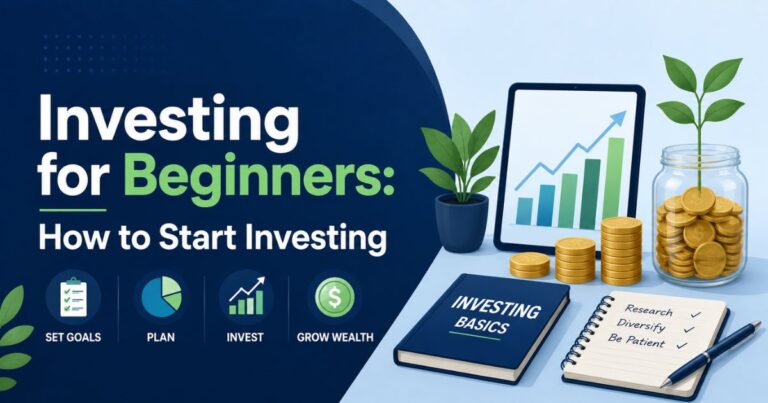
Quick Answer: Investing means putting money into assets like stocks, bonds, and funds with the goal of growing it over time. To start, set a goal, build a small emergency fund, open an investment account (a brokerage or retirement account like a Roth IRA), and buy a diversified, low-cost index fund. You can begin with as little as $1 thanks to fractional shares, and the most important factor is starting early and investing consistently.
Key Takeaways
- You can start investing with as little as $1 using fractional shares; most major brokers charge $0 for stock and ETF trades.
- The U.S. stock market has returned roughly 10% per year on average over the long run (about 7% after inflation) — but past performance does not guarantee future results, and returns vary widely year to year.
- Most experts recommend beginners start with low-cost index funds for instant diversification.
- In Florida there is no state income tax, so no state tax on capital gains or dividends — though federal taxes still apply.
- Best next step: build a small emergency fund, then automate monthly investing into a diversified fund.
Investing is how everyday money grows into long-term wealth — and starting is simpler and cheaper than most beginners think. This guide explains what investing is and why to start now, walks you through opening your first account in seven steps, defines every major investment type, breaks down the key concepts (compound interest, diversification, dollar-cost averaging), and answers the questions beginners ask most, including Florida’s tax angle. The goal is to get you from “I should invest” to confidently making your first investment.
Important: This guide is educational and is not financial, tax, or investment advice. All investing involves risk, including the possible loss of principal. Past performance does not guarantee future results. Consider speaking with a licensed financial professional about your specific situation, and verify any figures against primary sources before acting.
This guide is part of our broader Personal Finance: Complete Guide to Managing Your Money. If you haven’t budgeted or built savings yet, start there — investing works best on a stable foundation.
Table of Contents
- 1 What Is Investing?
- 2 Why Should You Start Investing?
- 3 How Much Money Do You Need to Start Investing?
- 4 How to Start Investing in 7 Steps
- 4.1 Step 1. Set Your Investing Goals and Time Horizon
- 4.2 Step 2. Build Your Financial Foundation First
- 4.3 Step 3. Choose the Right Investment Account
- 4.4 Step 4. Decide How Much to Invest
- 4.5 Step 5. Open and Fund Your Account
- 4.6 Step 6. Choose Your First Investments
- 4.7 Step 7. Automate and Stay Consistent
- 5 What Can You Invest In? Types of Investments
- 6 What Investment Account Should You Open?
- 7 Key Investing Concepts Every Beginner Should Know
- 7.1 What Is Compound Interest?
- 7.2 What Is Diversification?
- 7.3 What Is Dollar-Cost Averaging?
- 7.4 What Is Risk Tolerance?
- 7.5 Why Do Experts Recommend Index Funds?
- 7.6 What Should Beginners Invest In First?
- 7.7 How Much Can You Realistically Earn From Investing?
- 7.8 What Are the Most Common Beginner Investing Mistakes?
- 7.9 Investing vs Saving: What’s the Difference?
- 7.10 Active vs Passive Investing: Which Is Better?
- 7.11 Robo-Advisor vs DIY Investing: Which Should You Choose?
- 8 What Are the Best Investing Apps and Brokers for Beginners?
- 9 How Do You Keep Investing Successfully Long-Term?
- 10 Frequently Asked Questions About Investing for Beginners
What Is Investing?
Investing is the act of putting money into assets — such as stocks, bonds, funds, or real estate — with the expectation that it will grow in value or generate income over time. Unlike saving, where money sits safely but grows slowly, investing accepts some risk in exchange for the potential of meaningfully higher long-term returns.
The core idea is putting your money to work. When you buy a stock, you own a small piece of a company and share in its growth; when you buy a bond, you lend money in exchange for interest; when you buy a fund, you own a basket of many investments at once. Over years and decades, the returns from these assets — plus the compounding of reinvested gains — can turn modest, regular contributions into substantial wealth.
The trade-off is risk. Investments can fall as well as rise, and there are no guarantees. That’s why investing is best suited to money you won’t need for at least three to five years, and why time is an investor’s greatest advantage: the longer your horizon, the more room your investments have to ride out the market’s inevitable ups and downs.
Why Should You Start Investing?
You should start investing because it lets your money grow through compound returns and helps it outpace inflation — two things that saving alone usually can’t do. Money left in a typical savings account loses purchasing power over time as prices rise, while invested money has historically grown faster than inflation over the long run.
The most powerful reason is compounding: your returns earn their own returns, and over decades that snowball can dwarf what you originally contributed. The second is inflation. At roughly 3% average annual inflation, the buying power of cash halves in about 24 years; investments that grow faster than inflation protect and build real wealth.
Consider the long-run numbers (with appropriate caution). Over nearly a century, the U.S. stock market — measured by the S&P 500 — has returned about 10% per year on average with dividends reinvested, or roughly 7% after adjusting for inflation, according to long-run historical data. Those are long-term averages, not promises: individual years swing wildly (from roughly +30% to -37%), some decades have been nearly flat, and past performance does not guarantee future results. The takeaway isn’t a guaranteed return — it’s that staying invested for the long haul has historically rewarded patience. Educational resources from the SEC’s Investor.gov are a good place to ground your expectations in primary-source data.
How Much Money Do You Need to Start Investing?
You can start investing with as little as $1. Thanks to fractional shares (buying a slice of a stock or fund rather than a whole share) and $0-commission trades at most major brokers, the old barrier of needing hundreds or thousands of dollars is gone. What matters far more than your starting amount is starting at all and contributing consistently.
Here’s the reality for beginners: most large brokerages have no account minimum, charge nothing to trade stocks and ETFs, and let you buy fractional shares, so a $25 monthly contribution can buy a piece of a diversified fund. Robo-advisors often start at $0–$10. The reason small amounts still matter is compounding and habit: investing $50 a month consistently from a young age can outgrow a large one-time deposit made years later.
The smarter question than “how much do I need?” is “how much can I invest consistently?” Start with whatever fits your budget after covering essentials and a small emergency fund, automate it, and increase the amount as your income grows.
How to Start Investing in 7 Steps
To start investing, set your goals, build a small financial foundation, choose the right account, decide how much to invest, open and fund the account, pick your first investments, and automate your contributions. Following these steps in order keeps beginners from the two biggest pitfalls: investing money they’ll soon need, and freezing up over which stock to pick. Here’s the practical core.
Step 1. Set Your Investing Goals and Time Horizon
This first step is defining what you’re investing for and when you’ll need the money — your time horizon. It matters because your goal and timeline determine how much risk is appropriate: money for retirement in 30 years can take more risk than money for a house in 3 years.
How to do it: write down each goal, its dollar target, and its date. Long-term goals (retirement, a child’s college fund 15+ years out) suit growth investments like stocks and index funds; short-term goals (under 3–5 years) belong in safer places like savings or short-term bonds, not the stock market.
Common beginner mistake: investing money you’ll need soon in volatile assets, then being forced to sell at a loss when the market dips.
Tool/resource: a simple goal-and-timeline worksheet (or the goal-planning feature in most brokerage apps) helps you match each goal to the right account and asset mix.
Step 2. Build Your Financial Foundation First
This step is making sure your finances are stable before you invest — specifically, a small emergency fund and a handle on high-interest debt. It matters because investing without a safety net often means selling investments at the worst possible time when an emergency hits.
How to do it: build a starter emergency fund (around $1,000, then toward 3–6 months of expenses) in a high-yield savings account, and tackle high-interest debt like credit cards, which often costs more than investments are likely to earn. Our guide on how to save money with practical tips that actually work can help you build that cushion quickly.
Common beginner mistake: skipping the emergency fund, then cashing out investments (possibly at a loss, with taxes) when a surprise expense arrives.
Tool/resource: a high-yield savings account keeps your emergency fund safe, accessible, and earning interest while you build it.
Step 3. Choose the Right Investment Account
This step is selecting the type of account that holds your investments — a taxable brokerage account or a tax-advantaged retirement account. It matters because the account type affects your taxes, access to the money, and any employer match, often more than the specific investments inside it.
How to do it: if your goal is retirement, prioritize tax-advantaged accounts — a 401(k) (especially up to any employer match, which is free money) and an IRA (Roth or traditional). For goals before retirement or after maxing those, use a taxable brokerage account. Our retirement planning guide covers how to save for retirement across these accounts.
Common beginner mistake: leaving an employer 401(k) match on the table, or using a taxable account when a tax-advantaged one would fit the goal better.
Tool/resource: your employer’s HR portal handles 401(k) enrollment; any major brokerage opens an IRA or taxable account online in minutes.
Step 4. Decide How Much to Invest
This step is choosing a contribution amount you can sustain. It matters because consistency beats size — a steady monthly amount harnesses dollar-cost averaging and builds the habit that actually grows wealth.
How to do it: after covering essentials, a small emergency fund, and high-interest debt, invest what’s left over toward your goals — many people aim for 10–15% of income toward retirement, but any amount is a valid start. Automate it so it happens before you can spend it.
Common beginner mistake: waiting to invest until you can afford a “big” amount, and losing years of compounding in the meantime.
Tool/resource: a compound-growth calculator (free on most broker sites) shows how even small monthly amounts grow over decades, which is powerful motivation.
Step 5. Open and Fund Your Account
This step is the practical mechanics: opening your chosen account and transferring money in. It matters because it’s the point where intention becomes action — many would-be investors stall here, but it usually takes only minutes.
How to do it: choose a reputable broker or robo-advisor, complete the online application (you’ll need your Social Security number, ID, and bank details), link your bank account, and transfer your first contribution. Look for accounts with no minimums and $0 commissions.
Common beginner mistake: over-researching brokers for weeks instead of opening an account — most major brokers are very similar for beginners.
Tool/resource: Beginner-friendly options include broker/robo-advisor; we compare them by use case later in this guide.
Step 6. Choose Your First Investments
This step is deciding what to actually buy with your money. It matters because the right first investment for most beginners isn’t a hot stock — it’s a diversified, low-cost fund that spreads risk across hundreds or thousands of companies.
How to do it: most experts suggest beginners start with a broad, low-cost index fund or ETF (such as one tracking the total U.S. stock market or the S&P 500), which gives instant diversification in a single purchase. As you learn, you can add bonds for stability or a small amount of individual stocks if you wish. Keep fees low — expense ratios under about 0.20% are common for index funds.
Common beginner mistake: putting all your money into one stock or a trendy asset, instead of diversifying.
Tool/resource: a target-date fund (named for your retirement year) is an all-in-one, automatically diversified option that adjusts its mix as you age — ideal for hands-off beginners.
Step 7. Automate and Stay Consistent
This final step is setting up automatic, recurring investments so you keep going without relying on willpower. It matters because the investors who succeed are usually the ones who invest steadily through good markets and bad, rather than trying to time the perfect moment.
How to do it: set up an automatic transfer from your bank to your investment account each payday, and enable automatic investing into your chosen fund. Turn on dividend reinvestment (DRIP) so your earnings buy more shares. Then mostly leave it alone — check in periodically, not daily.
Common beginner mistake: trying to time the market or reacting emotionally to dips by selling, which locks in losses and misses the recovery.
Tool/resource: recurring-investment and auto-deposit features (standard at most brokers and robo-advisors) make consistency effortless once set up.
What Can You Invest In? Types of Investments
You can invest in stocks, bonds, index funds, ETFs, mutual funds, real estate and REITs, retirement accounts, and cryptocurrency, among others. They differ in risk, potential return, and how hands-on they are. The sections below define each — with its general risk/return profile (educational, not a recommendation), pros and cons, and who it tends to suit.
Stocks
A stock is a share of ownership in a single company; when the company grows and profits, the stock can rise in value and may pay dividends. Stocks offer the highest long-term growth potential of the major asset classes, but also the most short-term volatility — individual stocks can soar or collapse.
Risk/return profile (educational): high potential return, high risk, especially for any single stock. Pros: highest growth potential, liquidity, possible dividends. Cons: volatile, requires research to pick well, and concentration in one company is risky.
Best for: investors with a long time horizon and the tolerance to ride out swings — and, for most beginners, best accessed through diversified funds rather than picking individual stocks.
Bonds
A bond is a loan you make to a government or company in exchange for regular interest payments and the return of your principal at maturity. Bonds are generally less risky than stocks and provide steadier income, which is why they’re used to add stability to a portfolio.
Risk/return profile (educational): lower risk and lower return than stocks; government bonds (like U.S. Treasuries) are among the safest investments, while corporate bonds pay more but carry more risk. Pros: stability, predictable income, diversification. Cons: lower long-term growth, and bond prices fall when interest rates rise.
Best for: investors seeking stability, those closer to needing their money, and anyone balancing out the volatility of stocks.
Index Funds
An index fund is a fund that holds all (or a representative sample) of the investments in a market index, such as the S&P 500, to match the market’s return rather than beat it. Because it buys the whole market, it delivers instant diversification at very low cost — which is why index funds are the most commonly recommended starting point for beginners.
Risk/return profile (educational): matches its index’s risk and return; a total-market or S&P 500 fund carries stock-market risk but spreads it across hundreds of companies. Pros: low fees, broad diversification, simple, historically competitive with or better than most active funds. Cons: you get the market’s return (no outperformance), and it still falls when the market falls.
Best for: nearly every beginner, and core long-term holdings for many experienced investors.
ETFs (Exchange-Traded Funds)
An ETF is a fund that trades on an exchange like a stock, often tracking an index. ETFs combine the diversification of a fund with the flexibility of a stock — you can buy or sell them anytime the market is open, frequently with no commission and a low expense ratio.
Risk/return profile (educational): depends on what the ETF holds; a broad-market stock ETF carries stock-market risk with built-in diversification. Pros: low cost, diversified, tradable all day, often available as fractional shares. Cons: trading flexibility can tempt overtrading, and niche ETFs can be risky.
Best for: beginners and experienced investors alike; a broad index ETF is one of the simplest, lowest-cost ways to own the whole market.
Mutual Funds
A mutual fund pools money from many investors to buy a professionally managed portfolio of stocks, bonds, or other assets. Mutual funds can be passively managed (index mutual funds) or actively managed (a manager picks investments, usually for a higher fee).
Risk/return profile (educational): varies by what the fund holds and whether it’s active or passive; index mutual funds resemble index ETFs, while active funds aim to beat the market but often charge more and frequently underperform after fees. Pros: diversification, professional management, automatic investing. Cons: active funds carry higher fees, may have minimums, and trade only once per day at the closing price.
Best for: investors who want a hands-off, diversified option — favoring low-cost index mutual funds over high-fee active ones.
Real Estate and REITs
Real estate investing means buying property to earn rental income or appreciation; a REIT (real estate investment trust) lets you invest in real estate through the stock market without buying property directly. REITs trade like stocks and are required to pay out most of their income as dividends.
Risk/return profile (educational): moderate to high, with income potential; direct property is illiquid and management-intensive, while REITs are liquid but move with markets. Pros: diversification beyond stocks and bonds, income, inflation hedge. Cons: direct real estate needs capital and effort; REITs can be volatile and their dividends are taxed as ordinary income. For a deeper look, see our guide to real estate investing and how to get started.
Best for: investors wanting real-estate exposure — REITs for a simple, liquid entry; direct property for those with capital and time.
Retirement Accounts (401k, IRA)
Retirement accounts like 401(k)s and IRAs aren’t investments themselves — they’re tax-advantaged containers that hold investments (funds, stocks, bonds) and grow your money with major tax benefits. Using them is one of the most powerful moves a beginner can make.
Risk/return profile (educational): depends on what you hold inside; the accounts add tax advantages, not different market risk. Pros: tax breaks (deductions now or tax-free growth later), possible employer match in a 401(k), and powerful long-term compounding. Cons: contribution limits and early-withdrawal penalties before age 59½ (with exceptions). Our retirement planning guide covers 401(k)s, IRAs, and how to save for retirement.
Best for: anyone saving for retirement — especially capturing a 401(k) match first, then funding an IRA.
Cryptocurrency
Cryptocurrency is a digital asset, like Bitcoin, that runs on blockchain technology and isn’t backed by a government or central bank. Crypto is highly speculative and extremely volatile — prices can swing dramatically in a single day — so it’s generally considered a high-risk, small-allocation holding at most.
Risk/return profile (educational): very high risk and very high volatility; potential for large gains and large losses, with no guarantees and an evolving regulatory picture. Pros: high upside potential, growing adoption, portfolio diversification for some. Cons: extreme volatility, no underlying cash flow, security/scam risks, and you can lose your entire investment. Learn more in our cryptocurrency guide to how crypto and Bitcoin work.
Best for: investors with high risk tolerance who limit crypto to a small slice of their portfolio (only money they can afford to lose) — and only after the basics are covered.
What Investment Account Should You Open?
The investment account you should open depends on your goal: a 401(k) or IRA for retirement (for the tax advantages), and a taxable brokerage account for goals before retirement or for investing beyond contribution limits. Most beginners benefit from opening more than one over time. Here’s what each is for:
- 401(k): employer-sponsored retirement account; contribute at least enough to get any employer match (free money), with high contribution limits and pre-tax or Roth options.
- Traditional IRA: individual retirement account with potential upfront tax deductions; you pay taxes on withdrawals in retirement.
- Roth IRA: individual retirement account funded with after-tax money; qualified withdrawals in retirement are tax-free — powerful for younger or lower-income investors.
- Taxable brokerage account: no contribution limits or withdrawal penalties; use for goals before retirement or after maxing tax-advantaged accounts. You owe taxes on gains and dividends.
- Robo-advisor account: any of the above, but with automated portfolio management for a small fee — ideal for hands-off beginners.
Brokerage Account vs Retirement Account: What’s the Difference?
The difference is taxes and access: a retirement account offers tax advantages but restricts withdrawals until age 59½, while a taxable brokerage account has no tax perks but lets you access your money anytime. Most investors use both — retirement accounts for long-term goals, brokerage accounts for flexibility.
| Factor | Retirement account (401k/IRA) | Taxable brokerage account |
|---|---|---|
| Tax treatment | Tax-deferred or tax-free growth | Taxed on gains and dividends |
| Withdrawals | Penalty before 59½ (exceptions apply) | Anytime, no penalty |
| Contribution limits | Yes (annual IRS limits) | None |
| Best for | Retirement (long-term) | Flexible/shorter-term goals |
A common beginner order: capture the 401(k) match, then fund an IRA, then invest extra in a taxable brokerage account.
Roth IRA vs Traditional IRA: Which Is Better?
Neither is universally better — a Roth IRA is usually better if you expect to be in a higher tax bracket later (you pay taxes now, withdraw tax-free), while a traditional IRA is better if you want the tax deduction now and expect a lower bracket in retirement. For many young or early-career investors, the Roth’s tax-free growth is especially attractive.
| Factor | Roth IRA | Traditional IRA |
|---|---|---|
| Tax now | Contributions are after-tax (no deduction) | Contributions may be tax-deductible |
| Tax later | Qualified withdrawals are tax-free | Withdrawals taxed as income |
| Income limits | Yes, to contribute | No limit to contribute (deduction may phase out) |
| Best for | Expecting higher future taxes; younger savers | Wanting a deduction now; expecting lower future taxes |
Annual contribution limits and income thresholds change yearly — confirm the current figures with the IRS before contributing. Our retirement guide goes deeper on choosing between them.
Key Investing Concepts Every Beginner Should Know
A handful of concepts explain most of how successful investing works: compound interest, diversification, dollar-cost averaging, and risk tolerance. Understanding these four will take you further than any stock tip. Here’s each one, with a worked example.
What Is Compound Interest?
Compound interest (or compound growth) is when your investment returns earn their own returns, so your money grows at an accelerating rate over time. It’s often called the most powerful force in investing because the growth snowballs the longer you stay invested.
Worked example (illustrative): invest $200 a month starting at age 25, and at a 7% average annual return, you’d have roughly $480,000 by age 65 — even though you only contributed about $96,000 of your own money. The other ~$384,000 is compound growth. Wait until age 35 to start, and that same $200/month grows to only about $228,000 — roughly half — because you gave compounding 10 fewer years to work. (Figures are illustrative; actual returns vary and aren’t guaranteed.)
What Is Diversification?
Diversification means spreading your money across many investments so that no single one can sink your portfolio. The idea is simple: don’t put all your eggs in one basket, because different assets rise and fall at different times.
Worked example: if you put all $10,000 into one company’s stock and it drops 50%, you lose $5,000. If instead you put that $10,000 in an index fund holding 500 companies and one of them collapses, the impact on your total is tiny — the other 499 cushion the blow. That’s why a single broad index fund is considered “diversified” out of the box, while one stock is not.
What Is Dollar-Cost Averaging?
Dollar-cost averaging is investing a fixed amount on a regular schedule (say, $200 every month) regardless of whether the market is up or down. It removes the pressure of trying to “time” the market and automatically buys more shares when prices are low and fewer when prices are high.
Worked example: investing $200 monthly, you might buy 4 shares at $50 one month, then 5 shares at $40 the next month when the price dips, then about 3.3 shares at $60 when it rises. Over time your average cost per share smooths out, and you never have to guess the perfect moment to invest — you just keep buying consistently.
What Is Risk Tolerance?
Risk tolerance is how much investment volatility — and potential loss — you can handle emotionally and financially without panicking or being forced to sell. It’s shaped by your time horizon, your financial situation, and your temperament, and it should guide how you split your money between riskier assets (stocks) and safer ones (bonds).
In practice, a longer time horizon and stable finances allow for higher risk tolerance, because you have time to recover from downturns. A younger investor saving for retirement might hold mostly stocks, while someone needing the money in a few years would hold more bonds and cash. The key test: if a 30% market drop would make you sell in a panic, your portfolio is probably too aggressive — dial back to a mix you can hold through the bad times.
Why Do Experts Recommend Index Funds?
Experts recommend index funds because they offer broad diversification at very low cost and have historically matched or beaten most actively managed funds over the long run. The combination of low fees and instant diversification is hard to beat for everyday investors.
The case rests on two pillars. First, fees compound against you — an actively managed fund charging 1% a year versus an index fund charging 0.05% can cost you tens of thousands of dollars over decades. Second, the evidence: index-fund pioneer John Bogle argued, and decades of data support, that most active managers fail to beat their benchmark index after fees over long periods. By simply owning the whole market cheaply, index-fund investors capture the market’s return without paying for underperformance — which is why broad index funds are the default recommendation for beginners.
What Should Beginners Invest In First?
Most beginners should invest first in a low-cost, broadly diversified index fund or ETF — such as one tracking the total U.S. stock market or the S&P 500 — inside a tax-advantaged account if possible. This single step gives you instant diversification, low fees, and exposure to the market’s long-term growth without needing to pick individual stocks.
A simple, common starting portfolio is a broad U.S. (or total-world) stock index fund, optionally paired with a bond fund for stability as you near your goal. Even simpler: a single target-date fund handles the entire mix for you and adjusts it automatically as you age. The point isn’t to find the “perfect” investment — it’s to get started with something sensible, low-cost, and diversified, then keep contributing.
How Much Can You Realistically Earn From Investing?
Realistically, a diversified stock portfolio has historically earned an average of about 10% per year before inflation (roughly 7% after inflation) over the long run — but returns in any given year vary enormously and are never guaranteed. Over short periods you might see large gains or losses; the long-run average only shows up over many years.
Set expectations accordingly. The roughly 10% figure is a long-term historical average for the U.S. stock market with dividends reinvested; some decades have delivered far more, and others (like the 2000s) were nearly flat or negative. Bonds historically return less; cash savings less still. For planning, many advisors use a conservative 6–7% real (after-inflation) assumption rather than the full headline number. Crucially, past performance does not guarantee future results — use these averages as a rough guide, not a promise, and never invest money you can’t afford to have decline in value.
Is Investing Risky?
Yes, all investing carries risk — including the risk of losing money — but the level of risk varies widely by what you invest in, and avoiding investing carries its own risk: inflation eroding your savings. The goal isn’t to eliminate risk but to take an appropriate amount for your goals and manage it through diversification and time.
Some investments (a single stock, crypto) are far riskier than others (a diversified index fund, government bonds). Risk also falls the longer you hold: while the market can drop sharply in any year, a broad U.S. stock index has historically never lost money over any 20-year period (though, again, past results don’t guarantee the future). Managing risk means diversifying, matching investments to your time horizon, and not investing money you’ll need soon.
Can You Lose All Your Money Investing?
You can lose all your money in a single, concentrated investment — like one company’s stock that goes bankrupt or a speculative crypto token — but it’s extremely unlikely with a broadly diversified fund. A total-market index fund would only go to zero if essentially every major company failed at once, which has never happened.
This is the strongest practical argument for diversification. By owning hundreds or thousands of companies through an index fund, a single failure barely dents your portfolio. The investors who lose everything almost always had everything in one bet. Diversify, avoid putting money you can’t afford to lose into speculative assets, and the realistic risk shifts from “losing everything” to “temporary declines you can wait out.”
Should You Pay Off Debt or Invest First?
Generally, pay off high-interest debt (like credit cards, often 20%+ APR) before investing, because guaranteeing yourself a 20% “return” by eliminating that interest beats the market’s uncertain ~10%. But low-interest debt (like a mortgage or some student loans) can often be paid alongside investing, especially if you’d otherwise miss an employer 401(k) match.
A common framework: (1) get any free 401(k) match, (2) build a small emergency fund, (3) pay off high-interest debt aggressively, then (4) invest in earnest while paying low-interest debt on schedule. The math hinges on the interest rate — if a debt costs more than you can reliably earn investing, clear it first. Our guide to getting out of debt covers payoff strategies in detail.
What Are the Most Common Beginner Investing Mistakes?
The most common beginner investing mistakes are trying to time the market, failing to diversify, paying high fees, and panic-selling during downturns. Avoiding these handful of errors matters more than picking winning investments. Watch for:
- Trying to time the market. Waiting for the “perfect” moment usually means missing gains; consistent investing beats timing.
- Not diversifying. Putting everything in one stock or sector exposes you to avoidable risk.
- Paying high fees. High expense ratios and active-fund fees quietly erode returns over decades.
- Panic-selling. Selling when the market drops locks in losses and misses the recovery.
- Chasing hype. Buying whatever’s trending (a hot stock or coin) after it’s already soared often ends badly.
- Investing money you’ll need soon. Short-term money doesn’t belong in volatile assets.
Investing vs Saving: What’s the Difference?
Saving is setting money aside safely for short-term needs and emergencies; investing is putting money into assets for long-term growth, accepting risk in exchange for higher potential returns. You need both — savings for stability, investing for building wealth.
| Factor | Saving | Investing |
|---|---|---|
| Goal | Safety, short-term needs, emergencies | Long-term growth, building wealth |
| Risk | Very low (FDIC-insured) | Varies; can lose value |
| Return | Low (savings interest) | Higher potential over time |
| Time horizon | Short (under 3–5 years) | Long (5+ years) |
The rule of thumb: save first for emergencies and near-term goals, then invest money you won’t need for years. Learn the savings side in our guide on how to save money.
Active vs Passive Investing: Which Is Better?
For most beginners, passive investing is better — buying low-cost index funds that track the market — because it’s cheaper, simpler, and has historically outperformed most active strategies after fees. Active investing (picking stocks or funds to beat the market) can win but requires skill, time, and luck, and most active managers underperform over the long run.
| Factor | Passive investing | Active investing |
|---|---|---|
| Approach | Track the market via index funds | Pick investments to beat the market |
| Cost | Very low fees | Higher fees and trading costs |
| Effort | Minimal | High (research, monitoring) |
| Track record | Matches the market reliably | Most underperform after fees |
Passive investing is the default recommendation for beginners; some investors add a small active “satellite” portion once they’re comfortable, while keeping the core passive.
Robo-Advisor vs DIY Investing: Which Should You Choose?
Choose a robo-advisor if you want a hands-off, automated portfolio for a small fee; choose DIY investing if you want full control and to avoid that fee. Both can build a low-cost, diversified portfolio — the difference is how much you want to manage yourself.
| Factor | Robo-advisor | DIY investing |
|---|---|---|
| Management | Automated (picks & rebalances for you) | You choose and manage |
| Cost | Small advisory fee (~0.25%) | Just fund fees (can be near zero) |
| Effort | Very low | Moderate |
| Best for | Hands-off beginners | Those wanting control and lowest cost |
A robo-advisor is a great “set it and forget it” entry point; DIY with a single index or target-date fund is nearly as simple and slightly cheaper. Either is a fine way to start.
What Are the Best Investing Apps and Brokers for Beginners?
The best investing app for beginners depends on whether you want to do it yourself or have it automated — and the good news is that most major brokers now offer $0 stock and ETF trades, fractional shares, and no account minimums. Here are strong options by use case:
- Established full-service brokers (for low-cost funds and retirement accounts): large brokers like Fidelity, Charles Schwab, and Vanguard offer $0 trades, broad fund selection, and strong IRA/401(k) support — ideal core accounts.
- Beginner-friendly apps (for simple, mobile-first investing): apps offer easy interfaces, fractional shares, and $0 trades.
- Robo-advisors (for hands-off, automated portfolios): services like Betterment and Wealthfront build and manage a diversified portfolio for a small fee (~0.25%).
- Micro-investing apps (for tiny amounts and round-ups): apps like Acorns invest spare change automatically — good for building the habit.
For most beginners, a major low-cost broker (for a Roth IRA and a total-market index fund) or a robo-advisor is the simplest strong choice. Compare fees, account minimums, fractional-share availability, and retirement-account support, and pick the one you’ll actually use — they’re more similar than different.
Do You Pay State Taxes on Investments in Florida?
No — Florida has no state income tax, so there is no Florida state tax on capital gains, dividends, or other investment income. Florida’s constitution prohibits a personal income tax, which means investment profits avoid state-level taxation entirely. Federal taxes, however, still apply.
Here’s the full picture for Florida investors: you owe no state tax on investment gains, dividends, or interest, and Florida also has no state estate or inheritance tax. But the IRS still taxes you federally — long-term capital gains (on assets held over a year) are taxed at 0%, 15%, or 20% depending on your income, short-term gains are taxed as ordinary income, and high earners may owe an additional 3.8% net investment income tax. Investments inside retirement accounts like IRAs and 401(k)s grow tax-deferred (or tax-free for Roth) regardless of state. Because federal rules and thresholds change yearly, confirm current figures with the IRS, and see our guide to personal taxes and maximizing your refund. (Educational only — not tax advice; consult a tax professional for your situation.)
How Do You Keep Investing Successfully Long-Term?
You keep investing successfully long-term by staying consistent, keeping costs low, diversifying, and not reacting to short-term market swings. The investors who do best are usually the ones who set a sensible plan and stick with it through good times and bad, rather than constantly tinkering or trying to time the market.
The durable principles are simple: invest regularly (dollar-cost averaging) regardless of headlines; keep fees low with index funds; stay diversified across assets; reinvest dividends; and rebalance occasionally to keep your target mix. Most importantly, resist the urge to sell in downturns — historically, the market has recovered from every major crash given enough time, and the biggest gains often come right after the scariest drops. As the evidence consistently shows, time in the market beats timing the market. Set your plan, automate it, and let compounding do the heavy lifting over decades.
Frequently Asked Questions About Investing for Beginners
What Is the Best Way for a Beginner to Start Investing?
The best way for a beginner to start investing is to open a tax-advantaged account (like a Roth IRA) or a brokerage account, then buy a low-cost, broadly diversified index fund and set up automatic monthly contributions. This approach gives you instant diversification, low fees, and the discipline of consistent investing without needing to pick individual stocks. If you’d rather be hands-off, a robo-advisor or a single target-date fund handles the whole portfolio for you. The key is to start with something simple and keep going.
How Much Should I Invest as a Beginner?
As a beginner, invest whatever you can sustain consistently after covering your essentials, a small emergency fund, and high-interest debt — even $25 to $50 a month is a meaningful start thanks to fractional shares and compounding. Many people aim for 10–15% of their income toward long-term goals like retirement, but the right number is whatever you can keep up without straining your budget. Start where you are, automate it, and increase the amount as your income grows. Consistency matters far more than the starting size.
Is It Worth Investing Small Amounts of Money?
Yes, investing small amounts is absolutely worth it, because of compounding and the habit it builds. Thanks to fractional shares and $0-commission trades, even $10 or $25 a month buys into diversified funds and grows over time. A modest amount invested consistently from a young age can outgrow a much larger sum invested later, because it has more years to compound. Small, regular investing also builds the discipline that drives long-term success — so starting small is far better than waiting until you can invest “enough.”