
Key Takeaways
- About 78.7% of new U.S. businesses survive their first year, but only around half reach year five and roughly 35% are still operating after ten years (Bureau of Labor Statistics).
- The U.S. has 36.2 million small businesses — 99.9% of all firms — and they created about 9 of every 10 net new jobs in the latest year of data (SBA Office of Advocacy).
- Good management means mastering eight areas: financial, operations, people/HR, marketing & sales, customer, inventory, time, and risk/compliance.
- Cash flow is the #1 thing to control: track it weekly, keep a cash buffer, and watch profit margin, CAC, runway, and AR days.
- Best next step: set 3–5 measurable goals, build simple systems (SOPs), and pick one tool per function — then review the numbers monthly.
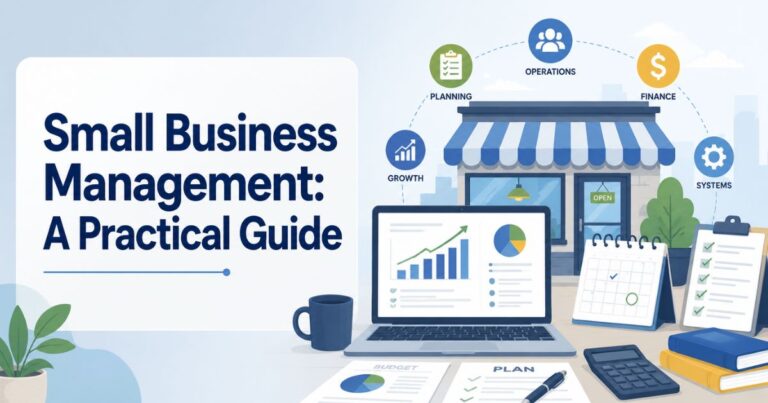
Small business management is the practical work of running a company day to day so it stays profitable, organized, and able to grow. It covers how you handle money, deliver your product or service, lead the people who help you, win and keep customers, and protect the business from risk. This guide breaks management into eight core areas, walks through a six-step system any owner can follow, and answers the questions first-time owners actually ask — from cash flow and hiring to software, scaling, and what changes if you run your business in Florida.
The stakes are real. The U.S. is home to 36.2 million small businesses, which make up 99.9% of all American businesses and employ nearly 46% of the private workforce, according to the SBA Office of Advocacy. Yet survival is far from guaranteed, and management is the difference-maker. This guide is built to be practical first: every section gives you the definition, why it matters, how to do it, the common mistake to avoid, and a tool to reach for.
Table of Contents
- 1 What Is Small Business Management?
- 2 Why Is Good Management Important for Small Businesses?
- 3 What Are the Key Areas of Small Business Management?
- 4 How to Manage a Small Business Effectively
- 4.1 Step 1. Set Clear Goals and KPIs
- 4.2 Step 2. Manage Cash Flow and Budget
- 4.3 Step 3. Build Systems and Standard Operating Procedures
- 4.4 Step 4. Hire, Delegate, and Lead a Team
- 4.5 Step 5. Choose the Right Tools and Software
- 4.6 Step 6. Track Performance and Improve
- 4.7 What Financial Metrics (KPIs) Should a Small Business Track?
- 4.8 How Do You Manage Cash Flow in a Small Business?
- 4.9 How Do You Manage Employees in a Small Business?
- 4.10 How Do You Manage Your Time as a Business Owner?
- 4.11 How Do You Scale a Small Business?
- 5 What Are the Most Common Small Business Management Mistakes?
- 6 What Are the Best Small Business Management Tools and Software?
- 7 What Skills Does a Small Business Manager Need?
- 8 How Do You Know If Your Business Is Well-Managed?
- 9 Frequently Asked Questions About Small Business Management
What Is Small Business Management?
Small business management is the process of planning, organizing, directing, and controlling the resources of a small company — its money, people, operations, and customers — to meet goals and stay profitable. In practice, it means making the daily and weekly decisions that keep a business running: setting priorities, watching cash, scheduling work, leading staff, serving customers, and adjusting when something breaks. Unlike corporate management, the small business owner usually wears all of these hats at once.
Day to day, management is less about theory and more about a recurring set of decisions. You decide what to work on first, what to charge, who to hire, which bills to pay, how to handle an unhappy customer, and whether this month’s numbers are healthy. Classic management theory describes four functions — planning, organizing, leading, and controlling — and they map cleanly onto small business life: plan the month, organize the work and the team, lead the people doing it, and control quality and cash by tracking results.
What makes small business management distinct is concentration and constraint. One person often owns the strategy, the bookkeeping, the hiring, and the customer relationship, so time and cash are always the binding limits. That’s why the most useful management skill for an owner isn’t any single discipline — it’s prioritization: knowing which lever moves the business this week and ignoring the noise. For a broader view of how management fits alongside funding, structure, and taxes, see our complete business and finance guide for owners.
Why Is Good Management Important for Small Businesses?
Good management matters because it is the main thing standing between a business and failure. Business survival data shows the pattern clearly: about 78.7% of new U.S. establishments survive their first full year, but only around half are still operating by year five, and roughly 35% survive to ten years, according to the Bureau of Labor Statistics. Most of those closures trace back to management problems — running out of cash, weak systems, poor hiring, or no plan — not to a bad product.
The attrition is steady rather than sudden. The Bureau of Labor Statistics reports that 34.7% of establishments born in 2013 were still operating a decade later in 2023 — meaning nearly two in three new businesses close within ten years. The encouraging flip side is that these are management failures, which means they are largely preventable. Cash-flow discipline, simple repeatable processes, and tracking a few key numbers each month are exactly the levers an owner controls.
Strong management also compounds. A business with clear goals, a cash buffer, documented processes, and the right tools can absorb a slow month, a lost client, or a key employee quitting. A poorly managed business of the same size cannot — one bad quarter becomes an existential threat. Management is what turns a fragile, owner-dependent operation into a durable, sellable asset. If cash is your weak point, start with our guide to business loans and financing and build the budgeting habit covered later in this guide.
What Does a Small Business Manager Do?
A small business manager runs the company’s daily operations and makes the decisions that keep it profitable and on track. In a small business this person is usually the owner, and the role blends strategy with hands-on execution across every function. Core responsibilities cluster into a handful of repeatable duties performed weekly and monthly.
- Set direction: define goals, priorities, and the plan for the month and quarter.
- Manage money: watch cash flow, approve spending, set prices, and review the numbers.
- Run operations: schedule work, maintain quality, and fix bottlenecks.
- Lead people: hire, train, delegate, and handle performance and pay.
- Win and keep customers: oversee marketing, sales, and service.
- Control risk: stay compliant, carry the right insurance, and protect the business legally.
- Measure and improve: track results and adjust what isn’t working.
The job is less about doing every task personally and more about making sure each one gets done well. As a business grows, the manager’s role shifts from doing the work to building the systems and team that do the work — the transition most owners find hardest.
What Are the Key Areas of Small Business Management?
The key areas of small business management are the eight functions every owner has to keep running at once: financial management, operations, people and HR, marketing and sales, customer management, inventory and supply chain, time and productivity, and risk and compliance. Together they cover money in, work done, people leading, customers served, and the business protected. Below, each area gets a plain-English definition, why it matters for a small business, how to do it well, the most common mistake, and a tool to use.
Think of these eight areas as the dashboard of your business. You don’t give them equal attention every day — cash and operations usually dominate early on — but neglecting any one for too long is how problems compound. The sections that follow go one by one.
1. Financial Management
Financial management is the practice of tracking, planning, and controlling the money flowing through your business — revenue, expenses, cash flow, pricing, and profit. It is the most important area for a small business because nearly every closure traces back to running out of cash. Done well, it means you always know your numbers and never get surprised by a shortfall.
- Why it matters: Cash, not profit, is what keeps the doors open. A profitable business can still fail if money is tied up in unpaid invoices or inventory when payroll is due. Owners who review their cash position weekly catch problems while they’re still fixable.
- How to do it well: Separate business and personal accounts from day one, use accounting software instead of spreadsheets, reconcile monthly, set prices from real costs plus margin, and keep a cash buffer of three to six months of expenses. Review a short financial dashboard every week.
- Worked example — pricing for profit: Say a service costs you $40 in direct labor and materials to deliver. Pricing it at $60 feels like a “$20 profit,” but once you load in overhead (rent, software, insurance) of, say, $15 per job, your real profit is $5 — an 8% margin that one slow month can erase. Price the same job at $90 and your margin jumps to roughly 39%. The lesson: set prices from fully loaded costs plus a target margin, not from what a competitor charges or what “feels” fair.
- Common mistake: Confusing revenue with profit and spending against money that’s booked but not yet collected. The fix is a 13-week cash-flow forecast so you see shortfalls before they arrive.
- Tool to use: Cloud accounting software like QuickBooks automates bookkeeping, invoicing, and reports. When you need outside money to smooth cash flow or grow, compare your options in our guide to business loans and financing: how to fund your business.
2. Operations Management
Operations management is the work of delivering your product or service efficiently and consistently — the systems, scheduling, workflows, and quality control behind everything a customer receives. For a small business, strong operations are what let you handle more volume without dropping quality or burning out the team.
- Why it matters: Operations is where promises become reality. Inconsistent delivery costs you repeat customers and referrals, and inefficient workflows quietly eat margin. As you grow, the business that has documented how work gets done scales smoothly; the one that lives in the owner’s head hits a ceiling.
- How to do it well: Map your core processes step by step, remove or automate the slowest steps, set clear quality standards, and measure throughput and error rates. Standardize anything you do more than a few times a month into a written procedure.
- Common mistake: Keeping every process in your own head, which makes the business fragile and impossible to delegate. The fix is documenting standard operating procedures (covered in the step-by-step system below).
- Tool to use: A project or workflow tool like Asana or Trello to assign tasks, track work, and standardize how jobs move from start to finish.
3. People and HR Management
People and HR management covers hiring, onboarding, paying, and leading employees, plus staying compliant with employment rules. Even a business with one or two staff has to handle payroll, taxes, and basic HR correctly. Get it right and you build a team that lets the business outgrow the owner; get it wrong and turnover and compliance penalties drain time and cash.
- Why it matters: Labor is usually a small business’s biggest expense and its biggest growth lever. A good hire multiplies what you can do; a bad one costs months of salary, lost productivity, and morale. Payroll and employment-tax mistakes also carry real penalties.
- How to do it well: Hire deliberately for both skill and fit, write clear role descriptions, onboard with a checklist, set expectations in writing, and run payroll through software that handles tax withholding and filings. Delegate outcomes, not just tasks.
- Common mistake: Hiring reactively under pressure and skipping documentation, then misclassifying workers or mishandling payroll taxes. The fix is a simple, repeatable hiring and onboarding process.
- Tool to use: Payroll and HR platforms like Gusto automate paychecks, tax filings, and onboarding. For the fundamentals, read our guide to payroll and HR basics for small business owners.
4. Marketing and Sales Management
Marketing and sales management is how you attract potential customers, turn them into buyers, and grow revenue predictably. Marketing creates awareness and demand; sales converts that demand into paying customers. For a small business with a limited budget, the goal is a few channels that reliably bring in profitable customers — not presence everywhere.
- Why it matters: No customers, no business. Marketing and sales are the engine that fills the pipeline, and without a repeatable way to generate leads, revenue depends on luck and referrals alone. Tracking what a customer costs to acquire keeps that engine profitable.
- How to do it well: Define your ideal customer, pick two or three channels you can do consistently (local SEO, referrals, email, social, paid ads), measure cost per acquisition, and double down on what converts. Build a simple sales process so leads don’t fall through the cracks.
- Worked example — CAC vs. lifetime value: If you spend $1,000 on ads in a month and win 10 customers, your customer acquisition cost is $100. If an average customer spends $400 with you over time, that $100 CAC is healthy — roughly a 4:1 return. But if those same ads brought in only 4 customers, your CAC is $250 and you’re barely breaking even. Tracking CAC by channel tells you exactly where to spend more and where to stop.
- Common mistake: Spreading a small budget thin across every channel and never measuring which one actually produces customers. The fix is to track customer acquisition cost (CAC) by channel and cut what doesn’t pay.
- Tool to use: An email and marketing platform plus a simple CRM. See our full playbook on business marketing: strategies to grow your company.
5. Customer Management
Customer management — often called customer relationship management (CRM) — is the practice of organizing, tracking, and improving every interaction your business has with prospects and customers. It keeps contact details, history, and follow-ups in one place so nothing slips, and it turns one-time buyers into repeat customers who refer others.
- Why it matters: Keeping an existing customer is far cheaper than winning a new one, and repeat customers spend more over time. Disorganized follow-up and dropped communication are silent revenue killers, especially for service businesses where relationships drive renewals and referrals.
- How to do it well: Capture every lead and customer in one system, log interactions, set follow-up reminders, ask for reviews and referrals, and respond fast. Use the data to spot your best customers and serve them better.
- Common mistake: Relying on memory, sticky notes, or scattered inboxes, which guarantees missed follow-ups and lost deals. The fix is a single CRM everyone uses.
- Tool to use: A small-business CRM like HubSpot’s free CRM centralizes contacts, deals, and follow-ups so relationships don’t depend on memory.
6. Inventory and Supply Chain Management
Inventory and supply chain management is the control of the goods, materials, and suppliers your business depends on — what you stock, how much, when you reorder, and who you buy from. For product businesses it directly ties up cash and determines whether you can fulfill orders. Even service businesses manage supplies and vendor relationships.
- Why it matters: Inventory is cash sitting on a shelf. Too much ties up money and risks spoilage or obsolescence; too little means stockouts and lost sales. Reliable suppliers and clear reorder points keep both the cash and the customer happy.
- How to do it well: Track stock in real time, set reorder points and safety stock for your best sellers, use first-in-first-out for perishables, and build relationships with more than one supplier so a single disruption can’t shut you down. Review slow-moving stock regularly.
- Common mistake: Over-ordering to feel safe and tying up cash you need elsewhere — or relying on a single supplier with no backup. The fix is data-driven reorder points and a second source for critical items.
- Tool to use: Inventory features built into your point-of-sale or accounting system, or dedicated software like Square or Zoho Inventory for product businesses.
7. Time and Productivity Management
Time and productivity management is how an owner controls their own attention and energy so the highest-value work gets done. In a small business, the owner’s time is the scarcest resource, and managing it well is the difference between working on the business and being trapped in it. The goal is to spend more hours on growth and less on low-value busywork.
- Why it matters: Owners routinely drown in tasks anyone could do, leaving no time for strategy, sales, or improvement. Reclaiming even a few hours a week for high-leverage work compounds into real growth. Burnout, by contrast, is a leading reason owners give up on otherwise viable businesses.
- How to do it well: Identify your highest-value activities, batch similar tasks, time-block deep work, automate repetitive steps, and delegate or outsource the rest. Protect a weekly planning block to step back from the day-to-day.
- Common mistake: Treating every task as equally urgent and personally doing work you could automate or hand off. The fix is ruthless prioritization — focus on the 20% of work that drives 80% of results.
- Tool to use: A calendar plus a task manager (Todoist, Google Calendar) for time-blocking, and automation tools like Zapier to remove repetitive manual steps.
8. Risk and Compliance Management
Risk and compliance management is the work of protecting your business from legal, financial, and operational threats — carrying the right insurance, meeting licensing and tax obligations, and planning for things that could go wrong. It rarely feels urgent, which is exactly why owners neglect it until a lawsuit, audit, or disaster makes it urgent and expensive.
- Why it matters: One uninsured accident, lapsed license, or compliance miss can wipe out years of profit or end the business outright. Managing risk proactively is far cheaper than reacting to a crisis, and it protects your personal assets when your business structure is set up correctly.
- How to do it well: Identify your real risks, carry appropriate insurance (general liability, professional liability, workers’ comp where required), keep licenses and filings current, maintain good records, and use a formal business structure like an LLC to separate personal and business liability.
- Common mistake: Skipping insurance or letting licenses and annual filings lapse to save money, leaving the business exposed. The fix is a simple compliance calendar with every renewal and filing date.
- Tool to use: Compare coverage in our guide to business insurance: types, costs, and what you need, and choose a liability-protecting structure with our guide to business structures (LLC, S-corp, and sole proprietorship).
How to Manage a Small Business Effectively
To manage a small business effectively, follow a repeatable six-step system: set clear goals and KPIs, manage cash flow and budget, build systems and standard operating procedures, hire and delegate to a team, choose the right tools, and track performance to keep improving. This system turns the eight management areas above into a routine you run every week and month instead of reacting to whatever is loudest. The steps below are the practical core of this guide.
None of these steps requires an MBA. They require consistency. Owners who run this loop — plan, fund, systemize, staff, tool up, measure — month after month build businesses that survive the five-year mark and beyond. Here is how to do each step.
Step 1. Set Clear Goals and KPIs
Setting clear goals and KPIs means defining where the business is going and the specific numbers that tell you whether you’re getting there. Goals give direction; KPIs (key performance indicators) make progress measurable. Without them, owners stay busy without knowing if they’re actually winning.
- Why it matters: Goals turn vague ambition into a plan, and KPIs catch problems early — a dipping margin or rising acquisition cost shows up in the numbers before it shows up in your bank balance. Measured businesses make better decisions because they’re working from data, not gut feel.
- How to do it: Set three to five specific, measurable goals for the year (for example, revenue, profit margin, and new customers), break them into quarterly targets, and pick one or two KPIs per goal. Review them on a fixed schedule — weekly for cash, monthly for the rest.
- Common mistake: Setting vague goals (“grow the business”) with no number or deadline, so there’s nothing to track. The fix is making every goal specific and time-bound.
- Tool to use: A simple KPI dashboard in your accounting software or a spreadsheet. Start with the metrics in the KPI section below.
Step 2. Manage Cash Flow and Budget
Managing cash flow and budgeting means controlling the timing of money in and out so you can always cover what’s due. Cash flow is the lifeblood of a small business — more closures come from cash shortfalls than from lack of profit. A budget plans your spending; cash-flow management makes sure the money is there when bills arrive.
- Why it matters: A business can be profitable on paper and still fail if cash is tied up in unpaid invoices or inventory when payroll is due. Forecasting cash even a few weeks ahead turns nasty surprises into manageable decisions.
- How to do it: Build a monthly budget, maintain a rolling 13-week cash-flow forecast, invoice promptly and follow up on late payments, negotiate supplier terms, and keep a cash reserve of three to six months of expenses. Review cash weekly.
- Common mistake: Spending against revenue that’s been booked but not yet collected, then getting caught short. The fix is managing from your cash-flow forecast, not your income statement.
- Tool to use: Accounting software with cash-flow forecasting, plus the methods in our beginner’s guide to budgeting, which apply directly to business finances.
Step 3. Build Systems and Standard Operating Procedures
Building systems and standard operating procedures (SOPs) means documenting how recurring work gets done so it happens the same way every time, with or without you. An SOP is a simple written checklist or guide for a task. Systems are what let a business grow beyond what the owner can personally do.
- Why it matters: Undocumented businesses live in the owner’s head — fragile, hard to delegate, and impossible to sell. Documented systems make quality consistent, onboarding faster, and delegation possible. They are the single biggest lever for escaping the day-to-day grind.
- How to do it: Start with the tasks you repeat most and the ones only you know how to do. Write each as a step-by-step checklist, store them in one shared place, and update them as processes improve. Record a quick screen video for software tasks.
- Common mistake: Waiting until you “have time” to document, which never comes. The fix is writing the SOP the next time you do the task — do it once, capture it once.
- Example SOP (handling a new customer inquiry): 1) Respond within 2 business hours. 2) Log the lead in the CRM with source and contact details. 3) Send the standard intro email and pricing sheet. 4) Schedule a call or quote within 48 hours. 5) Set a follow-up reminder for day 3 if no reply. A five-line checklist like this guarantees no lead is dropped — and any team member can run it without asking you.
- Tool to use: A shared knowledge base (Notion, Google Docs, or Trainual) where every SOP lives in one searchable place.
Step 4. Hire, Delegate, and Lead a Team
Hiring, delegating, and leading a team means bringing in the right people, handing off work effectively, and leading them so the business can do more than you can alone. This is the step where owners transition from doer to manager — and the one most find hardest, because it requires trusting others with work you’ve always done yourself.
- Why it matters: You are the bottleneck in your own business until you build a team. Good hiring and delegation free your time for higher-value work; poor hiring and micromanagement keep you stuck and drive away good people. Labor is also typically your largest cost, so getting it right protects margin.
- How to do it: Hire for both skill and culture fit, onboard with a checklist, delegate clear outcomes rather than dictating every step, give regular feedback, and pay and classify workers correctly. Start by delegating low-value tasks, then move up.
- Common mistake: Delegating tasks but not authority, then micromanaging — which wastes everyone’s time and signals distrust. The fix is to delegate the outcome, define “done,” and let people own the how.
- Tool to use: Payroll and onboarding software to handle the paperwork, plus our payroll and HR basics for small business owners for hiring, classification, and compliance.
Step 5. Choose the Right Tools and Software
Choosing the right tools means picking software that automates repetitive work and replaces error-prone manual processes — one solid tool per core function rather than a tangle of apps. The right stack saves hours every week, reduces mistakes, and gives you the data to manage by numbers. The wrong stack is expensive, confusing, and underused.
- Why it matters: Manual processes cap how much one person can handle and introduce errors in money, payroll, and customer follow-up. Good software is leverage — it lets a small team operate like a bigger one. But over-buying tools wastes money and creates complexity, so fit matters more than features.
- How to do it: Identify your biggest time sinks, choose one trusted tool per function (accounting, payroll, CRM, project management, communication), make sure they integrate, and actually train the team to use them. Add tools as you grow, not all at once.
- Common mistake: Buying tools you never fully implement, or stitching together too many overlapping apps. The fix is starting with the essentials and adding only when a clear need appears.
- Tool to use: See the categorized software recommendations later in this guide to build a starter stack without overspending.
Step 6. Track Performance and Improve
Tracking performance and improving means regularly reviewing your KPIs, comparing them to your goals, and adjusting what isn’t working. Management isn’t a one-time setup — it’s a loop. The businesses that thrive are the ones that measure results, learn from them, and make small improvements continuously.
- Why it matters: What gets measured gets managed. Without a review rhythm, problems compound quietly and good opportunities go unnoticed. A simple monthly review keeps the whole business honest and pointed at its goals.
- How to do it: Hold a short weekly check on cash and a monthly review of your KPIs against targets. Ask three questions: What worked? What didn’t? What will we change next month? Then act on one or two improvements rather than trying to fix everything.
- Common mistake: Tracking numbers but never acting on them — measurement without change is just paperwork. The fix is ending every review with specific next steps and an owner for each.
- Tool to use: A live KPI dashboard from your accounting or analytics tools so the numbers are always in front of you, not buried in a report.
What Financial Metrics (KPIs) Should a Small Business Track?
A small business should track a short list of financial KPIs every month: cash flow, profit margin, customer acquisition cost (CAC), cash runway, and accounts receivable (AR) days. These five tell you whether the business is liquid, profitable, growing efficiently, and getting paid on time. You don’t need dozens of metrics — you need the few that drive decisions.
- Cash flow: the net money moving in and out each period — the single most important number for survival.
- Profit margin: profit as a percentage of revenue, showing whether your pricing and costs actually work.
- Customer acquisition cost (CAC): what it costs in marketing and sales to win one customer — keep it well below the customer’s lifetime value.
- Cash runway: how many months you can operate at current burn before cash runs out.
- Accounts receivable (AR) days: the average time customers take to pay — rising AR days is an early cash-flow warning.
Review cash flow weekly and the rest monthly. If you track only one, track cash flow. Add metrics like gross margin, revenue growth rate, and inventory turnover as the business matures.
How Do You Manage Cash Flow in a Small Business?
To manage cash flow in a small business, forecast money in and out a few weeks ahead, speed up what comes in, slow down what goes out, and keep a reserve. Cash-flow management is about timing: making sure money is available when obligations are due, even when the business is profitable overall. A rolling forecast is the core tool.
- Forecast: maintain a rolling 13-week cash-flow projection so you see shortfalls before they hit.
- Speed up inflows: invoice immediately, require deposits, offer easy payment, and follow up on overdue accounts.
- Manage outflows: negotiate longer supplier terms, time large purchases, and cut non-essential spending in tight months.
- Build a buffer: keep three to six months of operating expenses in reserve.
- Secure backup credit: arrange a line of credit before you need it, not during a crisis.
The same budgeting discipline that works for personal finances applies here — see our guide to budgeting. When timing gaps are structural rather than temporary, explore the options in our business financing guide.
How Do You Manage Employees in a Small Business?
To manage employees in a small business, hire deliberately, set clear expectations, delegate outcomes, give regular feedback, and handle pay and compliance correctly. Managing a small team is more personal than in a large company — there’s nowhere to hide a bad fit, but also more room to build real loyalty and shared purpose. The basics matter most.
- Hire for fit and skill: a wrong hire on a small team is felt by everyone, so screen for both.
- Set clear expectations: write down roles, responsibilities, and what success looks like.
- Delegate and trust: hand off outcomes and resist micromanaging.
- Give feedback often: short, regular check-ins beat once-a-year reviews.
- Get pay and compliance right: run proper payroll, classify workers correctly, and follow employment law.
For the compliance and payroll mechanics — withholding, classification, and filings — see our payroll and HR basics for small business owners.
How Do You Manage Your Time as a Business Owner?
To manage your time as a business owner, focus on high-value work, batch and time-block tasks, automate the repetitive, and delegate the rest. The owner’s time is the business’s scarcest resource, so the goal is spending more of it on growth and less on tasks that don’t need you. A few habits make the biggest difference.
- Prioritize ruthlessly: identify the 20% of work that drives most of your results and protect time for it.
- Time-block: schedule deep work in focused blocks instead of reacting all day.
- Batch tasks: group similar work (email, calls, admin) to cut context-switching.
- Automate: use software to handle invoicing, scheduling, and follow-ups.
- Delegate and outsource: hand off or buy out low-value tasks so you can work on the business.
The payoff isn’t just more output — it’s avoiding the burnout that pushes many owners to quit viable businesses. Protect one weekly block to plan and step back from the day-to-day.
How Do You Scale a Small Business?
To scale a small business, grow revenue faster than costs by building systems, delegating to a team, and using tools and capital that let you serve more customers without proportionally more work. Scaling is different from simply getting busier: it means increasing output and profit without the owner working more hours. It requires foundations to be in place first.
- Systemize before you grow: documented SOPs let new hires deliver consistent quality.
- Build a team: hire and delegate so the business isn’t capped by the owner’s hours.
- Standardize and automate: use software and repeatable processes to handle higher volume.
- Protect margins and cash: make sure growth is profitable and funded — fast growth burns cash.
- Add capacity deliberately: expand staff, locations, or product lines once demand is proven.
Scaling too early — before systems, cash, and a team are ready — is a common way growing businesses fail. Make sure financing supports the growth; our financing guide covers funding options for expansion.
Do You Need a Business Manager or Can You Do It Yourself?
Most small business owners can and do manage the business themselves, especially in the early years — a dedicated business manager only makes sense once the company is large or complex enough that management is a full-time job the owner shouldn’t be doing. For solo operators and small teams, the owner is the manager, supported by software and outside help like a bookkeeper or accountant.
Consider hiring a manager when the owner’s time is worth more on growth than on operations, when the business runs multiple locations or shifts, or when day-to-day management is causing burnout or mistakes. Before a full-time manager, many owners first outsource specific functions — bookkeeping, payroll, or HR — which delivers much of the benefit at a fraction of the cost.
Should You Use Business Management Software?
Yes — almost every small business benefits from business management software, because it automates repetitive work, reduces costly errors, and provides the data to manage by numbers. The question isn’t whether to use software, but which tools and how many. The right starter stack pays for itself quickly in time saved and mistakes avoided.
Start with the essentials — accounting and a CRM — then add payroll, project management, and communication tools as the team grows. The mistake to avoid is over-buying: a tangle of overlapping apps you never fully implement costs money and adds complexity. Choose one trusted tool per function, make sure they integrate, and train the team to actually use them. See the categorized recommendations below.
What Are the Most Common Small Business Management Mistakes?
The most common small business management mistakes are running out of cash, growing too fast, failing to delegate, not tracking the numbers, and neglecting marketing or compliance. Each one is a management failure rather than a market failure — which means each is largely preventable. Recognizing these patterns is the first step to avoiding the closures that catch most new businesses within their first decade.
- Poor cash-flow management: the most common killer — spending against uncollected revenue and getting caught without cash for payroll or bills.
- Scaling too soon: adding staff, space, or inventory before systems and demand can support it, burning cash in the process.
- Failing to delegate: the owner becomes the bottleneck, doing everything and building a business that can’t grow or run without them.
- Not tracking KPIs: managing on gut feel instead of numbers, so problems are caught too late.
- Underpricing: setting prices on competitors or guesswork instead of real costs plus margin, quietly losing money on every sale.
- Neglecting marketing: stopping marketing when busy, then facing a dry pipeline when work slows.
- Ignoring compliance and insurance: skipping licenses, filings, or coverage to save money, leaving the business exposed to penalties or a single catastrophic event.
- Mixing personal and business finances: making bookkeeping, taxes, and liability protection far harder than they need to be.
Most failing businesses make several of these at once, and they compound. The defenses are the same throughout this guide: watch cash, track a few KPIs, document systems, delegate, and stay compliant.
What Are the Best Small Business Management Tools and Software?
The best small business management tools are one trusted app per core function: accounting, payroll and HR, CRM, project management, and team communication. You don’t need an expensive, sprawling software stack — you need a few well-chosen tools that integrate and that your team actually uses. The table below maps common functions to widely used options across budget levels.
| Function | What it does | Popular options |
|---|---|---|
| Accounting & bookkeeping | Track income, expenses, invoicing, and reports | QuickBooks, Xero, Wave (free) |
| Payroll & HR | Run payroll, file payroll taxes, onboard staff | Gusto, ADP, OnPay |
| CRM & customers | Organize contacts, deals, and follow-ups | HubSpot (free tier), Zoho, Pipedrive |
| Project & task management | Assign work, track projects, standardize workflows | Asana, Trello, ClickUp |
| Team communication | Internal messaging and collaboration | Slack, Microsoft Teams, Google Workspace |
| Inventory / POS | Track stock and process sales (product businesses) | Square, Shopify, Zoho Inventory |
| Documentation / SOPs | Store procedures and knowledge in one place | Notion, Google Docs, Trainual |
Start with accounting and a CRM — the two functions nearly every business needs — then add payroll once you hire and project management once work outgrows a to-do list. Two affiliate-friendly starting points many owners choose are QuickBooks for the books and Gusto for payroll. Prioritize tools that integrate with each other so data flows automatically instead of being re-entered by hand.
What Skills Does a Small Business Manager Need?
A small business manager needs a mix of hard skills (financial literacy, marketing, operations) and soft skills (leadership, communication, decision-making, time management). No owner starts with all of them — they’re learned on the job and supplemented with tools and advisors. The most important by far is the ability to prioritize and make decisions with incomplete information.
Hard skills are the teachable, technical abilities:
- Financial literacy: reading basic statements, managing cash flow, and pricing for profit.
- Marketing and sales: attracting customers and converting them affordably.
- Operations: building efficient, repeatable processes.
- Basic legal and tax awareness: knowing your obligations and when to call a professional.
Soft skills are the human abilities that often decide success:
- Leadership: setting direction and motivating a team.
- Communication: clear expectations with staff, customers, and vendors.
- Decision-making: acting on imperfect information without freezing.
- Time management: focusing on high-value work and delegating the rest.
- Adaptability: adjusting as conditions change.
The good news for first-time owners: these are learnable. Free mentoring, online courses, and the right software close the gaps quickly, and you can hire or outsource for the skills you don’t want to build yourself.
How Do You Manage a Small Business in Florida?
Managing a small business in Florida means meeting state-specific obligations: filing an annual report with the Division of Corporations (Sunbiz), handling local licensing, and taking advantage of Florida’s lack of a state personal income tax. The fundamentals of management are the same everywhere, but Florida’s filing rules, deadlines, and tax structure create specific to-dos owners can’t skip.
The single most important recurring deadline is the annual report. Every Florida LLC must file its annual report through Sunbiz between January 1 and May 1 each year, and the LLC filing fee is $138.75. Miss the May 1 deadline and the state imposes a $400 late fee that cannot be waived, according to the Florida Division of Corporations. Keep ignoring it and your business can be administratively dissolved in late September — so put the date on your compliance calendar.
Florida’s tax picture is a genuine advantage: the state has no personal income tax, which benefits pass-through owners of LLCs and sole proprietorships. You’ll still handle federal taxes, any applicable state sales tax, and local requirements, and many cities and counties require their own business tax receipt or licenses, so check with your local government. For setup and ongoing requirements, see our guides on how to start a business in Florida and how to start an LLC in Florida: cost, steps, and requirements. Florida’s small-business economy is one of the largest in the country, with about 3.5 million small businesses, so local resources are plentiful.
What Is the Difference Between Management and Leadership?
Management and leadership are related but distinct: management is about systems, processes, and execution — making sure the right things get done efficiently — while leadership is about vision, influence, and people — inspiring a team toward a goal. Small business owners need both. Management keeps today running; leadership shapes where the business is going.
| Dimension | Management | Leadership |
|---|---|---|
| Focus | Systems, processes, execution | Vision, direction, change |
| Goal | Do things right and efficiently | Do the right things |
| Time horizon | Today and this quarter | The future |
| Approach | Plan, organize, control | Inspire, influence, motivate |
| People | Coordinates tasks and resources | Builds trust and commitment |
In a small business the owner is both manager and leader, often within the same hour — setting a vision for the team in the morning and reconciling the books in the afternoon. Strong businesses balance the two: leadership without management produces exciting plans that never get executed, while management without leadership produces an efficient business with no direction.
Should You Manage the Business Yourself or Hire a Manager?
Whether to manage the business yourself or hire a manager comes down to scale, complexity, and the value of your time. Most owners self-manage early on, then bring in a manager when operations become a full-time job that’s pulling them away from higher-value work like strategy, sales, and growth. There’s a middle path too: outsourcing specific functions before hiring a full-time manager.
| Factor | Manage it yourself | Hire a manager |
|---|---|---|
| Best when | Early stage, small team, tight budget | Multiple locations/shifts, complex operations |
| Cost | Your time | A salary, but frees your time |
| Control | Full, hands-on | Delegated; requires trust and systems |
| Owner’s focus | Split across everything | Strategy, growth, key relationships |
| Middle option | Outsource bookkeeping, payroll, or HR before a full-time hire | |
A practical rule: when your time is worth more on growth than on day-to-day operations — and you’ve documented enough systems for someone else to run them — it’s time to delegate management. Until then, software and part-time outside help usually deliver most of the benefit at a fraction of the cost.
How Do You Know If Your Business Is Well-Managed?
A well-managed business is profitable, has positive or stable cash flow, runs on documented systems rather than the owner’s memory, tracks its key numbers, retains customers and staff, and stays compliant. If most of those are true, the business can absorb shocks and grow; if several are missing, it’s fragile no matter how busy it looks. Use the checklist below as a quick health check.
- Cash: you can cover three to six months of expenses and forecast cash a few weeks out.
- Profit: the business is profitable, and you know your margins by product or service.
- Numbers: you review a short set of KPIs on a regular schedule.
- Systems: core tasks are documented and could be handed to someone else.
- People: you delegate effectively and keep good staff.
- Customers: you retain customers and generate repeat business and referrals.
- Pipeline: marketing runs consistently, so new leads keep coming.
- Compliance: licenses, filings, taxes, and insurance are current.
- Owner’s role: you work on the business, not only in it.
Score yourself honestly. Any box you can’t check is your next priority — and most map directly to a section of this guide.
Frequently Asked Questions About Small Business Management
What Is the Most Important Part of Managing a Business?
Cash-flow management is the most important part of managing a small business. More businesses fail from running out of cash than from any other single cause, and cash shortfalls can sink even a profitable company. Owners who forecast cash, invoice promptly, control spending, and keep a reserve protect the business’s survival before optimizing anything else.
How Do First-Time Owners Learn to Manage a Business?
First-time owners learn to manage a business through a mix of free mentoring, hands-on practice, online courses, and the right tools. Organizations like SCORE offer free, experienced business mentors, and the SBA provides free courses and local Small Business Development Center support. The fastest path is combining a mentor’s guidance with software that handles the technical work while you learn.
Can You Manage a Business With No Experience?
Yes, you can manage a business with no experience — most small business owners start with none. Success comes from learning the fundamentals as you go, using software to handle technical tasks, leaning on mentors and advisors, and avoiding the common mistakes in this guide. Start small, track your numbers, document what works, and improve each month. Experience is built, not required up front.