Quick Answer: To start a business, validate your idea, write a simple business plan, choose a structure (most beginners pick an LLC), register with your state, get a free EIN from the IRS, open a business bank account, set up bookkeeping, secure funding, get insurance, build a brand and website, then market and launch. A lean home-based or online business can start for under $3,000 and launch in a few weeks; a storefront costs far more and takes longer.
Key Takeaways
- Startup cost ranges widely: many online or home-based businesses launch for under $3,000, while a brick-and-mortar location or restaurant can run $50,000 to $200,000+.
- Registration is cheap: forming an LLC costs roughly $50 to $500 depending on the state (it’s $125 in Florida), and an EIN from the IRS is free.
- Timeline: a sole proprietor can launch in days; an LLC with licenses typically takes 2 to 8 weeks, and most businesses reach steady profit in 18 to 24 months.
- Survival depends on planning: about 1 in 5 businesses close in year one and roughly half make it to five years — validating demand and managing cash are the biggest levers.
- Best first move: confirm real customers will pay before spending money; the most common reason startups fail is building something with no market need.
Starting a business is one of the most accessible wealth-building paths in the United States, and more people are doing it than ever: Americans filed roughly 5.2 million new business applications in 2024, according to the U.S. Census Bureau’s Business Formation Statistics, with Florida ranking third in the nation for applications per capita. This guide walks you through the entire process from idea to launch — the realistic costs, the legal steps, the funding options, and the mistakes that sink first-timers — so you can move forward with a clear, ordered plan instead of guesswork.
This is the hub for everything we cover on starting a company at FloridaIndependent. Below you will find the definitive answers to the questions every founder asks first (what it costs, how long it takes, whether you need money), a complete 12-step launch process, the best beginner-friendly business ideas with links to dedicated guides, and a Florida-specific section that explains why the state is one of the most founder-friendly in the country. Everything here is educational, not legal, tax, or financial advice; confirm fees and rules against the official source or a licensed professional before you act on them. For the wider context of running and financing a company, see our complete guide to business and finance.
Table of Contents
- 1 What Does It Mean to Start a Business?
- 2 How Much Does It Cost to Start a Business?
- 3 How Long Does It Take to Start a Business?
- 4 Do You Need Money to Start a Business?
- 5 How to Start a Business in 12 Steps
- 5.1 Step 1. Find and Validate Your Business Idea
- 5.2 Step 2. Do Market Research and Analyze Competitors
- 5.3 Step 3. Write a Business Plan
- 5.4 Step 4. Choose a Business Structure (LLC, S-Corp, Sole Prop)
- 5.5 Step 5. Register Your Business and Get Licenses & Permits
- 5.6 Step 6. Get an EIN and Open a Business Bank Account
- 5.7 Step 7. Set Up Accounting and Bookkeeping
- 5.8 Step 8. Secure Funding for Your Business
- 5.9 Step 9. Get Business Insurance
- 5.10 Step 10. Build Your Brand and Online Presence
- 5.11 Step 11. Market and Launch Your Business
- 5.12 Step 12. Manage Operations and Plan for Growth
- 6 What Should You Do in Your First 90 Days After Launching?
- 7 What Are the Best Businesses to Start for Beginners?
- 8 How Do You Name and Price Your New Business?
- 9 What Are the Most Common Mistakes When Starting a Business?
- 10 What Tools and Software Do You Need to Start a Business?
- 11 How Do You Know If You’re Ready to Start a Business?
- 12 Frequently Asked Questions About Starting a Business
- 12.1 What Is the First Step to Starting a Business?
- 12.2 How Do Beginners Start a Business With No Experience?
- 12.3 Is Starting a Business Worth It?
- 12.4 How Much Money Do You Need to Start a Small Business?
- 12.5 Can You Start a Business While Working Full-Time?
- 12.6 Do You Need a Business Plan to Start a Business?
What Does It Mean to Start a Business?
Starting a business means turning an idea into a legal, operating entity that sells a product or service for profit — a process that spans validating demand, choosing and registering a business structure, handling taxes and licensing, funding the operation, and actually delivering to paying customers. It is not a single event but a sequence: the “start” runs from the first validated idea through the first sale and into the early months of operating. A startup, in the broad sense, is simply a newly formed business working to establish a repeatable, profitable model.
In practical terms, starting a business involves both the creative work (finding an idea, building the offer, reaching customers) and the administrative work (registering with the state, getting an EIN, opening a bank account, setting up books, and staying compliant with taxes and licenses). Many first-time founders focus only on the product and underestimate the back-office steps, then scramble when a bank, a client, or the IRS asks for paperwork they don’t have. Doing both tracks in parallel is what separates a hobby from a business.
There is also a mindset shift. Running a business means you are now responsible for generating revenue, managing money, and carrying risk — there is no employer covering taxes or providing a steady paycheck. The upside is ownership: you keep the profit, control the direction, and build an asset. The rest of this guide breaks the work into a concrete order so the scope feels manageable rather than overwhelming.
How Much Does It Cost to Start a Business?
Starting a business costs anywhere from a few hundred dollars to several hundred thousand, depending entirely on the model: a home-based or online service business can launch for under $3,000, a typical small business runs $5,000 to $40,000 in the first year, and a brick-and-mortar location such as a restaurant can require $200,000 or more. According to the U.S. Small Business Administration, the biggest cost drivers are location, equipment, inventory, and labor — so the more physical and staffed your business is, the more capital it needs up front.
It helps to separate one-time startup costs from ongoing monthly costs. One-time costs are what you pay to open the doors; monthly costs are what keep them open. Here is a realistic breakdown of common one-time expenses, drawn from SBA guidance and current market ranges:
- Business registration, licenses, and permits: $50 to $500, depending on your state and industry.
- Forming an LLC: roughly $50 to $500 in state filing fees ($125 in Florida).
- Legal and professional fees (attorney, accountant, plan): $300 to $5,000, depending on complexity.
- Equipment and technology: $1,000 to $50,000+, from a single laptop to a full commercial kitchen.
- Website and branding: $120 to $360 per year for a builder-based site, more for custom design.
- Initial inventory or supplies: varies enormously — near zero for a consultant, tens of thousands for a retailer.
- Office or retail space and build-out: $2,000 to $50,000+ if you need physical space.
Costs cluster by business model more than by industry. Here’s a realistic range for common beginner models, useful for ballparking your own budget before you build a detailed one:
| Business model | Typical startup cost | Main cost drivers |
|---|---|---|
| Service / freelance (home-based) | $100 – $3,000 | Registration, website, basic tools |
| Cleaning / lawn care / handyman | $500 – $5,000 | Equipment, supplies, transportation |
| Online store / dropshipping | $500 – $10,000 | Website, inventory or supplier, ads |
| Consulting / coaching | $1,000 – $5,000 | Branding, website, certifications |
| Food truck | $40,000 – $200,000 | Truck, equipment, permits |
| Brick-and-mortar retail | $50,000 – $150,000+ | Lease, build-out, inventory, staff |
| Full-service restaurant | $200,000 – $750,000 | Lease, kitchen, staff, licensing |
These are starting-point ranges, not quotes — your actual costs depend on location, scale, and how much you do yourself. The pattern is clear, though: the more physical space, equipment, inventory, and staff a model requires, the more capital it needs before it earns a dollar, which is exactly why beginners are steered toward the top of this table.
The single most important budgeting rule is to fund not just the startup costs but also a cash runway — ideally six to twelve months of operating expenses — because most businesses spend before they earn and take 18 to 24 months to reach consistent profitability. Underestimating how long it takes to become profitable is the most common and most dangerous budgeting mistake. For a model-by-model breakdown of what specific businesses cost to start, browse the dedicated guides linked later in this article, and use the free SBA startup-cost worksheet to estimate your own numbers.
How Long Does It Take to Start a Business?
Starting a business takes anywhere from a single day to several months, depending on the structure and licensing involved. A sole proprietor selling a service can legally start almost immediately, while forming an LLC and obtaining the necessary licenses and permits typically takes 2 to 8 weeks from decision to “open for business.” Reaching consistent profitability is a separate, longer timeline — most businesses take 18 to 24 months to get there, and capital-intensive ventures like restaurants can take three years or more.
The administrative timeline breaks down roughly like this: choosing and registering a business structure takes a few days to a couple of weeks (online LLC filings are often approved within days to two weeks, depending on the state); getting an EIN from the IRS is immediate online; opening a business bank account takes a day or two once you have your formation documents and EIN; and any industry-specific licenses or permits can add days to months depending on your field and locale. Service businesses move fastest because they need the least equipment and inventory.
The validation and preparation work before you file is where the real time goes — and where it should go. Founders who rush from idea to launch without testing demand often spend weeks setting up a business nobody wants. A sensible pace is to spend the first few weeks validating the idea and writing a lean plan, then move quickly through the legal setup once you have evidence that customers will pay. Speed matters less than direction.
Do You Need Money to Start a Business?
No, you do not necessarily need money to start a business — but you need some, and the real question is how much and for what. Many service businesses (cleaning, consulting, freelancing, tutoring, dog walking) can be launched for a few hundred dollars by using skills you already have, working from home, and marketing for free on social media and word of mouth. What you cannot avoid entirely are the small unavoidable costs: state registration, a business bank account, and basic tools. “No money” realistically means “very little money,” not zero.
The amount of capital you need is driven by your business model, not your ambition. A consultant needs a laptop, a phone, and a website. A product business needs inventory. A restaurant needs a lease, a build-out, equipment, and staff before it sells a single meal. The lower the physical and staffing requirements, the less money you need to start — which is exactly why beginners are usually steered toward low-overhead service and online businesses first. You can always reinvest early profits to grow into something larger.
If you do need outside capital, options range from personal savings and a side income (the most common and cheapest) to SBA-backed microloans of up to $50,000, business credit, grants, and investors. Each has trade-offs in cost, speed, and control, which we cover in the funding step below. The key principle: borrow or raise only what the business genuinely needs, and prefer the cheapest capital — your own savings and early customer revenue — before taking on debt or giving up ownership.
One cost beginners routinely forget is their own living expenses. Even a business that costs almost nothing to start still has to support you while it ramps, and most don’t turn a reliable profit for many months. That’s the real reason starting on the side, with a paycheck still coming in, is so often the safest move: it removes the pressure to pull money out of the business before it can spare it. If you do go full-time, treat several months of personal expenses as part of your startup budget, not an afterthought — running out of personal cash forces good businesses to close before they ever get the chance to work.
How to Start a Business in 12 Steps
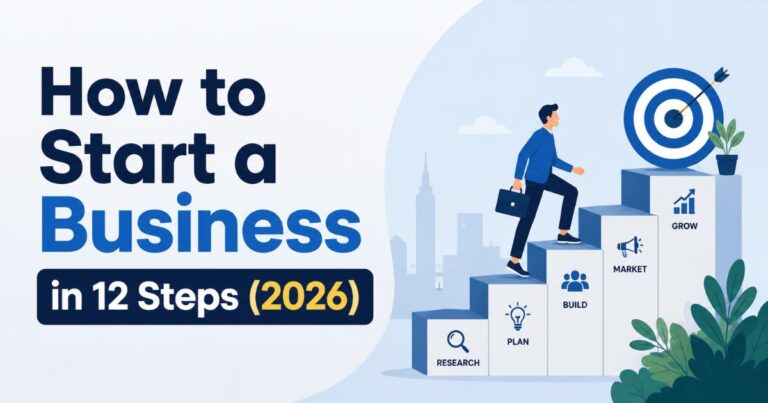
The process of starting a business breaks into twelve ordered steps: validate your idea, research the market, write a plan, choose a structure, register and get licenses, get an EIN and bank account, set up bookkeeping, secure funding, get insurance, build your brand, market and launch, then manage operations and grow. The order matters — each step builds on the last — but you do not need to perfect every step before moving on. Done beats perfect, especially early. Below is exactly what each step is, why it matters, how to do it, the mistake to avoid, and the tools that make it easier.
Step 1. Find and Validate Your Business Idea
The first step is finding a business idea and confirming that real customers will pay for it before you invest time or money. Validation matters more than the idea itself: the most common reason startups fail is building something with no market need, which research firm CB Insights found accounts for roughly 42% of failures. A good idea solves a real, specific problem for a group of people who are willing and able to pay to have it solved.
To do it: start from your skills, experience, and the problems you notice in your own life or work. Then test demand cheaply — talk to 10 to 20 potential customers, pre-sell to a small group, run a simple landing page, or take on a few paying clients before quitting anything. The goal is evidence, not enthusiasm. If people will pay before you have built the full thing, you have validation; if everyone says “great idea” but no one buys, you don’t.
The common mistake is falling in love with an idea and skipping validation, then building in isolation for months. Avoid it by seeking the fastest possible “will someone pay?” test. A useful resource here is simply a no-code landing-page builder and a small ad budget to gauge real interest before committing. For deeper idea-generation and validation methods, see the dedicated sections later in this guide.
Step 2. Do Market Research and Analyze Competitors
Market research is the work of understanding your customers, competitors, and industry before you commit — confirming there is a large enough market, identifying who you are competing against, and finding the gap you can fill. It matters because it turns assumptions into evidence: who your buyers are, what they will pay, how saturated the market is, and what competitors do well or poorly. Skipping it is how founders end up in crowded markets with no real differentiation.
To do it: define your target customer specifically (demographics, location, needs), then study the competition directly — visit their websites, read their reviews, note their pricing, and identify what customers complain about. Free tools go a long way: Google searches and Google Trends for demand, competitor reviews for pain points, and U.S. Census and BLS data for market size and industry wages. The goal is a clear picture of where you fit and why a customer would choose you.
The common mistake is confirmation bias — researching only enough to confirm what you already believe. Avoid it by actively looking for reasons your idea might not work, which is cheaper to discover now than after launch. Pay special attention to competitor reviews: the one-star and three-star reviews are a free roadmap of unmet needs you can build your positioning around.
Step 3. Write a Business Plan
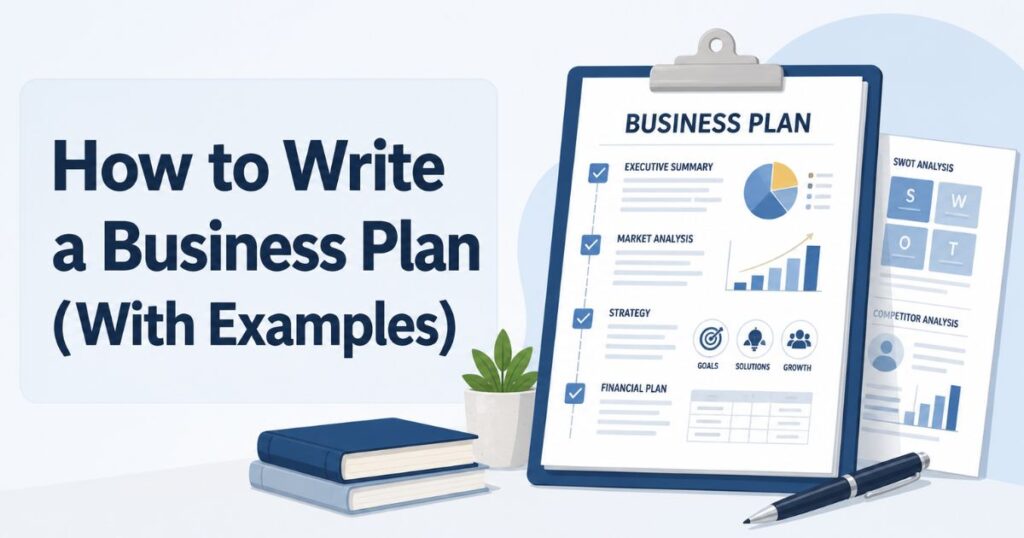
A business plan is a written document that defines what your business does, who it serves, how it will make money, and what it will cost to run — and it matters because it forces you to think through the model before you spend money, and because lenders and investors require one. For a simple business, a lean one-page plan is enough to start; for funding, you will need a fuller traditional plan with financial projections.
To do it: cover the essentials — an executive summary, your product or service, target market, competition, marketing and sales approach, operations, your team, and financial projections (startup costs, pricing, and a basic profit forecast). Keep it realistic and concise. The most useful parts for a beginner are the numbers: what it costs to start, what you will charge, how many sales you need to break even, and how long your cash will last. A plan you actually use beats an impressive one that sits in a drawer.
The common mistake is treating the plan as a one-time formality or, worse, skipping the financial projections that reveal whether the business can actually work. Avoid it by writing the plan to answer your own hardest questions first. For a full walkthrough with templates and examples, see our guide on how to write a business plan (with examples).
Step 4. Choose a Business Structure (LLC, S-Corp, Sole Prop)
Choosing a business structure means deciding the legal form your business takes — most commonly a sole proprietorship, LLC, S-corporation, or corporation — and it matters because the structure determines your personal liability, how you are taxed, and how much paperwork you carry. For most new small businesses, an LLC is the default recommendation: it separates your personal assets from business debts and lawsuits while staying simple and inexpensive to run.
Here is how the main options compare for a beginner:
- Sole proprietorship: the default if you do nothing — easiest and free, but offers no liability protection, so your personal assets are exposed.
- LLC (limited liability company): separates personal and business assets, flexible taxation, modest cost and upkeep. The most popular choice for small businesses.
- S-corporation: a tax election (often layered on an LLC) that can reduce self-employment tax once profits are high enough — typically worth considering past roughly $40,000–$80,000 in net profit.
- C-corporation: a separate taxable entity suited to startups raising venture capital; more complex and double-taxed, rarely the starting point for a small business.
The common mistake is operating as a sole proprietor longer than you should, leaving personal assets exposed once you have real revenue or liability risk. Avoid it by forming an LLC as soon as you have meaningful income or any chance of being sued. Formation services like ZenBusiness, Bizee, or LegalZoom can file the paperwork for you, though you can also file directly with your state for just the filing fee. For the full comparison, see LLC vs S-Corp vs sole proprietorship: business structures explained.
Step 5. Register Your Business and Get Licenses & Permits
Registering your business means making it official with your state — filing formation documents (like LLC Articles of Organization), registering your business name, and obtaining any licenses and permits your industry and locality require. It matters because operating without proper registration and licensing can mean fines, forced closure, or personal liability. What you need depends on your structure, industry, and where you operate, so requirements vary by city, county, and state.
To do it: file your formation paperwork with your state’s Secretary of State or Division of Corporations (in Florida, that’s Sunbiz), register your business name (or file a DBA if operating under a different name), then check federal, state, and local license requirements for your specific business. A restaurant needs health permits; a contractor needs trade licenses; many cities require a general business license or local business tax receipt regardless of industry. When in doubt, check your city and county websites directly.
The common mistake is assuming registration with the state covers everything and missing local licenses or industry permits — a gap that surfaces at the worst possible time. Avoid it by building a short compliance checklist for federal, state, county, and city requirements before you open. Because licensing rules vary so widely by location and industry, confirm your exact requirements with your state and local government rather than relying on a generic list.
Step 6. Get an EIN and Open a Business Bank Account
An EIN (Employer Identification Number) is your business’s federal tax ID, and you should get one right after registering — it’s free and issued immediately when you apply online with the IRS. You need it to open a business bank account, hire employees, and file business taxes, and it lets you avoid using your Social Security number on business paperwork. Once you have an EIN, opening a dedicated business bank account is the next step, and it is non-negotiable for keeping your finances clean.
To do it: apply for your EIN directly through the IRS’s free EIN tool — never pay a third-party site that charges for it, because the IRS issues it at no cost. Then open a business checking account using your formation documents and EIN. Separating business and personal money from day one makes bookkeeping, taxes, and proving your business’s legitimacy dramatically easier, and it protects the liability shield an LLC provides.
The common mistake is running business income and expenses through a personal account, which creates a bookkeeping nightmare at tax time and can legally undermine your LLC’s protection (called “piercing the corporate veil”). Avoid it by opening the business account before you make your first sale. For help choosing where to bank, see our banking guide to checking, savings, and choosing a bank.
Step 7. Set Up Accounting and Bookkeeping
Setting up accounting and bookkeeping means creating a system to record every dollar that moves in and out of your business — and doing it from day one, not at tax time. It matters because clean books tell you whether you are actually profitable, make tax filing painless, and are required if you ever seek a loan or investor. Bookkeeping is recording transactions; accounting is interpreting them. Most owners can handle the recording with software and bring in a professional for taxes.
To do it: choose accounting software, connect your business bank account, and categorize income and expenses as they happen (or weekly). Keep digital copies of receipts, track invoices and what customers owe you, and set aside money for taxes as you earn — a self-employed owner should generally reserve 25% to 30% of net profit for federal income tax plus the 15.3% self-employment tax. Reviewing your numbers monthly turns bookkeeping from a chore into a decision-making tool.
The common mistake is letting bookkeeping pile up until tax season, then losing deductions and making errors in a panic. Avoid it by automating as much as possible and reviewing weekly. Popular tools include QuickBooks and Xero for full-featured accounting, or Wave for a free option suited to very small businesses. For the bigger picture on small-business money management, see our practical guide to small business management.
Step 8. Secure Funding for Your Business
Securing funding means lining up the money to cover your startup costs and early operating expenses until the business can pay for itself. It matters because running out of cash is the second-leading cause of business failure — roughly 29% of startups die because they run out of money, per CB Insights. The right funding source depends on how much you need, how fast you can repay, and whether you are willing to take on debt or give up ownership.
The main funding sources, from generally cheapest to most expensive:
- Self-funding (bootstrapping): personal savings and early revenue — keeps full ownership and is the most common path for small businesses.
- SBA loans and microloans: government-backed loans (microloans up to $50,000) with favorable terms for qualifying businesses, though the process is slower.
- Business loans and lines of credit: term loans for equipment or expansion, revolving credit for short-term gaps.
- Grants: non-repayable funds from governments, foundations, or corporations — competitive and slow, but cost no ownership or interest.
- Investors: angels or venture capital in exchange for equity, suited to high-growth businesses willing to give up a share.
The common mistake is undercapitalizing — starting with just enough to open but not enough to survive the unprofitable early months. Avoid it by funding both your startup costs and six to twelve months of runway. Match the source to the need: bootstrap a lean service business, use an SBA loan for equipment, and reserve investors for genuinely high-growth ventures. For the complete breakdown of how to qualify and what each option truly costs, see our guide on business loans and financing: how to fund your business.
Step 9. Get Business Insurance
Business insurance protects your company from the financial fallout of accidents, lawsuits, property damage, and other risks — and most businesses need at least basic coverage before they open, sometimes by law or client contract. It matters because a single lawsuit, injury, or disaster can wipe out an uninsured small business. Even an LLC’s liability shield does not cover everything, so insurance fills the gaps that legal structure alone leaves open.
The core policies to know: general liability insurance (covers third-party injuries and property damage, the most common starting policy); a business owner’s policy (BOP) bundling liability and property coverage at a discount; professional liability (errors and omissions, for service and advice businesses); workers’ compensation (required in most states once you have employees); and commercial property or auto coverage if you own business property or vehicles. What you need depends on your industry, whether you have employees, and your client requirements.
The common mistake is skipping insurance to save money early, then facing a claim that the business cannot absorb. Avoid it by getting at least general liability coverage before you serve your first customer — it is usually inexpensive for low-risk businesses. Compare quotes from multiple insurers, since rates vary widely by industry and provider. For which policies apply to your situation and typical costs, see our guide to business insurance: types, costs, and what you need.
Step 10. Build Your Brand and Online Presence
Building your brand and online presence means creating the identity customers recognize and the digital storefront they find you through — your business name, logo, website, and listings. It matters because most customers research online before they buy, and a business with no website or reviews looks less credible than one that shows up professionally in search. Your brand is simply the promise and personality customers associate with you; your online presence is how they discover and judge it.
To do it: secure a business name and matching domain, create a simple logo, and build a website — even a one-page site with what you offer, pricing or a quote form, and contact details beats nothing. Claim your free Google Business Profile so you appear in local search and Google Maps (essential for local businesses), and set up the social platforms where your customers actually spend time rather than all of them. Consistency in name, colors, and messaging across these touchpoints builds recognition.
The common mistake is over-investing in a perfect logo and elaborate website before making a single sale, or the opposite — having no findable presence at all. Avoid both by launching a clean, simple presence quickly and improving it with revenue. Website builders like Wix, Squarespace, or Shopify (for product sellers) let you launch in a weekend without a developer. For the strategy behind turning that presence into customers, see our guide on business marketing: strategies to grow your company.
Step 11. Market and Launch Your Business
Marketing and launching your business means getting your first customers and officially opening for sales — putting your offer in front of the right people and converting interest into revenue. It matters because a business with no customers is a hobby; marketing is what turns your setup work into income. You do not need a big budget to start, but you do need a deliberate plan to reach the specific people you identified in your market research.
To do it: start with the channels that reach your customers most directly and cheaply. For local businesses, that’s Google Business Profile, local SEO, and word of mouth; for online businesses, it’s content, social media, and targeted ads. Offer a launch promotion to create urgency, ask early customers for reviews and referrals immediately (social proof compounds), and track which channels actually produce sales so you can double down on what works. Start with one or two channels done well rather than spreading thin.
The common mistake is “build it and they will come” — launching quietly and waiting for customers who never hear about you. Avoid it by lining up your first customers before or at launch, not after. Begin marketing during setup, not once everything is perfect. For a full playbook of low-cost and paid strategies, see our business marketing guide.
Step 12. Manage Operations and Plan for Growth
Managing operations and planning for growth means running the day-to-day business smoothly while building the systems that let it scale — handling fulfillment, customers, finances, and your own time, then reinvesting profits deliberately. It matters because launching is just the beginning; most of a business’s life is the ongoing work of operating profitably and improving. The owners who thrive are those who turn repeated tasks into systems instead of doing everything manually forever.
To do it: track your core metrics monthly (cash flow, profit margin, revenue trend), document repeatable processes, and use tools to automate or delegate low-value tasks. As you grow, decide deliberately when to hire, when to raise prices, and which investments actually pay back. Reinvest profits into the activities that demonstrably bring in customers, and build a cash reserve so a fast-growing business doesn’t outrun its bank balance. Growth should be intentional, not reflexive.
The common mistake is staying stuck in day-to-day tasks with no systems, so the business cannot grow beyond what the owner can personally do — or scaling an unprofitable model and just losing money faster. Avoid both by knowing your numbers and systematizing before you scale. For the full operational playbook, see our small business management guide.
What Should You Do in Your First 90 Days After Launching?
In your first 90 days after launching, focus on three things: getting paying customers, keeping clean financial records, and learning fast from real feedback. The early months are about proving the model works in reality, not about optimizing or scaling — those come later. Most of what you planned will meet the messiness of actual customers, and the businesses that survive are the ones that adapt quickly based on what they learn rather than clinging to the original plan.
A practical first-90-days priority list:
- Win and serve your first customers: deliver well, ask for reviews and referrals immediately, and treat early clients as a source of word-of-mouth and feedback.
- Track every dollar: record income and expenses from the first transaction, set aside taxes as you earn, and watch your cash closely — early cash-flow gaps are the most common crisis.
- Double down on what works: note which marketing channels actually produce sales and stop spreading effort across channels that don’t.
- Fix the obvious problems: listen to customer complaints and friction points, and improve your offer, pricing, or process based on real input.
- Stay compliant: confirm you’ve handled licenses, sales-tax registration, and any local requirements you discovered after opening.
Resist two temptations in this window: don’t scale before the model is profitable, and don’t quit at the first slow week. Early revenue is usually lumpy, and most businesses take well over a year to reach steady profit. Set a few simple milestones — first ten customers, first profitable month, first repeat customer — and measure progress against them rather than against an overnight-success fantasy. Steady, evidence-based adjustment in the first 90 days sets the foundation for everything that follows.
What Are the Best Businesses to Start for Beginners?
The best businesses for beginners are low-cost, service-based, or online models that use skills you already have and require little inventory or equipment — think cleaning, lawn care, consulting, freelancing, tutoring, pet services, and e-commerce. These businesses let you start cheaply, validate demand quickly, and reach profitability fast because overhead is low and you can run them from home. The “best” business for you is the one that matches your skills, your budget, and real demand in your market.
Here are beginner-friendly businesses worth considering, many with dedicated step-by-step guides:
- Cleaning business: low startup cost, steady demand, and easy to scale — see how to start a cleaning business.
- Lawn care and landscaping: modest equipment, recurring customers — see how to start a lawn care business.
- Consulting or freelancing: near-zero startup cost if you have a marketable skill — see how to start a consulting business.
- Pressure washing: one piece of equipment, high demand in warm climates like Florida — see how to start a pressure washing business.
- Photography: turn a skill and a camera into a service business — see how to start a photography business.
- Dropshipping or print-on-demand: sell online without holding inventory — see how to start a dropshipping business.
- Bookkeeping: high-margin, home-based, and in constant demand from other small businesses — see how to start a bookkeeping business.
Match the choice to your situation rather than chasing whichever idea sounds most profitable. A business you can actually run, fund, and sell beats a “hot” idea you have no advantage in. Tourism- and service-heavy states like Florida are especially favorable for cleaning, pressure washing, lawn care, and short-term rental services thanks to steady demand and population growth.
What Are the Easiest Businesses to Start With Little Money?
The easiest businesses to start with little money are service and online businesses that require no inventory, no storefront, and no employees — cleaning, freelancing, consulting, tutoring, dog walking, virtual assistance, and dropshipping all qualify. Most can be launched for under $1,000, and some for just the cost of registration and a website, because your main investment is your own time and existing skills rather than capital. Low cost also means low risk, which is ideal for a first business.
What makes these businesses cheap is the absence of the big cost drivers: no commercial lease, no equipment beyond a laptop or basic tools, and no upfront inventory. You trade money for effort — doing the work yourself and marketing for free — and reinvest early profits to grow. A house cleaner needs supplies and transportation; a freelance writer needs only a computer; a dropshipper needs a website and a supplier relationship rather than a warehouse full of stock.
The honest trade-off is that low-cost businesses are easy to start but also easy for others to start, so competition is higher and you compete on service, reliability, and reputation rather than capital. That’s a winnable game for a focused beginner. For inventory-free online models specifically, see how to start a dropshipping business, and for ideas you can run alongside a job, our guide to making money online with real side hustle ideas.
Can You Start a Business With No Money?
Yes, you can start a business with no money, but “no money” really means very little — you can avoid almost all startup costs by choosing a service business, using skills and tools you already own, working from home, and marketing for free, though small unavoidable costs like registration remain. Founders launch businesses for under a few hundred dollars all the time by selling a service first, collecting payment, and reinvesting that revenue to grow. The trade-off is that you substitute effort and time for capital.
The practical playbook for a near-zero-cost start: pick a service you can deliver with existing skills (cleaning, tutoring, consulting, handyman work, social media management), find your first paying customers through your network and free social media, and operate as a sole proprietor initially to avoid even formation fees if money is truly tight. Use free tools — a free Wave account for invoicing, a free Google Business Profile, free social platforms — and upgrade only once revenue justifies it. Let the business fund its own growth.
The realistic limits: capital-intensive businesses (restaurants, retail, manufacturing) genuinely cannot start with no money, and even a free start requires you to cover your own living expenses while the business ramps. Avoid high-interest debt and credit cards to force a launch — bootstrapping from service revenue is slower but far safer. If you need a small amount of outside capital, SBA microloans and grants are lower-risk than maxing out cards.
How Do You Come Up With a Business Idea?
You come up with a business idea by looking for problems worth solving — in your own life, your job, or your community — and matching them to your skills, interests, and what people will pay for. The best ideas usually sit at the intersection of something you’re good at, something there’s demand for, and something you can deliver profitably. You don’t need a revolutionary invention; most successful small businesses solve ordinary problems slightly better, cheaper, or more conveniently than the alternatives.
Practical idea-generation methods include:
- Mine your own frustrations: problems that annoy you in daily life or work often annoy others who would pay for a fix.
- Audit your skills and experience: what do people already ask you for help with, or what could you teach?
- Improve an existing business: read competitor reviews and build a business around the complaints customers keep repeating.
- Follow trends and local gaps: a growing area like Florida creates demand for services that haven’t caught up with the population.
- Productize a service: turn something people pay for one-on-one into a repeatable offering.
The goal at this stage is a shortlist of ideas you could realistically start, not the single perfect one. Resist over-thinking it — an idea is only a hypothesis until you test whether customers will pay, which is the next step. A mediocre idea you validate and execute beats a brilliant idea you never test.
How Do You Validate a Business Idea?
You validate a business idea by getting evidence that real customers will pay for it before you invest heavily — through customer conversations, pre-sales, a test landing page, or a small batch of actual paying clients. Validation matters because it’s far cheaper to discover a flaw now than after you’ve spent months and thousands of dollars. The single strongest signal is money: if people will pay before the product is fully built, you have demand.
A practical validation sequence:
- Talk to 10–20 target customers about the problem (not your solution) to confirm it’s real and painful enough to pay to solve.
- Make a simple offer — a landing page, a flyer, or a direct pitch — and measure whether people sign up, inquire, or pre-order.
- Pre-sell or take early clients at a small scale before building everything; a paid customer is the ultimate validation.
- Check the numbers: confirm you can deliver at a price customers accept and still make a profit.
The common mistake is “validating” by asking friends and family, who tell you what you want to hear. Avoid it by seeking real strangers and real payment. If you can’t find anyone willing to pay after genuine effort, that’s valuable information — refine the idea or the audience rather than pushing forward on hope. Validation isn’t a hurdle to clear; it’s how you avoid building the wrong thing.
How Do You Get Funding to Start a Business?
You get funding to start a business through a mix of personal savings, loans, grants, and investors — and most founders combine sources rather than relying on one. The right mix depends on how much you need, how quickly you can repay, and whether you want to keep full ownership. For most small businesses, the cheapest and most accessible capital is your own savings plus early revenue; outside funding comes in when the model needs more than you can self-fund.
The main funding sources to know:
- Personal savings and bootstrapping: the most common source — no debt, no lost ownership, full control.
- Small business grants: non-repayable money from government, corporate, and nonprofit programs, often targeted at specific groups or industries. Competitive but worth pursuing; Florida runs its own small-business grant programs.
- SBA-backed loans and microloans: favorable government-guaranteed terms, with microloans up to $50,000 for smaller needs.
- Bank loans and lines of credit: term loans and revolving credit for businesses with a plan and some history or collateral.
- Investors: friends and family, angels, or venture capital — equity in exchange for capital, suited to high-growth businesses.
Start by calculating exactly how much you need (startup costs plus six to twelve months of runway), then pursue the cheapest sources first. For the complete comparison of loans, grants, and investors — including how to qualify and what each truly costs — see our guide on business loans and financing: how to fund your business.
Do You Need an LLC to Start a Business?
No, you do not need an LLC to start a business — you can legally operate as a sole proprietor with no formation at all — but an LLC is strongly recommended once you have any liability risk or meaningful revenue, because it separates your personal assets from business debts and lawsuits. Forming one is inexpensive (roughly $50 to $500 depending on the state, and $125 in Florida) and adds credibility with banks, clients, and suppliers. For most owners, the protection is well worth the modest cost and paperwork.
The deciding factors are liability and income. If you’re testing a tiny side idea with no real risk, a sole proprietorship is fine to start. But the moment you sign client contracts, hire help, take on debt, or could be sued, the LLC’s liability shield matters — without it, a business lawsuit can reach your personal savings, car, and home. An LLC also makes it easier to open a business bank account, build business credit, and look professional. Because filing fees and rules vary by state, confirm the current requirements with your state’s filing office before you file — for example, see how to start an LLC in Florida.
Do You Need a Business License to Start a Business?
Most businesses need at least one license or permit to operate legally, but there is no single federal “business license” — requirements depend on your industry, state, county, and city. Many localities require a general business license or local business tax receipt regardless of what you do, and specific industries (food service, childcare, construction, salons, and others) require additional state or federal licensing. Operating without required licenses risks fines and forced closure, so checking is essential.
To find out what you need, work through four levels: federal (only certain regulated industries like alcohol, firearms, or transportation), state (professional and occupational licenses, plus sales tax registration if you sell taxable goods), county, and city (general business licenses and local permits). Your state and local government websites list the specifics, and the SBA provides a starting reference for federal requirements. Because the rules genuinely vary by location and industry, the only reliable approach is to confirm directly with your state and local authorities rather than assuming. Build a simple compliance checklist before you open so nothing surprises you after launch.
How Do You Name and Price Your New Business?
Naming and pricing are two early decisions that quietly shape how customers perceive you — a clear, available name makes you findable and credible, and confident pricing determines whether you actually make a profit. Both trip up beginners: many pick a name without checking availability, and most underprice out of fear. Getting these right early saves expensive rebrands and rescues thin margins before they become a habit.
How Do You Choose and Register a Business Name?
You choose a business name by finding something clear, memorable, and legally available, then registering it with your state when you form your entity. A good name is easy to say and spell, hints at what you do, and works as a website domain and social handle. Availability matters as much as creativity — a brilliant name you can’t legally use or get online is worthless. Check three things before committing: state business-name availability, domain availability, and trademark conflicts.
To do it: brainstorm options, then run each through the checks. Search your state’s business-entity database (Sunbiz in Florida) to confirm the name isn’t taken, check that a matching domain is available, and search the U.S. Patent and Trademark Office database for conflicts to avoid infringing an existing mark. When you form your LLC or corporation, the name is registered with the state automatically; if you operate under a different name than your legal entity, you file a “doing business as” (DBA) or fictitious name. The common mistake is falling in love with a name before checking availability, then having to rebrand after you’ve printed materials and built a following — avoid it by validating availability first.
How Much Should You Charge for Your Product or Service?
You should charge enough to cover your costs, pay yourself fairly, and leave a profit — which usually means more than beginners instinctively want to charge. Pricing is driven by three inputs: your costs (so you never sell at a loss), the value you deliver to the customer, and what the market and competitors charge. The biggest pricing mistake new owners make is competing on price by going too low, which leaves no margin to survive, reinvest, or weather slow periods.
To set a starting price: calculate your true cost to deliver (materials, time, overhead), research what competitors charge, and position yourself based on the value and quality you offer rather than racing to the bottom. For services, price for the outcome you deliver, not just the hours — clients pay for results. Test and adjust: if every prospect says yes instantly, you’re probably too cheap; if almost no one buys, the price or the value story needs work. Raising prices later is harder than starting at a confident, sustainable level, so resist the urge to underprice just to win early sales. Profit isn’t greed — it’s what keeps the business alive long enough to serve customers at all.
What Are the Most Common Mistakes When Starting a Business?
The most common mistakes when starting a business are building something with no proven demand, running out of cash, skipping market research, mixing personal and business finances, underpricing, and trying to do everything alone. Research by CB Insights found that the top reasons startups fail are no market need (about 42%) and running out of cash (about 29%) — both avoidable with validation and disciplined cash management. Knowing these pitfalls in advance is the cheapest insurance a founder can buy.
The mistakes that sink the most first-time businesses:
- No validated demand: building before confirming customers will pay. Fix it by validating first (Step 1).
- Undercapitalization: starting with enough to open but not enough to survive the unprofitable early months. Fund 6–12 months of runway.
- Mixing finances: running business money through a personal account, which wrecks bookkeeping and weakens LLC protection. Open a business account early.
- Underpricing: setting prices too low out of fear, leaving no margin to survive. Price for profit, not just to win the sale.
- Ignoring taxes: not setting aside 25–30% for taxes and facing a year-one cash crisis. Reserve as you earn and pay quarterly.
- No marketing plan: assuming customers will appear. Line up your first customers before launch.
- Skipping legal and licensing steps: missing local permits or staying an unprotected sole proprietor too long.
Notice that most of these are failures of preparation and discipline, not bad luck — which is good news, because it means they’re within your control. Survival data backs this up: according to the U.S. Bureau of Labor Statistics, about half of new businesses survive five years and roughly a third survive ten, and the survivors are overwhelmingly the ones who validated demand and managed cash carefully.
What Tools and Software Do You Need to Start a Business?
The essential tools to start a business fall into five categories: business formation, accounting and bookkeeping, banking, a website and marketing, and productivity. You don’t need all of them on day one — start with formation, a bank account, and bookkeeping, then add tools as you grow. The right stack keeps you compliant, organized, and visible to customers without draining your budget, since many options are free or low-cost for small businesses.
A practical starter toolkit by category:
- Business formation: file directly with your state for just the fee, or use ZenBusiness, Bizee, or LegalZoom to handle the paperwork and registered-agent service.
- Accounting and bookkeeping: QuickBooks or Xero for full features, or Wave for a free option.
- Banking: a dedicated business checking account — compare options in our banking guide.
- Website and marketing: Wix or Squarespace for a simple site, Shopify for product sellers, plus a free Google Business Profile for local search.
- Productivity: a business email, a password manager, and a simple project or scheduling tool.
Keep your stack lean at first — every subscription is a recurring cost, and tool overload is a real drain on early budgets. Add software only when a task genuinely justifies it. The two tools nearly every business should have from day one are accounting software (so your books are clean) and a business bank account (so your finances are separate).
How Do You Start a Business in Florida?
To start a business in Florida, validate your idea, choose a structure, then register with the state through Sunbiz (the Division of Corporations) — forming an LLC costs $125, and Florida charges no state personal income tax, which is a major advantage for owners. After registering, get a free EIN from the IRS, open a business bank account, register to collect Florida’s 6% sales tax with the Department of Revenue if you sell taxable goods, and obtain any local licenses your county and city require. Florida’s combination of no income tax, fast online filing, and strong population growth makes it one of the most founder-friendly states.
A few Florida specifics matter. Because there’s no state personal income tax, profits that pass through to your personal return (as with most LLCs and sole proprietorships) face federal tax but no state income tax — a meaningful saving versus high-tax states. Every Florida LLC must file an annual report between January 1 and May 1 for $138.75, and missing that deadline triggers a steep $400 late fee, so it’s the one date every Florida owner should calendar. The state sales tax is 6% plus a county surtax of roughly 0.5%–2%. As always, confirm current fees and rules with the official source before filing. For the complete walkthrough, see our guide on how to start a business in Florida.
Should You Start a Business or Buy a Franchise?
Whether to start a business or buy a franchise comes down to a trade-off between independence and a proven system: starting from scratch is cheaper and gives you full control but carries higher risk and a slower ramp, while a franchise offers a tested model, brand recognition, and support in exchange for high upfront fees, ongoing royalties, and limited freedom. Neither is universally better — the right choice depends on your budget, risk tolerance, and whether you value autonomy or a roadmap.
| Factor | Start From Scratch | Buy a Franchise |
|---|---|---|
| Upfront cost | Lower — pay only for what you build | Higher — franchise fee plus buildout, often $50k–$250k+ |
| Control | Full creative and operational control | Limited — follow the franchisor’s system and rules |
| Risk | Higher — unproven model | Lower — proven model and brand |
| Brand recognition | Build it yourself over time | Instant — established brand |
| Ongoing fees | None to a franchisor | Royalties and marketing fees (often 4%–12% of revenue) |
| Support | You’re on your own | Training, systems, and ongoing support |
Choose starting from scratch if you want maximum control and lower cost and you have a validated idea; choose a franchise if you’d rather pay for a proven system and brand and accept less freedom. Many first-time owners with capital but limited experience prefer a franchise’s guardrails, while creative or budget-constrained founders favor building their own. For a deeper look at the franchise route, see our guide to franchising: how to buy and run a franchise.
Is It Better to Start a Business Full-Time or as a Side Hustle?
Starting as a side hustle is usually the lower-risk path for beginners: you keep your income and benefits while you validate the business and build revenue, then go full-time once it can support you. Going full-time from day one gives the business your complete focus and faster growth potential but carries far more financial pressure, since you’re betting your livelihood before the model is proven. The better choice depends on your finances, risk tolerance, and how much runway you have.
| Factor | Side Hustle First | Full-Time From Day One |
|---|---|---|
| Financial risk | Low — keep your paycheck | High — no salary safety net |
| Growth speed | Slower — limited time | Faster — full focus |
| Validation | Test demand before quitting | Validate under pressure |
| Stress | Time-stretched but financially safer | Higher financial stress |
| Best for | Most beginners; unproven ideas | Validated ideas with savings runway |
The common-sense path for most people is to start on the side, hit clear revenue milestones, build a cash cushion, and transition full-time once the business consistently covers your living expenses (or comes close). That said, some businesses genuinely need full-time attention to get off the ground, and founders with 6–12 months of savings can justify the leap. For side businesses you can run alongside a job, see our guide to making money online with real side hustle ideas.
How Do You Know If You’re Ready to Start a Business?
You’re ready to start a business when you have a validated idea, enough financial runway to absorb the unprofitable early months, the core skills (or a plan to acquire them), and a realistic tolerance for risk and uncertainty. Readiness isn’t about feeling completely confident — most founders never do — it’s about having the practical pieces in place so that motivation meets preparation. If you’ve tested demand and can survive financially while the business ramps, you’re far more ready than someone waiting for the “perfect” moment.
Run through this readiness checklist honestly:
- Validated idea: have you confirmed real customers will pay, not just that friends like the idea?
- Financial runway: can you cover both startup costs and 6–12 months of personal and business expenses?
- Relevant skills: do you have (or can you reasonably acquire) the skills to deliver and run the business?
- Risk tolerance: can you handle irregular income and uncertainty without it derailing your life?
- Time: do you have the hours the business realistically needs, whether full-time or as a side hustle?
- A simple plan: do you know your costs, pricing, break-even, and first marketing moves?
If you can check most of these, you’re ready enough — the rest you’ll learn by doing. If several are missing, the gap tells you exactly what to work on next: validate the idea, build savings, learn the skill, or write the plan. Readiness is something you can build deliberately, not a feeling you wait for.
Frequently Asked Questions About Starting a Business
What Is the First Step to Starting a Business?
The first step to starting a business is validating your idea — confirming that real customers will pay for your product or service before you invest money or time. This comes before registering, building, or branding, because the most common reason businesses fail is a lack of market need. Validate by talking to potential customers, making a simple offer, and securing early paying clients. Once you have evidence of demand, the legal and operational steps follow.
How Do Beginners Start a Business With No Experience?
Beginners start a business with no experience by choosing a simple, low-cost business that matches a skill they already have, learning the basics step by step, and starting small to limit risk. You don’t need prior business experience to begin — you need a validated idea, a willingness to learn the fundamentals (sales, basic finances, marketing), and the discipline to start before you feel fully ready. Free resources, mentors through SCORE, and beginner-friendly service businesses make a first venture very achievable.
Is Starting a Business Worth It?
For many people, starting a business is worth it — the upside is ownership, unlimited income potential, independence, and building an asset — but it requires accepting real risk, irregular income, and hard work, and roughly half of new businesses close within five years. Whether it’s worth it depends on your goals, risk tolerance, and preparation. The founders who find it most worthwhile validate demand first, manage cash carefully, and start with realistic expectations rather than get-rich-quick hopes.
How Much Money Do You Need to Start a Small Business?
How much you need depends on the model: a home-based service business can start for under $3,000, a typical small business runs $5,000 to $40,000 in the first year, and a brick-and-mortar location can require $50,000 to $200,000 or more. Beyond startup costs, budget six to twelve months of operating expenses as runway, since most businesses take 18 to 24 months to reach steady profit. Lower-overhead online and service businesses need the least capital.
Can You Start a Business While Working Full-Time?
Yes, you can start a business while working full-time, and for most beginners it’s the smartest, lowest-risk path. Building on the side lets you validate demand and grow revenue while keeping your paycheck and benefits, then transition to full-time once the business consistently covers your living expenses. Check your employment contract for any conflict-of-interest or non-compete clauses first, and be realistic about the hours — a side business needs genuine, regular time to grow.
Do You Need a Business Plan to Start a Business?
You don’t strictly need a formal business plan to start a simple business, but you do need to think through the essentials a plan captures: what you sell, who buys it, what it costs, what you’ll charge, and how you’ll reach customers. A lean one-page plan is enough for most small businesses. A full, detailed plan with financial projections becomes necessary when you seek a bank loan, an SBA loan, or investors, because lenders and backers require one. Even when no one’s asking for it, writing a short plan forces you to spot weaknesses before they cost you money.