Key Takeaways
- Startup cost: ~$100–$500 to launch (store ~$29–$39/mo, domain, apps) — but budget for advertising, your real cost.
- Margins are thin: typically 10–30%, because the supplier takes the product cost and ads eat the rest — pricing discipline is everything.
- Suppliers make or break you: long shipping times and poor quality drive refunds; vet suppliers and order samples before selling.
- Sales tax is real: you need a sales-tax permit and must collect tax where you have nexus (physical or $100,000+ economic).
- Legal, not passive: dropshipping is a legitimate retail model, but it’s competitive and takes real marketing work.
- Best first step: validate a niche with genuine demand and healthy margins before you build anything.
Dropshipping lets you run an online store without ever holding inventory — your supplier ships products directly to your customers, so you can launch cheaply and test products fast. But it’s widely oversold as “passive income,” and the reality is a competitive, thin-margin business that lives or dies on product selection and marketing. This guide walks the full path in 9 steps, with verified 2026 costs, an honest look at profitability, and the tax rules most beginners miss. It’s a companion to our e-commerce guide and our national how to start a business step-by-step guide.
Cost and margin figures below are 2026 market benchmarks, not quotes, and platform pricing and tax thresholds are verified against current sources — but this is educational, not financial or tax advice, so confirm current details with the primary source or a licensed professional.
Table of Contents
- 1 How do you start a dropshipping business?
- 2 How much does it cost to start a dropshipping business?
- 3 Is dropshipping profitable?
- 4 Do you need a business license or LLC to dropship?
- 5 How to start a dropshipping business in 9 steps
- 5.1 Step 1: Choose a niche and products
- 5.2 Step 2: Find reliable suppliers
- 5.3 Step 3: Register your business and get an EIN
- 5.4 Step 4: Build your online store
- 5.5 Step 5: Set your pricing and margins
- 5.6 Step 6: Handle sales tax and compliance
- 5.7 Step 7: Market and drive traffic
- 5.8 Step 8: Fulfill orders and manage suppliers
- 5.9 Step 9: Optimize and scale
- 6 Dropshipping vs holding inventory
- 7 Dropshipping vs print-on-demand
- 8 Tools and apps for dropshipping
- 9 Starting a dropshipping business in Florida
- 10 Frequently Asked Questions About Dropshipping
How do you start a dropshipping business?
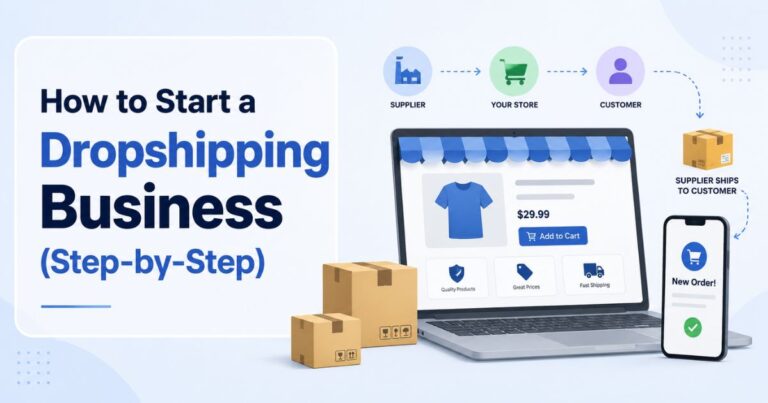
Starting a dropshipping business means picking a niche, finding a supplier who ships directly to customers, building an online store, and driving traffic — you never hold inventory. When a customer buys, you forward the order to your supplier, who ships it to the customer; your profit is the difference between your retail price and the supplier’s cost, minus advertising and fees.
The path is a clear sequence: choose a niche and products with real demand and healthy margins, find and vet reliable suppliers, register your business and get an EIN, build an online store and connect a supplier app, price for ad costs and returns, handle sales tax, drive traffic through ads and marketing, fulfill orders and monitor supplier performance, then cut losers and scale winners. The model’s appeal is the low startup cost and lack of inventory risk; the challenge is that those same low barriers mean heavy competition and thin margins. The 9 steps below cover the whole process in order.
How much does it cost to start a dropshipping business?
Starting a dropshipping business costs about $100–$500 to launch, making it one of the cheapest business models to start. The core costs are an e-commerce platform subscription (commonly $29–$39/month), a domain name (~$10–$20/year), and a few supplier and marketing apps. There’s no inventory to buy upfront, which is the model’s biggest financial advantage.
The catch is that the launch cost isn’t the real cost — advertising is. Because dropshipping products are widely available and easy to copy, most stores depend on paid ads (Meta, TikTok) to drive traffic, and ad spend is where the real budget goes. A realistic first few months often means spending several hundred to a few thousand dollars testing products and ads before finding a winner — and many products never become profitable. Plan on a meaningful ad-testing budget beyond the setup costs, and treat early ad spend as paid research, not guaranteed sales. If you need startup capital, our business loans and financing guide covers options, though most dropshippers bootstrap and reinvest.
Is dropshipping profitable?
Dropshipping can be profitable, but margins are thin — typically 10–30% — because the supplier takes the product cost and advertising eats much of what’s left. Profitability hinges on three things: choosing products with enough markup, pricing to cover ad costs and returns, and acquiring traffic cheaply enough that customer acquisition cost stays below your margin.
Here’s the honest math (illustrative): if you sell a product for $40 that costs $15 from your supplier, your gross margin is $25 — but if it costs you $18 in ads to make that sale, plus payment fees and the occasional refund, your net profit might be just $5–$7. That’s why product selection and ad efficiency matter more than anything else in dropshipping. High-margin, hard-to-find products in a focused niche beat cheap commodity items every buyer can price-compare. The stores that succeed treat it as a marketing-and-testing business (find winning products, kill losers fast, scale winners), not a passive storefront. These margin figures are benchmarks; your actual profit depends heavily on niche, pricing, and how efficiently you can advertise.
Do you need a business license or LLC to dropship?
You don’t need a special license to dropship, but you generally do need business registration, an EIN, and a sales-tax permit — and an LLC is recommended. There’s no “dropshipping license,” but because you’re a retailer, you’re subject to the same registration and tax rules as any online store: register your business, get a free EIN from the IRS, and obtain a sales-tax permit in states where you have nexus.
An LLC isn’t legally required (you can operate as a sole proprietor), but it’s worth it: it separates your personal assets from business liability, which matters when you’re selling physical products that could arrive defective or cause harm. You’ll also want a resale certificate, which lets you buy from suppliers without paying sales tax on goods you’re reselling (you collect it from the end customer instead). Requirements vary by state, so confirm your obligations locally. For the full retail setup, see our guide to running an online store.
How to start a dropshipping business in 9 steps
Here is the complete path from choosing a niche to scaling a profitable store. Each step covers what it is, why it matters, how to do it, and the common mistake to avoid.
Step 1: Choose a niche and products
Choosing a niche means picking a focused product category with genuine demand, healthy margins, and low return risk.
- Why it matters: the niche and products you pick determine your margins and your marketing difficulty — the single biggest predictor of whether a dropshipping store works.
- How to do it: look for products people want but can’t easily find locally, with enough markup to absorb ad costs, and validate demand (search trends, existing ad activity, competitor stores) before building anything.
- Common mistake: selling generic commodity products every store carries, which forces you to compete on price and destroys margins. Avoid fragile, heavy, or high-return items.
Step 2: Find reliable suppliers
Finding reliable suppliers means sourcing partners who ship quality products quickly and consistently.
- Why it matters: your supplier controls the two things that make or break your reputation — product quality and shipping time — even though the customer blames you when something goes wrong.
- How to do it: evaluate supplier marketplaces (overseas options like AliExpress, curated apps, or faster US-based suppliers), and always order samples yourself before selling to check quality and delivery speed.
- Common mistake: choosing the cheapest supplier with three-to-six-week shipping — slow delivery drives refunds, chargebacks, and one-star reviews that sink a new store. US-based or faster-shipping suppliers cost more but reduce this risk.
Step 3: Register your business and get an EIN
Registering your business makes it official and tax-compliant.
- Why it matters: an LLC protects your personal assets from product-liability claims, and an EIN lets you open a business bank account, work with suppliers, and register for sales tax.
- How to do it: register an LLC with your state, get a free EIN from the IRS (never pay a third party for the number itself), open a business bank account, and get a resale certificate for tax-free wholesale purchases.
- Common mistake: running everything through a personal PayPal and bank account, which muddies taxes and undermines liability protection. See our guide to choosing a business structure.
Step 4: Build your online store
Building your store means setting up the e-commerce site customers buy from.
- Why it matters: your store is your brand and your conversion engine — a clean, trustworthy store converts the traffic you pay for, while a sloppy one wastes ad spend.
- How to do it: choose an e-commerce platform (subscriptions commonly run $29–$39/month), pick a clean theme, connect a supplier/automation app to import products and route orders, and set up clear product pages, policies, and checkout.
- Common mistake: cluttering the store with hundreds of products instead of a focused catalog — a tight, well-presented selection converts better and is easier to market.
Step 5: Set your pricing and margins
Setting your pricing means pricing products to stay profitable after ads, fees, and returns.
- Why it matters: dropshipping’s thin margins mean a small pricing mistake turns a winning product into a money-loser once ad costs are included.
- How to do it: price to cover the supplier cost, payment processing, expected ad cost per sale, and a refund buffer — then add your profit; many dropshippers target a 2–3× markup on product cost to leave room for advertising.
- Common mistake: setting razor-thin markups to look competitive, then discovering ads cost more than your margin. Price for the full cost of a sale, not just the product.
Step 6: Handle sales tax and compliance
Handling sales tax means registering for permits and collecting tax where you have nexus.
- Why it matters: as a retailer you’re legally responsible for sales tax, and getting it wrong brings penalties.
- How to do it: you have physical nexus in your home state from day one (register for a sales-tax permit there), and you establish economic nexus in other states once you exceed their threshold (commonly $100,000 in sales or 200 transactions); use your store’s tax tools to track thresholds and collect the right rate. Give suppliers a resale certificate so they don’t charge you tax on goods you resell.
- Common mistake: ignoring sales tax until a state notice arrives. See our small business taxes guide, and confirm rules with each state.
Step 7: Market and drive traffic
Marketing means driving targeted visitors to your store, since a store with no traffic makes no sales.
- Why it matters: traffic is the lifeblood of dropshipping and usually your biggest cost — most stores rely on paid ads to find customers, so your ability to advertise profitably determines whether you survive.
- How to do it: test paid ads (Meta, TikTok) with small budgets to find winning product-audience combinations, layer in influencer partnerships and organic content, and build SEO and email for cheaper long-term traffic.
- Common mistake: scaling ad spend on a product before it’s proven, or relying on a single channel. Test small, kill losers fast, and scale only what’s profitable. See our marketing your business guide.
Step 8: Fulfill orders and manage suppliers
Fulfilling orders means routing purchases to suppliers and monitoring their performance.
- Why it matters: fulfillment is where customer experience is won or lost — late shipments and quality problems generate refunds and reputation damage, even though the supplier is doing the actual shipping.
- How to do it: automate order routing so purchases flow to your supplier automatically, track shipping times and delivery quality, communicate proactively with customers about timelines, and keep backup suppliers for your best products.
- Common mistake: setting fulfillment on autopilot and not noticing a supplier’s quality or shipping times slipping until refunds spike.
Step 9: Optimize and scale
Optimizing means using data to cut what’s failing and scale what’s working.
- Why it matters: dropshipping is a testing business — most products won’t work, and success comes from quickly identifying the few winners and pouring resources into them.
- How to do it: track profit by product and ad campaign, kill unprofitable products and ads fast, scale winning campaigns carefully, and add complementary products or suppliers around proven winners.
- Common mistake: emotional attachment to a product that isn’t converting, or scaling too fast and losing control of ad efficiency. Let the numbers, not hope, drive decisions.
Dropshipping vs holding inventory
The core trade-off between dropshipping and holding your own inventory is upfront risk versus control and margin. Dropshipping needs almost no upfront capital and carries no inventory risk, but you sacrifice margin, control over quality and shipping, and speed. Holding inventory costs money upfront and carries the risk of unsold stock, but gives you better margins, faster shipping, and full control.
| Factor | Dropshipping | Holding Inventory |
|---|---|---|
| Upfront cost | Very low — no inventory to buy | High — buy stock in advance |
| Margins | Thin (10–30%) | Higher — buy wholesale, control pricing |
| Control | Low — supplier handles product & shipping | Full — quality, packaging, speed |
| Shipping speed | Often slow (especially overseas) | Fast — you ship directly |
| Risk | Low financial risk; high reputation risk | Inventory risk (unsold stock) |
| Best for | Testing products with little capital | Proven products; brand building |
The bottom line: dropshipping is the lowest-risk way to test products and learn e-commerce, while holding inventory is how you build a real margin and brand once you know what sells. Many successful stores use dropshipping to validate demand cheaply, then switch winning products to held inventory (or a third-party fulfillment warehouse) to improve margins, shipping speed, and control. Think of dropshipping as a starting point, not necessarily the destination.
Dropshipping vs print-on-demand
Dropshipping and print-on-demand (POD) are both inventory-free models, but they differ in products, branding, and margins. Dropshipping resells existing generic products from suppliers; POD creates custom-printed products (shirts, mugs, posters) with your own designs, made to order. POD offers stronger branding and less direct competition, while general dropshipping offers a wider product range.
| Factor | Dropshipping | Print-on-Demand |
|---|---|---|
| Products | Existing generic products | Custom-designed items made to order |
| Branding | Hard — same products as competitors | Strong — your unique designs |
| Margins | Thin (10–30%) | Moderate — design adds value |
| Competition | High — easy to copy | Lower — designs are differentiated |
| Fulfillment | Supplier ships existing stock | Item printed & shipped on order |
| Best for | Trending/practical products | Design-led, niche, brand-driven stores |
The bottom line: choose dropshipping if you want to sell trending or practical products and compete on marketing and product selection; choose print-on-demand if you have design skills or a brand/audience and want differentiated products that are harder to copy. POD’s built-in differentiation helps with the biggest dropshipping problem — competing against identical stores — but its product range is narrower. Some stores combine both, using POD for branded merchandise alongside dropshipped products.
Is dropshipping still worth it?
Dropshipping is still worth it in 2026, but only with realistic expectations — it’s a competitive, thin-margin business, not passive income. Success now requires a genuine niche, healthy margins, strong marketing, and reliable suppliers; the easy days of selling random cheap products are over. Treat it as a real e-commerce business that takes work and testing, and it can be a viable, low-capital way to start.
Can you start dropshipping with no money?
You can start dropshipping with almost no money using platform free trials and free supplier apps, but you can’t scale without an advertising budget. Traffic is the hard part, and most stores need paid ads to find customers. Starting with organic content (TikTok, SEO) instead of ads is possible but slower. Realistically, budget at least a few hundred dollars for ad testing.
Is dropshipping legal?
Dropshipping is completely legal — it’s a legitimate retail fulfillment model used by businesses of all sizes. You simply have the same obligations as any retailer: collect and remit sales tax where you have nexus, follow FTC advertising and consumer-protection rules, honor your stated shipping and refund policies, and only sell products you’re legally allowed to sell. Using trademarked or counterfeit products, however, is not legal.
Tools and apps for dropshipping
Several categories of tools run a dropshipping store.
- Store platform — the e-commerce platform your store runs on, handling the storefront, cart, and checkout.
- Supplier/automation apps — import products from suppliers and automatically route orders for fulfillment.
- Product research — tools that surface trending products and analyze competitor stores and ads.
- Advertising & analytics — ad platforms (Meta, TikTok) plus profit-tracking tools to see true net margin per product.
- Sales-tax tools — track nexus thresholds by state and calculate the right rate at checkout.
Because dropshipping is really a subset of running an online store, our e-commerce guide covers the broader store-building and operations side in depth.
Starting a dropshipping business in Florida
Starting a dropshipping business in Florida means forming your entity through Sunbiz, registering with the Florida Department of Revenue for sales tax, and benefiting from the state’s lack of a personal income tax. Forming an LLC through Sunbiz costs $125, and Florida’s no personal income tax means more of your store’s profit stays in your pocket than in most states.
Two Florida tax points matter. First, sales tax: as a Florida-based seller you have physical nexus in Florida from day one, so you must register with the Florida Department of Revenue for a sales-tax certificate (registering online is free) and collect Florida’s 6% state sales tax plus any county surtax on taxable orders shipped to Florida customers. Second, economic nexus: Florida requires out-of-state sellers to register once they exceed $100,000 in Florida sales in the prior calendar year — and as a Florida seller, you’ll cross other states’ thresholds (commonly $100,000) as you grow, creating obligations there too. One more thing to watch in 2026: the federal $800 de minimis rule that let low-value imported packages enter duty-free is under review and being tightened, which could raise costs for dropshippers importing from overseas suppliers — verify the current rule before building a business around cheap overseas shipping. Our starting a business in Florida guide covers the entity and registration setup, and confirm current details with FloridaRevenue.com.
Frequently Asked Questions About Dropshipping
Here are quick, sourced answers to the most common questions about dropshipping.
How much does it cost to start dropshipping?
Starting a dropshipping business costs about $100–$500 to launch, covering an e-commerce platform subscription (commonly $29–$39/month), a domain, and a few apps — there’s no inventory to buy. The bigger real cost is advertising: most stores need a few hundred to a few thousand dollars to test products and ads before finding a profitable winner, so budget for ad spend beyond setup.
Is dropshipping profitable in 2026?
Dropshipping can be profitable in 2026 with the right niche, but margins are thin — typically 10–30% — because suppliers take the product cost and advertising consumes much of the rest. Profitability depends on choosing high-margin products, pricing to cover ad costs and returns, and acquiring traffic cheaply. It’s a competitive marketing business, not passive income, and many stores never turn a profit.
Do you need an LLC for dropshipping?
You don’t legally need an LLC to dropship — you can operate as a sole proprietor — but an LLC is recommended. It separates your personal assets from business liability, which matters when selling physical products that could be defective or cause harm, and it adds credibility with suppliers and payment processors. You will need an EIN and a sales-tax permit regardless of structure.
What is the best supplier for dropshipping?
The best dropshipping supplier depends on your niche, but the priorities are consistent: product quality, shipping speed, and reliability. Overseas marketplaces offer the widest selection at the lowest cost but slower shipping; curated apps and US-based suppliers cost more but ship faster and reduce refunds. Always order samples yourself to check quality and delivery time before selling a supplier’s products.
Is dropshipping legal?
Yes, dropshipping is completely legal — it’s a legitimate retail fulfillment model. You have the same obligations as any retailer: collect and remit sales tax where you have nexus, follow FTC advertising and consumer-protection rules, honor your shipping and refund policies, and sell only products you’re authorized to sell. Selling counterfeit or trademarked goods without permission is illegal and a common way dropshippers get into trouble.