Key Takeaways
- Monthly cost: About $3,200/mo for a single adult and $7,800/mo for a working family of four (MIT Living Wage, Leon County, 2026).
- Rent: The HUD FY2026 Fair Market Rent runs $1,097 (studio) to $1,674 (3-bed), with a two-bedroom at $1,352 — among the lowest of any Florida metro.
- Insurance edge: Inland and ~22 miles from the Gulf, Tallahassee has among the lowest homeowners insurance in Florida — commonly $1,400–$1,750/yr, roughly half the state average.
- Taxes: No state income tax; combined sales tax is 7.5% (groceries and prescriptions exempt); Leon’s effective property-tax rate is about 1.2% — higher than coastal metros, but on lower home values.
- Best first step: If you’re a student, state, or university worker, target a sub-median neighborhood and budget for a car — Tallahassee is affordable but spread out.
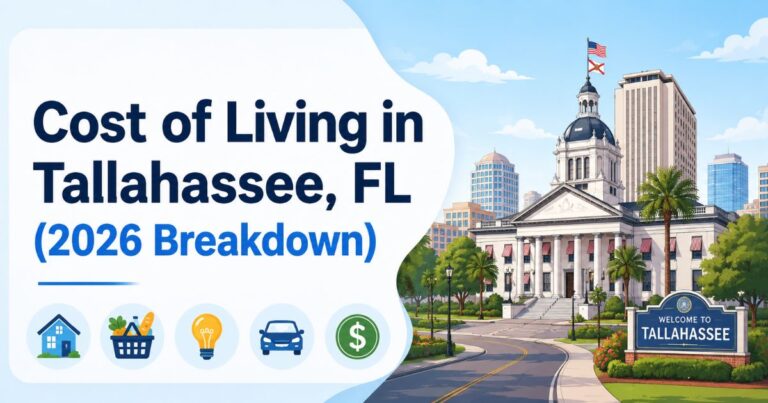
Tallahassee is Florida’s capital and a college town — home to Florida State University, Florida A&M University, and Tallahassee State College — which gives it a younger, more affordable profile than most of the state. Its inland location in the North Florida panhandle, about 22 miles from the Gulf, keeps both housing and home insurance well below coastal Florida. This guide breaks down what it actually costs to live here in 2026 — housing, utilities, groceries, transportation, healthcare, childcare, and taxes — for a single adult and a family of four, then compares Tallahassee with Florida’s other major metros.
If you’re weighing a move tied to work, school, or a new venture, it pairs naturally with our guide to starting a business in Florida and the broader Business & Finance complete guide. The figures below are educational, not financial advice, and cost data changes — confirm current numbers against the primary sources linked throughout before you budget.
Table of Contents
- 1 How much does it cost to live in Tallahassee, Florida?
- 2 What salary do you need to live comfortably in Tallahassee?
- 3 Is Tallahassee, Florida an expensive place to live?
- 4 Is the cost of living in Tallahassee higher than the national average?
- 5 What is the cost of living in Tallahassee by category?
- 5.1 How much does housing cost in Tallahassee? (rent & home prices)
- 5.2 How much are utilities in Tallahassee?
- 5.3 How much do groceries and food cost in Tallahassee?
- 5.4 How much does transportation cost in Tallahassee?
- 5.5 How much does healthcare cost in Tallahassee?
- 5.6 How much is childcare in Tallahassee?
- 6 How much do taxes cost in Tallahassee, Florida?
- 7 What are the cheapest and most expensive neighborhoods in Tallahassee?
- 8 How does Tallahassee’s cost of living compare to other Florida cities?
- 9 How can you lower your cost of living in Tallahassee?
- 10 Is Tallahassee a good place to live and work?
- 11 Frequently Asked Questions About the Cost of Living in Tallahassee
- 11.1 How much money do you need to live comfortably in Tallahassee?
- 11.2 What is the average rent in Tallahassee in 2026?
- 11.3 Is Tallahassee cheaper because of the universities?
- 11.4 Does living in Tallahassee cost less than coastal Florida?
- 11.5 Is Tallahassee a good place to live for state and university workers?
How much does it cost to live in Tallahassee, Florida?
Living in Tallahassee costs a single adult about $3,200 per month, or roughly $38,700 a year after tax, to cover housing, food, transportation, healthcare, and other basics, according to the MIT Living Wage Calculator for Leon County. A working family of four needs closer to $7,800 a month (about $94,000 after tax), with childcare the single largest add-on. Those totals run below most large Florida metros, driven by Tallahassee’s cheap housing and low insurance.
Here is roughly how a single adult’s monthly budget breaks down using MIT Living Wage figures for Leon County: about $1,170 for housing, $385 for food, $655 for transportation, $305 for healthcare, and the remainder for utilities, phone, internet, and other necessities. For a family of four with two working parents, housing rises to roughly $1,445, food to about $1,120, and childcare can add $790–$1,250 per child. The numbers below come from HUD, the MIT Living Wage Calculator, City of Tallahassee Utilities, and the Florida Department of Revenue rather than crowd-sourced sites, so treat them as planning benchmarks and confirm your own quotes.
What salary do you need to live comfortably in Tallahassee?
A single adult needs about $45,000 a year before tax to cover basic costs in Tallahassee and roughly $50,000–$55,000 to live comfortably with savings and a cushion, based on MIT Living Wage data for Leon County. A working family of four needs around $103,500 combined for the basics — or about $80,600 if one parent stays home — and closer to $108,000–$118,000 to be comfortable. Florida’s lack of a state income tax stretches every one of those dollars further than the same salary elsewhere.
The quickest sanity check is the 30% rule: spend no more than 30% of gross income on housing. At Tallahassee’s median two-bedroom rent of $1,352 ($16,224 a year), you’d want a gross income of about $54,000 to keep rent comfortably under that line — or split it with a partner or roommate, which is common in this student-heavy market. A useful companion framework is the 50/30/20 budget: 50% of take-home for needs, 30% for wants, 20% for savings and debt payoff. Want to map your own numbers? Our guide on how to build a monthly budget walks through both methods step by step.
Because Florida has no state income tax, take-home pay is noticeably higher than an identical salary in a state with a 5%+ income tax. On a $50,000 salary, that difference is often $2,000–$3,000 a year more in your pocket.
Is Tallahassee, Florida an expensive place to live?
No — Tallahassee is among Florida’s more affordable metros, especially on housing and insurance. Its median two-bedroom rent ($1,352) and typical home value (about $281,000) are the lowest of Florida’s major metropolitan areas, and its inland location gives it the cheapest home insurance of any major Florida city. The one wrinkle is the student rental market: with tens of thousands of FSU, FAMU, and Tallahassee State College students, demand near campus is seasonal and competitive, spiking each August even as the city’s overall housing stays cheap.
Where Tallahassee is not the cheapest is property taxes. Leon County’s effective property-tax rate runs about 1.2% of market value — higher than coastal metros like Jacksonville — though lower home prices keep the typical annual bill (around $2,524) moderate. Auto insurance is also high, as it is everywhere in Florida. On balance, though, Tallahassee’s cost of living lands below both the Florida and national averages.
Is the cost of living in Tallahassee higher than the national average?
Tallahassee’s overall cost of living sits below the U.S. average of 100, with housing well below the national benchmark. The typical Tallahassee home value of about $281,000 is roughly 24% under the U.S. figure of about $370,000, and the median sale price runs around a third below the national median. Housing is what pulls the city’s composite index down.
The biggest cost advantage is insurance. Tallahassee is inland in the North Florida panhandle, about 22 miles from the Gulf, with no storm-surge exposure — so homeowners insurance is meaningfully lower than coastal Florida, commonly $1,400–$1,750 a year versus a statewide average well over $2,500. That said, inland hurricanes still bring high winds and tree-fall risk (Tallahassee took direct hits from Hurricane Hermine in 2016 and felt Hurricane Michael in 2018), and homes in low-lying or flood-zone areas need separate flood insurance.
What is the cost of living in Tallahassee by category?
Tallahassee’s cost of living breaks down across seven core categories — housing, utilities, groceries, transportation, healthcare, childcare, and taxes. The table below shows typical monthly costs for a single adult and a working family of four, drawn from the MIT Living Wage Calculator for Leon County, HUD Fair Market Rents, and City of Tallahassee Utilities data. Treat these as benchmarks; your own costs depend on neighborhood, home age, and lifestyle.
| Category | Single adult ($/mo) | Family of 4 ($/mo) | vs. U.S. average |
|---|---|---|---|
| Housing (rent) | ~$1,100–$1,200 (studio/1BR) | ~$1,350–$1,675 (2–3BR) | Well below |
| Utilities (electric, water, trash, internet) | ~$260–$320 | ~$330–$400 | Below |
| Groceries / food at home | ~$385 | ~$1,120 | About average |
| Transportation | ~$655 | ~$1,095 | Above (high auto insurance) |
| Healthcare | ~$305 | ~$1,160 | About average |
| Childcare | $0 | ~$790–$1,250 per child (infant) | Above |
| Taxes | No state income tax; 7.5% combined sales tax; ~1.2% effective property tax | Mixed | |
| All-in monthly (after tax) | ~$3,200 | ~$7,800 | Below average |
How much does housing cost in Tallahassee? (rent & home prices)
Housing is Tallahassee’s biggest affordability advantage. The HUD FY2026 Fair Market Rent for the Tallahassee metro (which covers Gadsden, Jefferson, and Leon counties) is $1,097 for a studio, $1,204 for a one-bedroom, $1,352 for a two-bedroom, $1,674 for a three-bedroom, and $1,790 for a four-bedroom. To buy, the typical Tallahassee home value is about $281,000 (Zillow), with the median sale price near $290,000 (Redfin) in early 2026 — roughly a third below the national median.
Prices vary by area and by the student housing cycle. The large supply of multi-bedroom student rentals near FSU and FAMU actually helps keep per-bedroom costs down, though leases near campus turn over on an August academic cycle, so timing matters. West Tallahassee (near the universities) and the south side offer the most affordable homes — often in the $200,000s — while East Tallahassee neighborhoods like Killearn and the 32312 ZIP run higher, with median values in the $350,000–$440,000 range. One genuine Florida bonus: because the city sits inland with no storm surge, homeowners insurance is among the lowest in the state. (Home-price figures are market data from Zillow and Redfin, not a primary government source, so confirm current listings.)
How much are utilities in Tallahassee?
Utilities in Tallahassee for a one- or two-person household typically run $260–$320 a month all in, and the city runs cheaper than most of Florida. Electricity, water, sewer, gas, and trash all come from City of Tallahassee Utilities, a municipal (nonprofit) provider whose average residential electric bill — around $128–$135 — beats both the state’s municipal and investor-owned averages. The electricity rate (about 13–14¢/kWh) is below the Florida and national average.
On top of electric, budget about $70–$100 a month for City of Tallahassee water, sewer, and trash combined, plus roughly $60–$75 for home internet. As everywhere in Florida, summer air-conditioning is the swing factor — bills peak in August — so set a year-round average rather than budgeting off a mild month. A handy local perk: City of Tallahassee customers can look up the actual 13-month utility history for any address before renting or buying.
How much do groceries and food cost in Tallahassee?
Groceries in Tallahassee cost a single adult about $385 a month and a family of four roughly $1,120 a month for food at home, close to regional U.S. averages, per MIT Living Wage data for Leon County. A meaningful Florida perk: the state exempts unprepared groceries and prescription medications from sales tax, so your supermarket receipt isn’t padded by the 7.5% rate that applies to most other goods.
Dining out adds up on top of that — a casual meal runs roughly $14–$20 and a mid-range dinner for two $55–$85 before tip — and a college town like Tallahassee has plenty of budget-friendly options, so households that eat out often should budget that line separately.
How much does transportation cost in Tallahassee?
Transportation is one area where Tallahassee costs more than the national average, mostly because the city is car-dependent and Florida auto insurance is expensive. A single adult should budget about $655 a month for car ownership — payment, fuel, maintenance, and insurance — and a family closer to $1,095. Full-coverage auto insurance in Florida averages roughly $3,000–$4,100 a year (about $250–$340 a month), among the highest in the country, driven by the state’s no-fault system and high accident rates.
Public transit is more useful here than in many Florida cities, but mainly for students. StarMetro, the city bus system, plus the FSU and FAMU campus shuttles cover the university core well, so students living near campus can often get by without a car. Off-campus, in a spread-out city, most residents need a vehicle for work and errands.
How much does healthcare cost in Tallahassee?
Healthcare in Tallahassee costs a single adult roughly $305 a month and a family of four about $1,160 a month in typical out-of-pocket and premium spending, close to national norms, per MIT Living Wage estimates for Leon County. Actual cost depends heavily on whether coverage comes through an employer, the ACA marketplace, or a public program, and on age and health status.
On access, Tallahassee is the medical hub for the entire North Florida–South Georgia region. The major systems are Tallahassee Memorial HealthCare (TMH) — which, after a 2026 agreement, is now affiliated with and owned by Florida State University, integrating it with FSU’s academic medicine — and HCA Florida Capital Hospital. That regional draw is a quality-of-life and employment plus, though it doesn’t by itself lower what an individual pays for coverage.
How much is childcare in Tallahassee?
Childcare is the single biggest swing in a Tallahassee family budget. Full-time infant and toddler daycare at a licensed center typically runs $790–$1,250 a month in the Tallahassee area (roughly $9,500–$15,000 a year), with infant care at the top of that range because of stricter caregiver ratios. For two young children, that can rival a mortgage payment — which is why childcare flips a family’s monthly total well above a single adult’s.
Florida offers real relief at age four: the Voluntary Prekindergarten (VPK) program provides free pre-K for every 4-year-old (540 instructional hours in the school-year option), regardless of income. Lower-income working families may also qualify for the School Readiness subsidy through the local Early Learning Coalition of the Big Bend. (Childcare prices vary by provider — confirm current tuition directly, and flag this as a VERIFY line in your own budget.)
How much do taxes cost in Tallahassee, Florida?
Florida has no state income tax, so the main taxes Tallahassee residents pay are sales tax and property tax. The combined sales tax in Tallahassee (Leon County) is 7.5% — the 6% Florida state rate plus a 1.5% county discretionary surtax — and that surtax applies only to the first $5,000 of any single item, so big-ticket purchases are effectively capped. Unprepared groceries and prescriptions are exempt. For a full breakdown of how the surtax works for sellers, see our Florida sales tax guide for businesses.
On property, Leon County’s effective property-tax rate runs about 1.2% of market value — above the Florida median (≈1.1%) and the national median (≈1.0%), and notably higher than coastal Jacksonville. The saving grace is low home values: the median Tallahassee tax bill is about $2,524 a year, only modestly above the national median. Two breaks soften it. The Homestead Exemption removes up to $50,000 of assessed value for a primary residence (the first $25,000 applies to all taxes; the next $25,000 to non-school taxes). The Save Our Homes cap then limits annual increases in your home’s assessed value to 3% or the change in CPI, whichever is lower. Rates also vary widely by ZIP within the city, so confirm your specific parcel with the Leon County Property Appraiser, and file the Homestead Exemption by March 1.
One forward-looking note: a measure on Florida’s November 2026 ballot would raise the homestead exemption on non-school taxes substantially (phasing toward $250,000) — it is not law yet and needs 60% voter approval, so budget on today’s rules and treat any savings as upside.
What are the cheapest and most expensive neighborhoods in Tallahassee?
Tallahassee’s neighborhoods split fairly cleanly between the student-oriented and budget areas to the west and south, and the established, higher-priced areas to the north and east. The most affordable rentals cluster near FSU and FAMU (shared student housing keeps per-bedroom costs down) and in areas like Apalachee Ridge and parts of Frenchtown. The premium areas are Myers Park, Midtown, Killearn Estates, and SouthWood (a master-planned community on the southeast side).
| Neighborhood | Approx. 1BR rent | Typical home price | Character & commute |
|---|---|---|---|
| Near FSU/FAMU | ~$900–$1,250 | $200,000s (often student rentals) | Walkable to campus; seasonal, competitive leasing |
| Apalachee Ridge / Southside | ~$950–$1,200 | $180,000s–$250,000s | Most affordable; quick to downtown & capital |
| Midtown | ~$1,200–$1,550 | $300,000s–$450,000s | Walkable, dining; central, popular with professionals |
| Myers Park | ~$1,250–$1,600 | $350,000s+ | Historic, near downtown; short commute |
| Killearn Estates | ~$1,300–$1,650 | $350,000–$440,000+ | Established NE suburb, top schools; 15–20 min to downtown |
| SouthWood | ~$1,400–$1,750 | $400,000s+ | Planned community SE; near state office complexes |
Neighborhood rent and price ranges above are illustrative market estimates, not a primary source — verify current listings before committing. If you’re comparing Tallahassee against elsewhere in the state, the sibling guides for Jacksonville, Orlando, and Tampa use the same framework.
How does Tallahassee’s cost of living compare to other Florida cities?
Tallahassee is one of the cheapest major metros to live in across Florida, leading on rent, home price, and home insurance. Its only cost disadvantages are a higher effective property-tax rate and a job market concentrated in government and education rather than a broad private sector. The trade-off for the low cost is a smaller, more specialized economy than Jacksonville, Orlando, or Tampa.
| Metric (2026) | Tallahassee | Jacksonville | Orlando | Tampa |
|---|---|---|---|---|
| Median 2BR rent (HUD FMR) | $1,352 | $1,658 | $1,972 | $1,977 |
| Typical home value (Zillow) | ~$281,000 | ~$296,000 | ~$376,000 | ~$376,000 |
| Combined sales tax | 7.5% | 7.5% | 6.5% | 7.5% |
| Homeowners insurance | Lowest (inland) | Moderate | Moderate | Higher (Gulf surge) |
| Effective property tax | ~1.2% | ~0.77% | ~0.95% | ~0.9% |
| Overall affordability | Most affordable | Affordable | Mid | Mid |
One honest caveat: Tallahassee isn’t the cheapest on every line. Orlando’s combined sales tax (6.5%) is a point lower than Tallahassee’s 7.5%, and Jacksonville’s effective property-tax rate (~0.77%) is well below Leon County’s ~1.2%. But housing and insurance are the two largest items in most budgets, and Tallahassee wins on both.
Tallahassee vs Jacksonville: which is cheaper to live in?
Tallahassee is cheaper to live in than Jacksonville, mostly on rent and insurance. Tallahassee’s median two-bedroom rent of $1,352 runs about $306 a month (≈$3,670 a year) below Jacksonville’s $1,658, typical home values are roughly $15,000 lower, and inland Tallahassee’s home insurance is lower than Jacksonville’s. Jacksonville pushes back with a lower effective property-tax rate (~0.77% vs. ~1.2%) and a larger, more diverse job market. See the full cost of living in Jacksonville breakdown.
Tallahassee vs Orlando: which is cheaper to live in?
Tallahassee is significantly cheaper to live in than Orlando. Its two-bedroom FMR of $1,352 sits about $620 a month (≈$7,440 a year) below Orlando’s $1,972, and typical home values are roughly $95,000 lower (~$281,000 vs. ~$376,000). Tallahassee’s inland home insurance is also far below Orlando’s. Orlando claws back a little on sales tax (6.5% vs. 7.5%) and offers a much larger job market, but on cost of living Tallahassee wins clearly. Compare the full cost of living in Orlando guide.
Tallahassee vs Tampa: which is cheaper to live in?
Tallahassee is much cheaper to live in than Tampa. Its two-bedroom FMR of $1,352 is about $625 a month below Tampa’s $1,977, and typical home values are roughly $95,000 lower. The two share the same 7.5% combined sales tax, but Tampa Bay’s Gulf-facing storm-surge exposure makes its home insurance far more expensive than inland Tallahassee’s. Tampa’s advantage is a larger, more diverse private-sector economy. See the full cost of living in Tampa guide.
Is Tallahassee cheaper than Orlando?
Yes, Tallahassee is cheaper than Orlando. A two-bedroom rents for about $620 less per month ($1,352 vs. $1,972), typical home values run roughly $95,000 lower, and inland Tallahassee’s home insurance is far below Orlando’s. Orlando’s sales tax is one point lower (6.5% vs. 7.5%), but housing and insurance make Tallahassee the cheaper city overall.
Is Tallahassee an affordable place to live?
Yes, Tallahassee is an affordable place to live, especially versus coastal Florida. It has the lowest major-metro rent in the state (a two-bedroom around $1,352), the lowest home insurance thanks to its inland location, and no state income tax. The main offsets are a higher effective property-tax rate (~1.2%) and Florida’s high auto insurance.
Can you live in Tallahassee on $40,000 a year?
Yes, a single adult can live in Tallahassee on $40,000 a year, though it’s modest. With no state income tax, $40,000 yields roughly $2,800 a month take-home — enough to cover a studio or one-bedroom (around $1,097–$1,204) plus essentials, especially in the budget-friendly student rental market. MIT’s basic budget for one adult is about $45,000, so a roommate or sub-median area makes $40,000 comfortable.
Is $50,000 a good salary in Tallahassee?
Yes, $50,000 is a good salary for a single person or couple in Tallahassee. Florida’s lack of a state income tax leaves roughly $42,000 in take-home (about $3,500 a month), comfortably above the ~$45,000 a single adult needs for basics. It covers a one- or two-bedroom with room for savings, though a family of four would find it stretched.
Do you need a car in Tallahassee?
Mostly yes — you need a car in Tallahassee unless you live and study near campus. StarMetro buses and the FSU and FAMU campus shuttles cover the university core well, so many students manage without a car. Off-campus, the city is spread out, so most working residents need a vehicle for commuting and errands.
How can you lower your cost of living in Tallahassee?
Lowering your cost of living in Tallahassee comes down to neighborhood choice, claiming tax breaks, and smart energy habits — housing is already cheap, so the wins compound. Because rentals near campus turn over on a seasonal cycle, timing your lease also matters.
- Target sub-median neighborhoods. Areas near the universities, plus Apalachee Ridge and the south side, offer the lowest rents and home prices — often $200–$400 a month less than Midtown or the northeast suburbs — while staying close to downtown and the capital complex.
- Claim the Homestead Exemption if you buy. It removes up to $50,000 of assessed value and locks in the 3% Save Our Homes cap — which matters more here given Leon’s higher effective rate. File with the Leon County Property Appraiser by March 1; it’s free and renews automatically.
- Shop home and auto insurance. Tallahassee already has Florida’s lowest home premiums, but quotes still vary by hundreds of dollars; comparing carriers and bundling home + auto routinely saves more. Wind-mitigation features and a newer roof cut premiums further.
- Use the City utility look-up. Before renting or buying, pull the 13-month utility history for the exact address from City of Tallahassee Utilities, and budget a year-round average for summer A/C rather than a winter baseline.
- Lean on transit if you’re near campus. Students and downtown workers can use StarMetro and campus shuttles to drop a car entirely — a major saving given Florida auto insurance.
For a deeper playbook, see our guide on practical ways to save money, and if you’re opening or moving accounts, our roundup of the best banks for small business in Florida can help you avoid unnecessary fees.
Is Tallahassee a good place to live and work?
Tallahassee is a stable place to live and work, anchored by recession-resistant government and education jobs and very low living costs. The metro unemployment rate was about 5.0% in early 2026, in line with most of the state. As Florida’s capital, the city’s economy is built on the public sector: government and business/financial-operations roles make up a far larger share of jobs here (around 11% of employment, versus under 7% nationally) than in most metros — stable work, if narrower than a big private-sector city.
The largest employers are the State of Florida (the legislature and state agencies), higher education — Florida State University, Florida A&M University, and Tallahassee State College, plus the joint FAMU-FSU College of Engineering — and healthcare, led by Tallahassee Memorial HealthCare (now owned by FSU) and HCA Florida Capital Hospital. For remote workers and entrepreneurs, the no-income-tax advantage plus rock-bottom housing makes Tallahassee an attractive base; the trade-off is a smaller private job market than Jacksonville or Tampa. See our guide to the best cities to start a business in Florida for how Tallahassee stacks up.
Frequently Asked Questions About the Cost of Living in Tallahassee
Below are common questions people ask about living costs in Tallahassee, with short, current answers.
How much money do you need to live comfortably in Tallahassee?
A single adult needs about $50,000 to $55,000 a year to live comfortably in Tallahassee, above the roughly $45,000 required for bare basics, per MIT Living Wage data for Leon County. A family of four typically needs around $108,000 to $118,000 combined. Florida’s lack of a state income tax raises take-home pay versus most states.
What is the average rent in Tallahassee in 2026?
The average rent in Tallahassee in 2026 runs about $1,097 for a studio, $1,204 for a one-bedroom, and $1,352 for a two-bedroom, per HUD’s FY2026 Fair Market Rents for the Tallahassee metro. Rents near FSU and FAMU swing with the academic calendar, peaking each August as students return for the fall term.
Is Tallahassee cheaper because of the universities?
Tallahassee’s universities help keep rent low by adding a large supply of multi-bedroom student housing, which lowers per-bedroom costs across the market. The flip side is that demand near campus is seasonal and competitive, so rentals close to FSU and FAMU lease up fast each summer and can cost more during the academic year.
Does living in Tallahassee cost less than coastal Florida?
Yes, living in Tallahassee costs less than most coastal Florida. Its inland location, about 22 miles from the Gulf with no storm surge, gives it among the lowest home insurance in the state — commonly $1,400 to $1,750 a year, roughly half the statewide average — plus the lowest major-metro rent and home prices. Auto insurance stays high statewide.
Is Tallahassee a good place to live for state and university workers?
Yes, Tallahassee is well suited to state and university workers. As Florida’s capital and home to FSU, FAMU, and Tallahassee State College, it offers stable public-sector and education employment with strong benefits, paired with the lowest major-metro housing costs in the state and no state income tax — a combination that stretches a government salary further than most Florida cities.