Key Takeaways
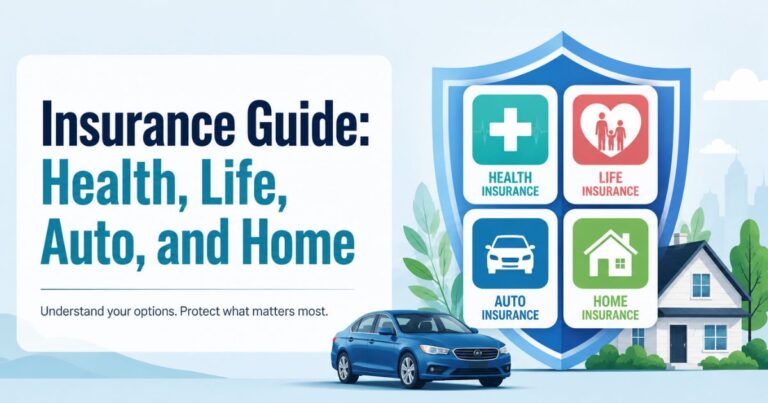
- The essentials: health, auto, home/renters, and life cover the risks that can do the most financial damage; disability and umbrella fill important gaps.
- What’s required: auto liability by state law and homeowners by your mortgage lender; health and life are strongly recommended but not legally mandated.
- 2026 average costs: ~$2,500/yr full-coverage auto, ~$1,950/yr home ($350k dwelling), ~$47/mo term life for a healthy 30-year-old; all vary widely.
- Term beats whole for most: term life costs a fraction of whole life and fits the years your family actually needs coverage.
- Flood is separate: standard home policies exclude flood — a major issue in Florida, where auto and home premiums are among the nation’s highest.
- Best first step: list what you must protect (income, health, home, car), then compare quotes from at least three insurers.
Insurance is the financial backstop that keeps a single accident, illness, or disaster from wiping out everything you’ve built. This guide explains what insurance is, how much each type costs in 2026, what you actually need versus what’s optional, the main types with real average figures, and a six-step process to choose coverage wisely. It’s part of our Personal Finance complete guide.
Costs below are 2026 national averages from named sources, not quotes — your premium depends on your age, health, location, coverage, and history. This content is educational, not insurance advice; confirm coverage with a licensed agent before you buy.
Table of Contents
- 1 What is insurance and how does it work?
- 2 How much does insurance cost?
- 3 What types of insurance do you actually need?
- 4 What are the main types of personal insurance?
- 5 Term life vs whole life insurance
- 6 HMO vs PPO health plans
- 7 How to choose the right insurance in 6 steps
- 8 Insurance tools and resources
- 9 Insurance in Florida: auto and home
- 10 Frequently Asked Questions About Insurance
What is insurance and how does it work?
Insurance is a contract that protects you financially from specific risks: you pay a regular premium, and in exchange the insurer covers large, unexpected losses up to your policy’s limits. It works through risk pooling — many people pay premiums, and the pool covers the losses of the unlucky few, so no single household has to absorb a catastrophic cost alone.
Four terms define how any policy works. The premium is what you pay (monthly or annually) to keep coverage active. The deductible is what you pay out of pocket before the insurer starts paying. The coverage limit is the maximum the policy will pay for a covered loss. And a claim is the request you file to be reimbursed after a covered event. Generally, choosing a higher deductible lowers your premium (you’re taking on more risk yourself), and vice versa — a key lever you’ll use to balance cost against protection across every policy you own.
How much does insurance cost?
Insurance costs vary enormously by type, age, location, and coverage, but 2026 national averages give useful benchmarks: full-coverage auto insurance averages roughly $2,300–$2,600 per year; homeowners insurance averages about $1,950 per year for $350,000 in dwelling coverage; marketplace health insurance averages around $600+ per month before subsidies (employer coverage costs the worker far less); and term life insurance runs about $47 per month for a healthy 30-year-old buying $1 million of 20-year coverage.
Every one of these is an average, not a quote — your actual cost swings on specific factors. Auto premiums depend on your driving record, age, vehicle, credit (in most states), and ZIP code; home premiums track your home’s rebuild cost, location, and claims history; life premiums hinge on age, health, and tobacco use; health premiums vary by age, plan tier, and location, with income-based subsidies cutting marketplace costs sharply for many buyers. Because the spread is so wide (auto full coverage ranges from about $1,400 a year in the cheapest states to well over $3,000 in the priciest), the single most valuable habit is comparing quotes from several insurers for identical coverage.
What types of insurance do you actually need?
The insurance you actually need splits into legally or contractually required and strongly recommended. Required: auto liability insurance (mandated by nearly every state to drive legally) and homeowners insurance (required by mortgage lenders as a condition of the loan). Strongly recommended but not legally required: health insurance, life insurance (if anyone depends on your income), renters insurance, and disability insurance.
The honest way to prioritize is by the size of the financial hole each risk could create. Health insurance tops the list for almost everyone, because a serious illness is both common and financially devastating. Auto liability is both legally required and essential. Life insurance is critical if you have dependents or shared debts, and irrelevant if you have neither. Disability insurance is widely overlooked despite protecting your single biggest asset — your ability to earn. Umbrella insurance matters mainly for higher-asset households. Match coverage to your real exposures rather than buying every product a salesperson offers.
What are the main types of personal insurance?
There are six types of personal insurance most households consider. Here’s each one: what it is, what it covers, its typical 2026 cost, and who needs it. (Costs are national averages and move constantly — treat them as benchmarks, not quotes.)
Health insurance
Health insurance covers medical expenses — doctor visits, hospital stays, prescriptions, and preventive care — in exchange for a premium, deductible, and cost-sharing (copays and coinsurance). Most Americans get it through an employer, the ACA Marketplace (HealthCare.gov, where income-based subsidies apply), or Medicare (age 65+). It’s the most important coverage for nearly everyone, because medical costs are the leading cause of personal bankruptcy.
Typical 2026 cost: employer plans cost the average worker roughly $1,400/year for individual coverage (the employer pays most of the true cost); unsubsidized Marketplace plans average $600+/month, but subsidies cut that substantially for many. Who needs it: everyone. If you’re healthy and want lower premiums, a High-Deductible Health Plan (HDHP) paired with a Health Savings Account (HSA) offers a triple tax advantage and doubles as a long-term savings tool — see our retirement planning guide on using an HSA for the long run.
Life insurance
Life insurance pays a tax-free lump sum (the death benefit) to your beneficiaries if you die, replacing your income and covering debts and final expenses. It comes in two main forms: term (coverage for a set period, e.g. 20 years, at low cost) and whole/permanent (lifelong coverage with a cash-value component, at much higher cost). Most families are best served by term.
Typical 2026 cost: a healthy 40-year-old nonsmoker pays roughly $47–$59/month for a $500,000, 20-year term policy; a 30-year-old pays less. Whole life for the same coverage often costs 5–15× more. Who needs it: anyone whose death would leave dependents, a spouse, or co-signers financially strained. A common rule of thumb is coverage of 10–12× your annual income. If no one depends on your income, you likely don’t need it yet.
Auto insurance
Auto insurance covers costs from car accidents and related events, and liability coverage is legally required in almost every state. Policies bundle several coverages: liability (injury and property damage you cause to others), collision (damage to your car in a crash), comprehensive (theft, weather, animals), and uninsured/underinsured motorist (UM/UIM). Some states add PIP or MedPay for your own medical costs.
Typical 2026 cost: the national average is roughly $2,300–$2,600/year for full coverage and about $1,200–$1,600/year for minimum/liability-only, with enormous state variation (Florida is among the most expensive). Who needs it: every driver, by law — and if you finance or lease, your lender requires full coverage (collision + comprehensive). See our loans guide on why financed vehicles must carry it, and the Florida section below for state specifics.
Homeowners and renters insurance
Homeowners insurance protects your home and belongings against covered perils (fire, storms, theft) and includes liability coverage if someone is injured on your property; it typically has four parts — dwelling, personal property, liability, and additional living expenses. Renters insurance covers your belongings and liability (not the building) at a fraction of the cost. Mortgage lenders require homeowners coverage.
Typical 2026 cost: homeowners insurance averages about $1,950/year for $350,000 in dwelling coverage nationally (far higher in disaster-prone states); renters insurance often runs $15–$25/month. Critical gap: standard policies exclude flood damage, which requires a separate policy through the NFIP or a private insurer — a major issue in Florida. Who needs it: all homeowners (required by lenders) and all renters (cheap and well worth it).
Disability insurance
Disability insurance replaces a portion of your income if illness or injury prevents you from working — protecting your single largest financial asset, your earning power. It comes as short-term (weeks to months) and long-term (years to retirement age) coverage, often offered through employers, and typically replaces around 40–70% of income.
Typical 2026 cost: long-term disability generally runs 1–3% of your annual salary, varying by occupation, benefit period, and elimination period. Who needs it: anyone who relies on their income to pay the bills — which is most working people. It’s one of the most overlooked coverages despite the fact that a disabling injury or illness is more likely during your working years than an early death, making it a serious gap for many households.
Umbrella insurance
Umbrella insurance provides extra liability coverage above the limits of your auto and homeowners policies, kicking in when a large claim or lawsuit exceeds those underlying limits. It covers costs like legal judgments that could otherwise reach your savings and assets, usually in increments of $1 million.
Typical 2026 cost: often just $150–$300/year for $1 million in coverage, because it only pays after your primary policies are exhausted. Who needs it: higher-asset households, landlords, and anyone with enough net worth to be worth suing — the rule of thumb is to carry umbrella coverage at least equal to your net worth. For most middle-income households with modest assets, maxing out the liability limits on auto and home first is the higher priority.
Term life vs whole life insurance
The core choice in life insurance is term versus whole (permanent). Term life covers you for a set period at low cost and pays only if you die during the term; whole life covers you for life, costs far more, and builds cash value you can borrow against. For most families, term provides the right protection at a fraction of the price.
| Factor | Term Life | Whole Life |
|---|---|---|
| Coverage length | Set term (10–30 years) | Lifetime |
| Cost | Low (~$47/mo for a healthy 30-something, $500k) | High (often 5–15× more) |
| Cash value | None | Builds cash value over time |
| Premium | Level for the term, then expires | Level for life |
| Best for | Most families — income replacement during working/child-raising years | Lifelong needs, estate planning, or specific tax situations |
The bottom line: buy term and invest the difference is sound advice for most people — cover the years your dependents actually need your income, and use the money you’d have spent on whole-life premiums to build wealth elsewhere. Whole life makes sense for narrower situations: lifelong dependents (such as a child with special needs), estate-tax planning, or business-succession needs. If someone pushes whole life as an investment, get a second, unbiased opinion first.
HMO vs PPO health plans
The two most common health-plan structures are HMO and PPO, and they differ mainly in network flexibility and cost. An HMO (Health Maintenance Organization) keeps costs lower by requiring you to stay in-network and get referrals from a primary care physician; a PPO (Preferred Provider Organization) costs more but lets you see any provider, in or out of network, without referrals.
| Factor | HMO | PPO |
|---|---|---|
| Network | In-network only (except emergencies) | In- and out-of-network |
| Referrals | Required to see specialists | Not required |
| Cost | Lower premiums and out-of-pocket | Higher premiums and out-of-pocket |
| Primary care physician | Required | Optional |
| Best for | Lower cost, don’t mind network limits | Flexibility and specialist access |
The bottom line: choose an HMO if keeping premiums low matters most and your preferred doctors are in-network; choose a PPO if you want the freedom to see any provider or specialist without referrals and will pay more for it. Check that your current doctors and any needed specialists are in a plan’s network before enrolling, and weigh the premium difference against how often you actually use out-of-network care.
How to choose the right insurance in 6 steps
Choosing insurance well is a repeatable process. Here are the six steps from assessing your risks to reviewing coverage each year — with what to do, why it matters, and the mistake to avoid.
Step 1: Assess your risks and needs
Assessing your risks means listing what you need to protect: your health, your income, your home, your car, and anyone who depends on you. Why it matters: your risk profile determines which coverages you actually need, so you don’t overpay for the wrong ones or leave a dangerous gap. How to do it: map your assets and obligations (dependents, debts, property) to the risks that threaten them. Common mistake: insuring small, affordable risks (like extended warranties) while under-insuring the catastrophic ones (health, disability, liability) that could actually bankrupt you.
Step 2: Understand coverage types and limits
Understanding coverage means learning what each policy’s deductibles, limits, and exclusions actually mean before you buy. Why it matters: the cheapest policy is worthless if its limits are too low or it excludes your biggest risk (like flood). How to do it: for each policy, note the deductible, the coverage limit, and the key exclusions; make sure limits are high enough to cover a realistic worst case. Common mistake: choosing a policy on premium alone and discovering after a loss that the limit doesn’t cover the damage or that a critical peril was excluded.
Step 3: Compare quotes from multiple insurers
Comparing quotes means getting prices for identical coverage from at least three insurers, because rates for the same driver or home vary widely between companies. Why it matters: shopping around is the single most effective way to lower your premium — the same coverage can differ by hundreds of dollars a year. How to do it: request quotes directly from several insurers or work with an independent agent who represents multiple carriers; compare identical coverage levels, not just headline prices. Common mistake: auto-renewing year after year without re-shopping, which is how loyal customers quietly end up overpaying.
Step 4: Check the insurer’s financial strength and reviews
Checking financial strength means confirming the insurer can actually pay claims, using independent ratings and complaint records. Why it matters: a cheap policy from a weak or poorly-rated insurer is a false economy if they’re slow to pay or dispute valid claims. How to do it: check the insurer’s AM Best financial-strength rating and review complaint data through the NAIC (National Association of Insurance Commissioners) consumer tools and your state insurance department. Common mistake: picking purely on price without checking whether the company has a solid record of paying claims fairly and promptly.
Step 5: Bundle and look for discounts
Bundling means buying multiple policies from one insurer to earn a multi-policy discount, alongside other available discounts. Why it matters: bundling home and auto typically saves 10–25%, and other discounts (safe driver, security systems, paperless, paying annually) add up. How to do it: ask each insurer for every discount you might qualify for and compare the bundled price against buying separately — bundling usually wins but not always. Common mistake: assuming bundling is always cheapest without checking; occasionally two separate best-in-class policies beat one bundle.
Step 6: Review your coverage annually
Reviewing annually means re-checking your coverage and re-shopping rates each year as your life changes. Why it matters: marriage, a new home, a new car, a baby, or a big change in assets all shift what you need — and insurers raise rates over time, so last year’s best deal may not be this year’s. How to do it: at renewal, update your coverage for life changes and get fresh quotes to confirm you’re still competitive. Common mistake: setting policies on autopilot for years, leaving you both overpaying and under-covered for your current life.
Is life insurance worth it?
Life insurance is worth it if other people depend on your income or share your debts — it replaces your earnings and covers obligations so your family isn’t left financially stranded. For a single person with no dependents and no co-signed debt, it’s usually unnecessary. Term life is inexpensive for healthy young adults, so if you have or plan to have dependents, buying early locks in low rates.
How much life insurance do you need?
A common rule of thumb is coverage worth 10–12 times your annual income, adjusted for your specific obligations. Add up what your family would need — income replacement for the years they’d rely on you, remaining mortgage and debts, future costs like college, and final expenses — then subtract existing savings and coverage. A 20- or 30-year term policy usually matches the years dependents actually need protection.
Do you need renters insurance?
Renters insurance is strongly recommended for anyone who rents, because your landlord’s policy covers the building, not your belongings or liability. For roughly $15–$25 a month, it replaces your possessions after theft, fire, or certain disasters, and covers you if someone is injured in your unit or you accidentally damage others’ property. Many landlords now require it, and it’s one of the best values in insurance.
Insurance tools and resources
A few free, unbiased tools help you compare coverage and buy wisely — no referrals needed, just resources.
- Coverage calculators — life-insurance-needs and home-replacement-cost calculators help you size coverage accurately before you shop, so you neither over- nor under-insure.
- Financial-strength ratings — check an insurer’s AM Best rating to confirm it can pay claims; look up complaint records through the NAIC and your state department of insurance.
- Consumer resources — the Insurance Information Institute (III) publishes free, neutral explainers on every coverage type, and HealthCare.gov handles Marketplace health plans and subsidy eligibility.
- Flood-risk lookup — FEMA’s flood map service shows whether your address is in a flood zone, which standard home policies don’t cover.
If you’re self-employed or run a small business, personal policies won’t cover business risks — see our guide to business insurance types and costs for the coverage a company needs.
Insurance in Florida: auto and home
Florida is one of the most expensive states in the country for both auto and home insurance, driven by hurricane risk, litigation, and past insurer withdrawals. On the auto side, Florida remains a no-fault state: as of the 2026 legislative session, the law still requires $10,000 in Personal Injury Protection (PIP) plus $10,000 in Property Damage Liability (PDL) under Fla. Stat. §627.736, and bodily injury liability is not required for most drivers. Florida’s average auto premium is the highest in the nation.
An important correction, because it’s widely reported wrong: several bills proposed repealing PIP as of July 1, 2026 and replacing it with mandatory bodily injury liability ($25,000/$50,000) plus MedPay — but those bills did not become law (the most recent died in committee before the session ended in March 2026). Until a repeal is actually signed, PIP remains mandatory; dropping it would leave you illegally uninsured. Because this is genuinely in flux, verify the current requirement with the Florida Highway Safety and Motor Vehicles (FLHSMV) before making changes.
On the home side, Florida’s premiums are among the nation’s highest because of windstorm and hurricane exposure, and flood is excluded from standard policies (you need separate NFIP or private flood coverage — critical given how much of the state sits in a flood zone). Many homeowners rely on Citizens Property Insurance, the state-backed insurer of last resort, after private carriers pulled back. These costs materially affect housing affordability — see our cost of living in Orlando breakdown for how insurance factors into a real Florida budget, and confirm current specifics with licensed Florida agents.
Frequently Asked Questions About Insurance
Here are quick, sourced answers to the most common questions about insurance.
What are the main types of insurance?
The main types of personal insurance are health, life, auto, and homeowners or renters insurance, plus disability and umbrella coverage. Health covers medical costs, life replaces income for dependents, auto covers accidents (liability is legally required), and home/renters protects property and liability. Disability protects your income if you can’t work, and umbrella adds extra liability coverage above your other policies.
How much car insurance do I need in Florida?
As of 2026, Florida drivers must carry at least $10,000 in Personal Injury Protection (PIP) and $10,000 in Property Damage Liability (PDL) under state no-fault law. Bodily injury liability is not required for most drivers, though it’s strongly recommended since minimums rarely cover a serious crash. Proposed 2026 changes to this system were not enacted — confirm current requirements with FLHSMV.
Is term or whole life insurance better?
Term life insurance is better for most people: it costs far less and covers the specific years your dependents need your income. Whole life costs 5–15 times more but provides lifelong coverage and builds cash value, making it suitable for narrower needs like estate planning or a lifelong dependent. A common approach is to buy term and invest the savings elsewhere.
Does homeowners insurance cover floods?
No — standard homeowners insurance does not cover flood damage. Flood coverage requires a separate policy through the National Flood Insurance Program (NFIP) or a private flood insurer. This gap is especially important in flood-prone states like Florida, where much of the state sits in a flood zone and a standard policy alone would leave a homeowner exposed to major storm losses.
To lower insurance premiums: bundle multiple policies with one insurer (saving 10–25%), raise your deductibles if you have savings to cover them, shop and compare quotes from at least three insurers annually, and ask about every available discount (safe driver, security systems, paperless, paying annually). Maintaining good credit, where allowed, and a clean claims history also keeps premiums down over time.