Key Takeaways
- Cost to form: $425 — three mandatory bundled filings: Articles of Organization ($75) + Initial List ($150) + State Business License ($200). The “$75 to form” figure many sites quote is misleading.
- Ongoing cost: $350/year — Annual List ($150) + State Business License renewal ($200), due by the last day of your anniversary month.
- No state income tax: Nevada has no personal or corporate income tax (constitutionally protected) and no franchise tax — its main draw.
- Strong privacy: Nevada allows members/managers to keep ownership relatively private and has strong asset-protection law — the other main draw.
- The trap for non-residents: if you live and operate elsewhere, you’ll register Nevada as a foreign LLC and pay your home state — doubling costs for no benefit.
- Fast filing: SilverFlume online filings are typically processed within about one business day.
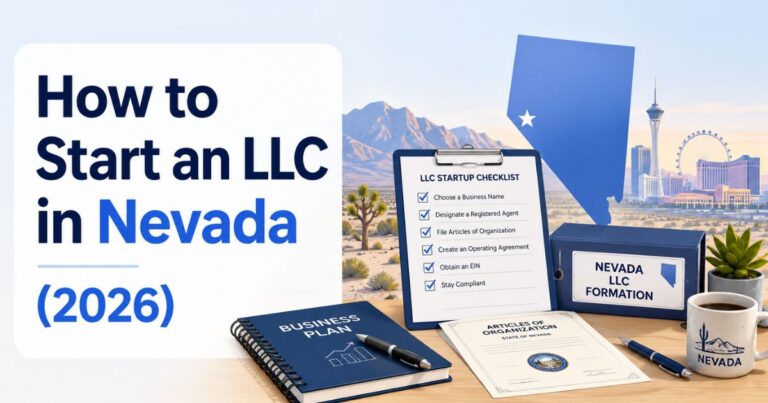
- Best first step: confirm you actually do business in Nevada before forming here; if you do, file all three documents together on SilverFlume.
Nevada has a reputation as a business haven — no income tax, strong privacy, robust asset protection — and for the right business it genuinely delivers. But that reputation hides two things most guides underplay: Nevada is one of the most expensive states to form and maintain an LLC, and for anyone who actually lives and works in another state, forming here usually backfires. This guide covers the real all-in cost, the three bundled filings, the timeline, the annual requirements, the seven filing steps, how a Nevada LLC is taxed, and how Nevada compares to sole proprietorships, Delaware, and Florida.
Everything below is verified against the Nevada Secretary of State and Department of Taxation, but fees and rates change. This is educational, not legal or tax advice — confirm current figures with the Secretary of State before you file, and talk to a CPA or attorney about your specific situation. It’s part of our broader guide to LLC vs S-corp vs sole proprietorship.
Table of Contents
- 1 How do you start an LLC in Nevada?
- 2 How much does it cost to start an LLC in Nevada?
- 3 How long does it take to form an LLC in Nevada?
- 4 What are the annual requirements for a Nevada LLC?
- 5 How to start an LLC in Nevada in 7 steps
- 5.1 Step 1: Choose a Nevada LLC name
- 5.2 Step 2: Appoint a registered agent
- 5.3 Step 3: File the three formation documents together
- 5.4 Step 4: Create an operating agreement
- 5.5 Step 5: Get an EIN from the IRS
- 5.6 Step 6: Register for Nevada state taxes and licenses
- 5.7 Step 7: Open a business bank account and stay compliant
- 6 The three bundled formation fees (and the annual business license)
- 7 How is a Nevada LLC taxed?
- 8 LLC vs sole proprietorship in Nevada
- 9 Nevada LLC vs forming in Delaware or Wyoming
- 10 LLC formation services for Nevada
- 11 Nevada LLC vs Florida LLC: a cost comparison
- 12 Frequently Asked Questions About Starting an LLC in Nevada
How do you start an LLC in Nevada?
Starting an LLC in Nevada means choosing a compliant name, appointing a registered agent with a Nevada street address, and filing three documents together with the Nevada Secretary of State — the Articles of Organization, the Initial List of Managers/Members, and the State Business License application — for a combined $425. Most online filings through the state’s SilverFlume portal are approved within about a business day.
Nevada’s process is genuinely fast and fully online through SilverFlume (nvsilverflume.gov), but it differs from most states in one structural way: you can’t form with a single filing. The Articles, the Initial List, and the State Business License are all mandatory and filed simultaneously, which is why the real entry cost is $425, not the $75 “filing fee” many sites headline. After that, the sequence is the familiar one: operating agreement → EIN → any sales/employer tax registration → business bank account. The single most important thing to get right before you start, though, isn’t a form — it’s the decision of whether to form in Nevada at all, which depends entirely on where you actually do business (covered below).
How much does it cost to start an LLC in Nevada?
Starting an LLC in Nevada costs $425, combining three mandatory, simultaneously-filed documents: the Articles of Organization ($75), the Initial List of Managers/Members ($150), and the State Business License ($200). You cannot form a Nevada LLC without all three. This makes Nevada one of the most expensive states in the country to enter, before you’ve paid for a registered agent or anything else.
Here’s the full first-year cost picture, with figures from the Nevada Secretary of State filed through the SilverFlume portal:
| Item | Cost | Required? |
|---|---|---|
| Articles of Organization | $75 | Yes |
| Initial List of Managers/Members | $150 | Yes (with formation) |
| State Business License | $200 | Yes (with formation) |
| Total to form | $425 | All three mandatory |
| Registered agent | $0 (yourself) or ~$100–$300/yr (service) | Agent required; service optional |
| EIN from the IRS | $0 | Effectively yes |
| Operating agreement | $0 (DIY) | No (recommended) |
| Name reservation (optional, 90 days) | $25 | Optional |
If you need speed, Nevada’s expedite tiers are among the priciest in the nation: roughly $125 for 24-hour, $500 for 2-hour, and $1,000 for 1-hour processing (on top of the filing fees). Other common fees: name reservation is $25 for 90 days, an out-of-state LLC registering as a foreign LLC in Nevada pays $75 for the application (plus the same $150 list and $200 license), and reinstating a revoked LLC starts around $300 plus all past-due annual fees. Verify current fees on the Secretary of State’s schedule before filing, since Nevada also historically applied a small online-processing surcharge.
How long does it take to form an LLC in Nevada?
Nevada LLC processing is fast: filings submitted online through SilverFlume are typically processed within about one business day, while mailed paper filings run roughly one to two weeks. If you need it even faster, Nevada’s paid expedite options can turn a filing around in 24 hours, 2 hours, or 1 hour, at escalating cost.
Because the state doesn’t publish a firm processing-time guarantee and volume fluctuates, treat any timeline (including this one) as indicative and check current turnaround before filing if timing is critical. Two practical takeaways: file online through SilverFlume rather than by mail — it’s dramatically faster and bundles all three required filings into one checkout — and only pay for expedited service if you have a genuine hard deadline, since standard online processing is already quick. Given Nevada’s high base cost, there’s rarely a reason to add a four-figure one-hour expedite fee unless a closing or funding deadline demands it.
What are the annual requirements for a Nevada LLC?
Every Nevada LLC must complete two filings each year — the Annual List of Managers/Members ($150) and the State Business License renewal ($200) — for a combined $350 per year, both due by the last day of the LLC’s anniversary month. This is one of the highest recurring state costs for an LLC in the country, and it’s the flip side of Nevada’s no-income-tax appeal: the state funds itself partly through these flat entity fees.
The mechanics are straightforward but unforgiving. Your anniversary month is the month your LLC was approved (shown on your stamped Articles of Organization). An LLC approved on April 9, 2026 has its first Annual List and license renewal due by April 30, 2027, and every April 30 after. Both filings run through SilverFlume in a single checkout and take only a few minutes. Miss the deadline and Nevada adds a $75 late penalty to the Annual List, and continued non-filing leads to your LLC being administratively revoked (Nevada’s term for dissolution), after which reinstatement costs around $300 plus all the back fees you skipped. Because the recurring cost is high and the penalty compounds, calendar the anniversary-month deadline carefully. Beyond these two filings, you must keep a registered agent at all times and, if you have employees or taxable sales, file the applicable Nevada Department of Taxation returns.
How to start an LLC in Nevada in 7 steps
You can start an LLC in Nevada in seven steps: choose a name, appoint a registered agent, file the three formation documents together, create an operating agreement, get an EIN, register for state taxes and licenses, and open a business bank account. Here’s each step — what it is, why it matters, how to do it, and the mistake to avoid.
Step 1: Choose a Nevada LLC name
Your LLC name must include “Limited Liability Company,” “LLC,” or “L.L.C.” and be distinguishable from every other entity registered with the Nevada Secretary of State. Search the Secretary of State’s business database on SilverFlume before you commit to branding, a domain, or signage. You can optionally reserve a name for 90 days for $25. The mistake is printing materials or buying a domain before confirming the name clears — a rejected name means refiling and re-doing the bundled filing.
Step 2: Appoint a registered agent
Nevada requires a registered agent (the state also uses the term “resident agent”) with a physical Nevada street address (no PO boxes) available during business hours to receive legal documents. You can be your own agent if you have a Nevada address, or hire a commercial service (~$100–$300/year). For the many people who form in Nevada precisely because they don’t live there, a commercial Nevada registered agent isn’t optional — it’s the only way to have a valid Nevada address. The mistake is assuming you can use an out-of-state address; the agent’s address must be physically in Nevada.
Step 3: File the three formation documents together
Forming a Nevada LLC means filing three documents at once through SilverFlume: the Articles of Organization ($75), the Initial List of Managers or Managing Members ($150), and the State Business License application ($200) — $425 total. The Articles legally create the LLC; the Initial List discloses who runs it; the State Business License grants the privilege of doing business in Nevada. The mistake is budgeting only for the $75 Articles fee and being surprised at checkout — all three are mandatory and there’s no way to form without them.
Step 4: Create an operating agreement
An operating agreement is the internal contract that sets ownership percentages, voting rights, profit distributions, management duties, and what happens when a member leaves or the company dissolves. Nevada does not require you to file one with the state, but it is strongly recommended: without it, Nevada’s statutory default rules govern your company, and those defaults may not match what you and your co-owners intended. It’s especially important in Nevada, where owners often value the LLC for asset protection — a well-drafted agreement strengthens the separation that protection relies on. See our guide to LLC vs S-corp vs sole proprietorship. The mistake is skipping it because “it’s just me.”
Step 5: Get an EIN from the IRS
An EIN (Employer Identification Number) is your business’s federal tax ID, and it’s free from the IRS online in about ten minutes. You need it to open a business bank account, hire employees, and handle most tax filings — and a multi-member LLC needs one by default. Get your EIN directly from the IRS — never pay a third-party site for what the government gives away for nothing. The mistake is paying a service $50–$100 for a free ten-minute form, or letting a Nevada formation company upcharge you for it.
Step 6: Register for Nevada state taxes and licenses
Nevada has no state income tax, but it isn’t tax-free. If you sell taxable goods, register with the Nevada Department of Taxation for sales-and-use tax; if you have employees, you’ll owe the Modified Business Tax (a payroll tax) and unemployment insurance. Businesses with more than $4 million in Nevada gross revenue also owe the Commerce Tax. Your State Business License (from Step 3) is separate from these tax registrations, and many cities and counties require their own local business license too. See our guide to small business taxes. The mistake is assuming “no income tax” means “no taxes” and missing a sales-tax or payroll-tax registration.
Step 7: Open a business bank account and stay compliant
Open a dedicated business bank account as soon as your EIN arrives, and run every dollar of business income and expense through it. This isn’t just bookkeeping hygiene — it’s what preserves your liability protection, the very thing many people choose Nevada for. Commingling personal and business funds is the most common way owners hand a plaintiff the argument to pierce the corporate veil. Then calendar your real obligations: the $350 Annual List + license renewal by your anniversary month, plus any tax returns. Consider coverage too — see our guide to business insurance types and costs. The mistake is treating the LLC as a formality while running money through a personal account, which undermines the asset protection you paid a premium for.
The three bundled formation fees (and the annual business license)
Nevada’s cost structure is genuinely unusual, and misunderstanding it is the most common Nevada LLC mistake, so it’s worth spelling out clearly. Forming a Nevada LLC requires three simultaneous filings, not one: the Articles of Organization ($75), the Initial List of Managers/Members ($150), and the State Business License application ($200). Together that’s $425 all-in, and you cannot form without all three. Every year after, you renew the Annual List ($150) and the State Business License ($200) for $350.
| Filing | At formation | Every year after |
|---|---|---|
| Articles of Organization | $75 | — |
| Initial / Annual List of Managers/Members | $150 | $150 |
| State Business License | $200 | $200 |
| Total | $425 | $350 |
The reason this matters: many sites headline “form a Nevada LLC for $75,” which is technically the Articles fee but practically misleading, because the other two filings are mandatory and simultaneous. When you compare Nevada to other states, compare the real numbers — $425 to form and $350/year — against, say, Florida’s $125 and $138.75, or Arizona’s $50 and $0. Nevada is not a low-fee state. Its genuine advantages are different: no state income tax (constitutionally protected) and strong privacy and asset-protection laws, including the ability to keep members and managers relatively private and some of the country’s most owner-friendly charging-order protections. You’re paying a premium in fees for those benefits — which makes sense for some businesses and is pure waste for others (see the comparison sections below). (Verify all figures with the Nevada Secretary of State — educational, not legal advice.)
How is a Nevada LLC taxed?
A Nevada LLC is a pass-through entity by default for federal tax: the LLC itself pays no federal income tax, and profits flow to the members’ personal returns (a single-member LLC is a “disregarded entity”; a multi-member LLC is taxed as a partnership). At the state level, Nevada’s headline advantage is real: no state personal income tax and no state corporate income tax — both protected by the Nevada Constitution — and no franchise tax. A member pays no Nevada tax on their share of LLC profits.
But “no income tax” is not “no taxes,” and three other Nevada taxes can apply. First, the Commerce Tax: a gross-receipts tax that applies only to businesses with more than $4 million in Nevada-source gross revenue in a fiscal year, at industry-specific rates from about 0.051% to 0.331%. The overwhelming majority of small LLCs are under the threshold and owe nothing (though a no-tax-due filing may still be required). Second, the Modified Business Tax (MBT): a quarterly payroll tax of 1.17% on wages above $50,000 per quarter for general businesses — so it only applies once you have meaningful payroll. Third, sales and use tax (combined state and local rates roughly 6.85%–8.375%) if you sell taxable goods. And of course self-employment tax (15.3%) still applies at the federal level to active members’ earnings regardless of Nevada’s rules. See our guide to small business taxes. (Educational, not tax advice — confirm current rates with the Nevada Department of Taxation and the IRS.)
LLC vs sole proprietorship in Nevada
An LLC and a sole proprietorship differ most in one respect that outweighs the rest: an LLC creates a legal separation between you and your business, and a sole proprietorship does not. In Nevada, though, that protection is unusually expensive — $425 to form and $350 a year — so the calculus is a little different than in cheaper states. The table compares them.
| Factor | LLC | Sole proprietorship |
|---|---|---|
| Liability protection | Yes — personal assets separated | No — you are the business |
| Cost to form | $425 (three bundled filings) | $0 (may still need a state business license) |
| Ongoing state cost | $350/year | Lower, but Nevada’s business-license rules may still apply |
| Taxes | Pass-through; no state income tax | Pass-through; no state income tax |
| Asset protection | Strong (Nevada charging-order rules) | None |
| Credibility | Higher with banks, clients, vendors | Lower |
Note a Nevada-specific wrinkle: even sole proprietors often need a Nevada State Business License, so the “$0” sole-prop option isn’t always truly free here. Still, the core logic holds — if your business has real liability exposure (contracts, a physical product, employees, clients, debt), the LLC’s protection is worth the premium, and Nevada’s asset-protection law is genuinely among the strongest in the country. If you’re testing a tiny, low-risk idea, the sole proprietorship’s lower cost may make sense at first. Just remember that Nevada’s LLC premium buys unusually strong protection, which is much of the point of forming here.
Nevada LLC vs forming in Delaware or Wyoming
Nevada is itself one of the “big three” states people form in for privacy and tax reasons — alongside Delaware and Wyoming — so the real question isn’t Nevada versus those states, but whether you should form in any of them instead of your home state. For most small businesses, the answer is no, because of the foreign-registration trap: if you live and operate in another state, you must register your Nevada LLC as a foreign LLC in your home state anyway, paying both states’ fees and maintaining agents in both — while your home state still taxes the income you earn there. The table compares the three “haven” states.
| Factor | Nevada | Delaware | Wyoming |
|---|---|---|---|
| Cost to form | $425 | ~$90 | ~$100 |
| Annual cost | $350 | $300 franchise tax | ~$60 minimum |
| State income tax | None | Corporate (if applicable) | None |
| Privacy | Strong | Moderate | Strong |
| Best known for | No income tax + asset protection | Corporate law (for startups raising capital) | Low cost + privacy |
Among the three, Wyoming is generally the cheapest and Nevada the most expensive; Delaware’s advantage is its corporate law, which matters mainly to venture-backed companies raising institutional money. But the honest bottom line for most readers is the same regardless of which haven state is “best”: if you don’t actually operate in Nevada, Delaware, or Wyoming, forming there usually just adds a second set of fees and filings on top of your home state. Form where you do business. Nevada makes real sense if you live and operate in Nevada, or occasionally for specific asset-protection or holding-company strategies designed with a professional — not as a generic “tax hack” for an out-of-state business.
Do you need a registered agent for a Nevada LLC?
Yes. Every Nevada LLC must appoint and continuously maintain a registered agent (resident agent) with a physical Nevada street address (no PO boxes) available during business hours. You can serve as your own agent if you have a Nevada address, but most out-of-state owners — a large share of Nevada filers — must hire a commercial service (~$100–$300/year), since the agent’s address has to be physically in Nevada.
Can a non-resident form an LLC in Nevada?
Yes. Nevada has no residency or citizenship requirement to form an LLC, and many Nevada LLCs are owned by non-residents. What you must have is a registered agent with a physical Nevada street address. Be aware, though, that if you actually run your business from another state, you’ll likely have to register the Nevada LLC as a foreign LLC there too — paying both states.
Is an LLC worth it in Nevada?
It depends on where you operate. Nevada is expensive to form ($425) and maintain ($350/year), but offers no state income tax and among the strongest privacy and asset-protection laws in the country. For a business that actually operates in Nevada, that combination is often worth the premium. For an out-of-state business forming here purely to “save on taxes,” it usually isn’t — you’ll pay twice and still owe your home state.
LLC formation services for Nevada
There are three honest paths to forming a Nevada LLC, and none of the mentions here are sponsored — this section is purely editorial. Nevada is one of the most heavily marketed states by formation companies, so it’s worth being clear-eyed:
- DIY, directly with the Secretary of State (cheapest — always): file all three documents yourself through SilverFlume for the $425 state fee. Nothing is cheaper, and nothing you can buy makes the filing itself any more valid. The portal walks you through all three filings in one flow.
- Registered-agent service (~$100–$300/year): genuinely necessary if you don’t live in Nevada, since you must have a physical Nevada address. This is the one Nevada-specific service many out-of-state owners truly need.
- Full formation service: these companies file the same documents on your behalf and add their fee on top. Nevada formation is heavily promoted with “tax haven” marketing — be skeptical of pitches implying a Nevada LLC lets an out-of-state business escape home-state taxes, because it generally doesn’t. Read what’s included, and watch for auto-renewing charges and upsells for the free EIN.
The honest bottom line: filing directly with the state is always the cheapest path, and SilverFlume is built for ordinary people to use. The one service that’s genuinely worth paying for is a Nevada registered agent if you don’t have a Nevada address. See our broader how to start a business step-by-step guide for what comes after formation.
Nevada LLC vs Florida LLC: a cost comparison
Nevada and Florida are both no-income-tax states, which makes the comparison unusually clean: neither taxes your LLC’s profits, so the difference comes down to fees — and Florida is dramatically cheaper, at $125 to form and $138.75/year versus Nevada’s $425 and $350. The table compares them.
| Factor | Nevada | Florida |
|---|---|---|
| Cost to form | $425 (three filings) | $125 |
| Annual cost | $350 | $138.75, due May 1 |
| State income tax | None | None |
| Privacy / asset protection | Very strong | Moderate |
| Gross-receipts tax | Commerce Tax above $4M revenue | None |
| 10-year cost of state filings | ~$3,575 | ~$1,512 |
Over a decade, Nevada’s state filings run roughly $3,575 versus about $1,512 in Florida — more than double — and both states spare you income tax on LLC profits. So if your only goal is “no income tax at low cost,” Florida wins this matchup outright. Nevada earns its premium only where its stronger privacy and asset-protection law specifically matters to you, or where you actually operate in Nevada. For a business that could legitimately domicile in either, Florida is usually the more economical no-income-tax home. And as always, the decisive factor for most people is simpler: form where you actually live and do business. See our guide to starting an LLC in Florida for that side.
Frequently Asked Questions About Starting an LLC in Nevada
Here are quick, standalone answers to the most common questions about forming a Nevada LLC. All are educational, not legal or tax advice.
How much does an LLC cost in Nevada?
A Nevada LLC costs $425 to form, because three filings are mandatory and simultaneous: the Articles of Organization ($75), the Initial List of Managers/Members ($150), and the State Business License ($200). After that, you pay $350 per year to renew the Annual List ($150) and State Business License ($200). Nevada is one of the most expensive states to form and maintain an LLC.
Does Nevada require an LLC annual report?
Yes. Nevada requires two annual filings: the Annual List of Managers/Members ($150) and the State Business License renewal ($200), totaling $350 per year, both due by the last day of the LLC’s anniversary month. A $75 late penalty applies to a missed Annual List, and continued non-filing leads to administrative revocation of the LLC.
How long does it take to get an LLC in Nevada?
Nevada LLC processing is fast: online filings through the SilverFlume portal are typically processed within about one business day, while mailed paper filings take roughly one to two weeks. Nevada also offers paid expedited processing — around $125 for 24-hour, $500 for 2-hour, and $1,000 for 1-hour service — though standard online processing is already quick.
Does Nevada have income tax on LLCs?
No. Nevada has no state personal income tax and no state corporate income tax, both protected by the Nevada Constitution, and no franchise tax — so LLC members pay no Nevada tax on their share of profits. Nevada does levy a Commerce Tax on businesses with over $4 million in Nevada gross revenue, a payroll-based Modified Business Tax, and sales tax, but most small LLCs avoid the first two.
Should I form my LLC in Nevada if I live in another state?
Usually no. If you live and operate in another state, forming in Nevada typically means registering your Nevada LLC as a foreign LLC in your home state anyway — paying both states’ fees and maintaining two registered agents — while your home state still taxes the income you earn there. For most people, forming in your home state is cheaper and simpler. Nevada makes sense mainly if you actually operate there.