Key Takeaways
- Filing fee: $70 for the Articles of Organization (Form LLC-1) via BizFile Online.
- Ongoing: $20 Statement of Information (within 90 days, then every 2 years) + the $800 minimum annual franchise tax.
- No first-year waiver: the AB 85 exemption expired after 2023 — LLCs formed in 2026 owe the full $800 in year one, due the 15th day of the 4th month after formation.
- Gross-receipts fee: on top of the $800, LLCs owe $900 to $11,790 more once California gross receipts hit $250,000.
- The out-of-state trap: forming in Delaware or Wyoming while doing business in California means registering as a foreign LLC and paying the $800 anyway.
- Best first step: budget for the $800 before you file — it’s due whether or not you earn a dollar.
California is one of the cheapest states to form an LLC and one of the most expensive to maintain. The $70 filing fee is genuinely low, but the state’s $800 minimum annual franchise tax applies from year one regardless of revenue, and a graduated gross-receipts fee stacks on top once you cross $250,000. This guide covers the full picture — every fee, the 7 filing steps, the annual requirements, and the traps — with figures verified against the Secretary of State and the Franchise Tax Board. It’s part of our guide to LLC vs S-corp vs sole proprietorship.
This content is educational, not legal or tax advice. Fees and tax rules change, so confirm every figure against the California Secretary of State (BizFile Online) and the Franchise Tax Board before you file.
Table of Contents
- 1 How do you start an LLC in California?
- 2 How much does it cost to start an LLC in California?
- 3 How long does it take to form an LLC in California?
- 4 What are the annual requirements for a California LLC?
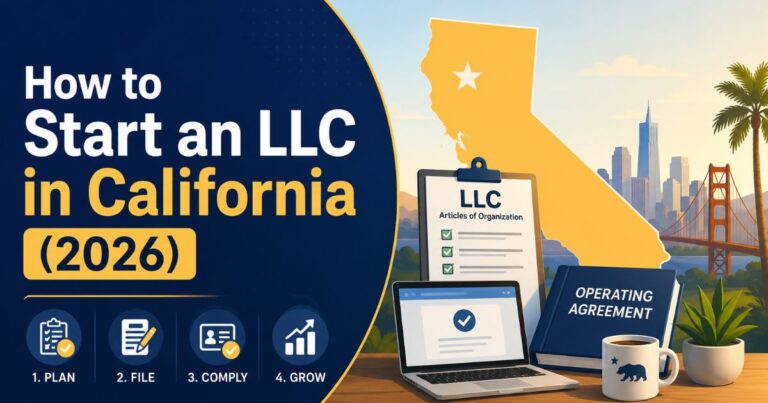
- 5 How to start an LLC in California in 7 steps
- 5.1 Step 1: Choose a California LLC name
- 5.2 Step 2: Appoint a registered agent
- 5.3 Step 3: File the Articles of Organization (Form LLC-1)
- 5.4 Step 4: Create an operating agreement
- 5.5 Step 5: Get an EIN from the IRS
- 5.6 Step 6: Register for California state taxes and licenses
- 5.7 Step 7: Open a business bank account and stay compliant
- 6 The $800 franchise tax and gross-receipts fee: California’s defining cost
- 7 How is a California LLC taxed?
- 8 LLC vs sole proprietorship in California
- 9 California LLC vs forming in Delaware, Wyoming, or Nevada
- 10 LLC formation options in California
- 11 California LLC vs Florida LLC: a cost comparison
- 12 Frequently Asked Questions About Starting an LLC in California
How do you start an LLC in California?
Starting an LLC in California means choosing a compliant name, appointing a registered agent (an agent for service of process), filing the Articles of Organization (Form LLC-1) with the California Secretary of State through BizFile Online, and paying the $70 filing fee. That filing is what legally creates the LLC.
From there, four things complete the setup: file a Statement of Information (Form LLC-12) within 90 days ($20), draft an operating agreement (not filed with the state but strongly recommended), get a free EIN from the IRS, and register with the Franchise Tax Board — where the $800 minimum annual franchise tax begins. Most founders focus on the $70 and are blindsided by the $800. Budget for the ongoing cost, not just the filing fee. The 7 steps below walk the whole process in order.
How much does it cost to start an LLC in California?
Starting an LLC in California costs $70 to file the Articles of Organization. But the realistic first-year cost is far higher, because the $800 minimum franchise tax and the $20 Statement of Information both come due within months of formation. A realistic first-year total for a DIY filer is about $890, and more if you hire a registered-agent service.
Here’s the full first-year cost breakdown:
| Cost item | Amount | When |
|---|---|---|
| Articles of Organization (Form LLC-1) | $70 | At formation |
| Statement of Information (Form LLC-12) | $20 | Within 90 days, then every 2 years |
| Minimum annual franchise tax (FTB) | $800 | 15th day of the 4th month after formation |
| EIN (IRS) | $0 | Anytime — free online |
| Operating agreement (DIY) | $0 | At formation |
| Registered agent | $0 (yourself) or ~$100–$300/yr | Ongoing |
| Name reservation (optional) | ~$10 | Optional, before filing |
| Realistic first-year total (DIY) | ≈ $890 |
Expedited processing is available for an additional fee, and in-person drop-off at the Sacramento office carries a handling charge. Because the Secretary of State periodically changes its service tiers and turnaround options, confirm current expedite pricing on BizFile Online rather than relying on any third-party figure. The headline to remember: the $70 is not the cost of a California LLC — the $800 is.
How long does it take to form an LLC in California?
Forming an LLC in California typically takes a few business days when filed online through BizFile Online, though processing times fluctuate with filing volume and can stretch considerably longer during busy periods. Paper filings by mail take substantially longer than online submissions.
Expedited service is available for an added fee if you need faster turnaround. Because the Secretary of State’s processing times shift throughout the year — sometimes dramatically — the only reliable source is the current processing-times page on BizFile Online. Check it before you file, and don’t commit to a client contract, lease, or bank appointment that depends on your LLC being approved by a specific date until you’ve confirmed the current turnaround. Note that your first taxable year begins on the date the Secretary of State stamps your Articles, which has real cost consequences (see the franchise-tax section below).
What are the annual requirements for a California LLC?
California LLCs have two separate ongoing obligations, handled by two different agencies. The Statement of Information (Form LLC-12) goes to the Secretary of State: $20, due within 90 days of formation and then every two years. The $800 minimum annual franchise tax goes to the Franchise Tax Board, every year, on Form 3522.
Confusing these two is a common and expensive mistake. The Statement of Information is biennial and cheap; the franchise tax is annual and is the real cost of keeping a California LLC alive. Miss the Statement of Information and the Secretary of State can assess a $250 penalty. Fall behind on the franchise tax and the FTB can assess penalties and interest, and ultimately suspend or forfeit your LLC — meaning you lose the right to conduct business, and to sue or defend a lawsuit, in California, and your name is no longer protected. Reinstatement requires paying all back taxes, penalties, and interest and filing every delinquent return. Calendar both deadlines the day you form.
How to start an LLC in California in 7 steps
Here is the complete filing path, from name to bank account. Each step covers what it is, why it matters, how to do it, and the common mistake to avoid.
Step 1: Choose a California LLC name
Choosing your name means picking one that’s both available and legally compliant.
- Why it matters: California rejects filings whose name conflicts with an existing registered entity, and a rejection costs you time.
- How to do it: your name must include “Limited Liability Company,” “LLC,” or “L.L.C.” and be distinguishable from existing entities — search the Secretary of State’s business database on BizFile Online first. Name reservation is optional.
- Common mistake: assuming a name is free because the domain is available. The state database is the only check that matters for your filing, and a trademark search is a separate (and worthwhile) step.
Step 2: Appoint a registered agent
A registered agent in California is called an agent for service of process — the person or company authorized to receive legal documents on your LLC’s behalf.
- Why it matters: California requires one, and the agent must have a physical California street address (no P.O. boxes) and be available during business hours.
- How to do it: you can serve as your own agent, appoint another individual, or hire a commercial service (typically $100–$300/year).
- Common mistake: naming yourself and using your home address — which then becomes part of the public record. A service is the standard way to keep your home address off public filings.
Step 3: File the Articles of Organization (Form LLC-1)
Filing the Articles of Organization is what legally creates your LLC.
- Why it matters: until the Secretary of State stamps this filing, your LLC doesn’t exist and you have no liability protection.
- How to do it: file Form LLC-1 online through BizFile Online and pay the $70 fee; you’ll list your LLC’s name, address, agent for service of process, and management structure (member-managed or manager-managed).
- Common mistake: not realizing that the stamp date starts your first taxable year — and therefore your $800 franchise-tax clock. Filing in late December can mean owing $800 for a year in which you did almost nothing.
Step 4: Create an operating agreement
An operating agreement is the internal contract governing how your LLC runs.
- Why it matters: California does not require you to file one with the state, but without one, the state’s default rules govern your business — which may not match what you and your partners actually intended. It also reinforces the separation between you and the LLC, supporting your liability protection.
- How to do it: document ownership percentages, voting rights, profit distributions, management duties, and what happens if a member leaves or the LLC dissolves.
- Common mistake: multi-member LLCs skipping it and then having no agreed mechanism when partners disagree. See our guide to LLC vs S-corp vs sole proprietorship for how structure affects these terms.
Step 5: Get an EIN from the IRS
An EIN is your LLC’s federal tax ID, and it’s free from the IRS.
- Why it matters: you need it to open a business bank account, hire employees, and handle most tax filings, and it lets you avoid using your Social Security number on business paperwork.
- How to do it: apply on the official IRS website — the online application takes minutes and issues the number immediately.
- Common mistake: paying a third-party site for an EIN. The number itself is always free directly from the IRS; you only pay if you’re buying a broader formation package that bundles it as a convenience.
Step 6: Register for California state taxes and licenses
Registering with the state means getting on the Franchise Tax Board’s books and handling any other tax and licensing obligations.
- Why it matters: this is where California’s real cost lives — every LLC owes the $800 minimum annual franchise tax under Rev. & Tax. Code §17941, regardless of income or activity, plus a graduated gross-receipts fee under §17942 once California gross receipts reach $250,000.
- How to do it: pay the $800 on Form 3522, file Form 568 (LLC Return of Income) annually, register with the CDTFA for sales tax if you sell taxable goods, and check your city and county for local business licenses.
- Common mistake: assuming an inactive or unprofitable LLC owes nothing. It owes $800. See our small business taxes guide.
Step 7: Open a business bank account and stay compliant
Opening a business bank account separates your personal and business finances — which is what actually preserves the liability protection you filed for.
- Why it matters: commingling funds is one of the main ways owners “pierce their own veil” and lose the protection an LLC provides.
- How to do it: bring your stamped Articles of Organization, your EIN, and your operating agreement to the bank; then calendar your two recurring obligations (the $20 biennial Statement of Information and the $800 annual franchise tax).
- Common mistake: running business income through a personal account “just for now.” Also line up coverage — see our business insurance types and costs guide, since an LLC limits liability but doesn’t pay claims.
The $800 franchise tax and gross-receipts fee: California’s defining cost
Every California LLC owes an $800 minimum annual franchise tax under Rev. & Tax. Code §17941 — whether it earns a dollar or not, whether it’s active or dormant. On top of that, a graduated gross-receipts fee under §17942 applies once California-source gross receipts reach $250,000. Together these are the single most important numbers in this guide, and the reason many founders regret forming in California without budgeting first.
Here is the gross-receipts fee schedule, which stacks on top of the $800:
| California gross receipts | §17942 fee | Total FTB cost (with the $800) |
|---|---|---|
| Under $250,000 | $0 | $800 |
| $250,000 – $499,999 | $900 | $1,700 |
| $500,000 – $999,999 | $2,500 | $3,300 |
| $1,000,000 – $4,999,999 | $6,000 | $6,800 |
| $5,000,000 and above | $11,790 | $12,590 |
So an LLC with $3 million in California revenue owes $6,800 to the Franchise Tax Board before any income tax. Two details catch people out. First, the fee is calculated on gross receipts, not profit — a low-margin business moving significant volume can owe a large fee while barely breaking even. Second, the fee is estimated on Form 3536 during the year and reconciled on Form 568.
The first-year myth — read this carefully. Many websites still say California waives the $800 in an LLC’s first year. That is no longer true. The AB 85 exemption applied only to LLCs formed between January 1, 2021 and December 31, 2023, and it expired. LLCs formed in 2024, 2025, and 2026 owe the full $800 in year one. Worse, the first payment isn’t due the following April — it’s due on the 15th day of the 4th month after formation. An LLC formed on June 1, 2026 owes its first $800 by September 15, 2026, and then another $800 by April 15, 2027. (Note: California’s 2026–27 budget legislation would reduce the first-year tax to $400 for tax years 2027–2029, but that does not help anyone forming in 2026 — and pending legislation can change. Confirm current-year treatment directly with the Franchise Tax Board before you file.)
How is a California LLC taxed?
A California LLC is taxed as a pass-through entity by default at the federal level: a single-member LLC is a disregarded entity (reported on Schedule C), and a multi-member LLC is taxed as a partnership — profits flow to the owners’ personal returns, with an S-corp election available. At the state level, California adds the $800 minimum franchise tax plus the §17942 gross-receipts fee, and California income tax applies to the owners’ pass-through income.
Three points matter for planning. First, self-employment tax (15.3%) still applies to active members’ earnings, on top of income tax. Second, an S-corp election can reduce self-employment tax once profits are consistent, but it doesn’t eliminate the $800 — and it adds payroll complexity, so it’s a CPA conversation. Third, California is a full-income-tax state, so unlike Florida or Texas, your pass-through profits face state income tax as well as the franchise tax. All of this is educational, not tax advice — confirm your situation with the FTB or a licensed CPA. Our small business taxes guide covers the federal side in depth.
LLC vs sole proprietorship in California
For most California owners the real choice is an LLC versus a sole proprietorship. A sole proprietorship is free and automatic but offers no liability protection; an LLC costs $70 to form and at least $800 a year to keep, but shields your personal assets. In California, that $800 makes the decision more consequential than in most states.
| Factor | Sole Proprietorship | LLC |
|---|---|---|
| Formation cost | $0 | $70 (Form LLC-1) |
| Annual cost | $0 | $800+ franchise tax (+ $20 biennial SOI) |
| Liability protection | None — personal assets exposed | Yes — separates personal & business |
| Taxes | Pass-through | Pass-through by default (+ CA franchise tax) |
| Paperwork | Minimal | Articles, SOI, Form 3522, Form 568 |
| Credibility | Lower | Higher with banks and clients |
| Best for | Very small, low-risk side income | Real liability exposure, employees, or growth |
The bottom line: in California, an LLC costs at least $800 a year to maintain, so the honest test is whether your liability exposure and revenue justify that. For a side project earning a few thousand dollars with essentially no risk, a sole proprietorship may be the rational choice. For any business with real liability, clients, employees, or meaningful revenue, the $800 is cheap insurance against losing your home and savings to a lawsuit.
California LLC vs forming in Delaware, Wyoming, or Nevada
Forming in Delaware, Wyoming, or Nevada to escape California’s $800 franchise tax is one of the most common — and most expensive — mistakes California founders make. Here’s the reality: if you live in California and run your business from California, you must register that out-of-state LLC as a foreign LLC in California anyway — which means paying the $800 regardless, plus a second state’s fees and a second registered agent.
| Factor | California LLC | Out-of-state LLC (DE/WY/NV) doing business in CA |
|---|---|---|
| Formation fee | $70 | Home-state fee + CA foreign registration fee |
| CA franchise tax | $800/year | $800/year anyway — you can’t escape it |
| Registered agents | One (in CA) | Two — one in each state |
| Annual filings | One state | Two states |
| Privacy | Standard | Marginally better in WY/NV — but CA filings still exist |
| Net result | Simpler and cheaper | More cost, more paperwork, no tax savings |
The bottom line: if you live and do business in California, form in California. Under California law, a foreign LLC must register with the Secretary of State before transacting intrastate business, and the FTB applies its own “doing business” test — so an out-of-state LLC operated from a California kitchen table is squarely within reach. Out-of-state formation genuinely makes sense in narrow cases (a Delaware C-corp for venture funding, or a business with no California nexus at all), but it is not a way for a California-based small business to avoid the $800. Anyone selling it as such is selling you two sets of fees.
Do you need a registered agent for a California LLC?
Yes, every California LLC must designate an agent for service of process — a person or company with a physical California street address (no P.O. boxes) available during business hours to receive legal documents. You can serve as your own agent, appoint another individual, or hire a commercial service for roughly $100–$300 a year to keep your home address off the public record.
Can a non-resident form an LLC in California?
Yes, a non-resident can form an LLC in California — there’s no residency or citizenship requirement. You do need an agent for service of process with a physical California street address, and you’ll get an EIN from the IRS. Be aware that the $800 minimum annual franchise tax and all California filing requirements apply exactly the same to non-resident owners.
Is an LLC worth it in California?
An LLC is usually worth it in California if you have real liability exposure or meaningful revenue, since it shields your personal assets. But weigh the true cost honestly: California is cheap to form ($70) and expensive to keep ($800/year minimum) — the opposite of what most founders expect. For a tiny, low-risk side income, a sole proprietorship may make more sense.
LLC formation options in California
There are three realistic ways to form a California LLC, and they trade cost against convenience. This section is editorial only — no paid placements.
- DIY, direct with the state (cheapest). File Form LLC-1 yourself on BizFile Online for $70. The state’s filing process is designed to be used directly by business owners, and this is always the lowest-cost path. For most simple, single-member LLCs, it’s genuinely all you need.
- Registered-agent service (privacy). If your main concern is keeping your home address off the public record, you can file yourself and pay only for a commercial agent for service of process (~$100–$300/year).
- Full formation service (convenience). These companies file on your behalf and often bundle an agent and an operating-agreement template. You’re paying for convenience, not for anything you can’t do yourself — and the state fee is the same either way.
Be honest with yourself about which you’re buying. Filing directly with the Secretary of State is the cheapest option, and no service can reduce the $70 fee or the $800 franchise tax. If you’re weighing the whole launch process, our how to start a business step-by-step guide covers what comes before and after formation.
California LLC vs Florida LLC: a cost comparison
California and Florida sit at opposite ends of the LLC cost spectrum, and the contrast is stark. California is cheaper to form ($70 vs $125) but dramatically more expensive to maintain, because of the $800 franchise tax and state income tax. Florida costs more upfront but has no state income tax and a much lower annual fee.
| Factor | California | Florida |
|---|---|---|
| Formation fee | $70 | $125 |
| Annual/biennial report | $20 Statement of Information (every 2 years) | $138.75 annual report (due May 1) |
| Minimum annual state tax | $800 franchise tax | $0 |
| Gross-receipts fee | $900–$11,790 above $250k | None |
| State income tax | Yes — applies to pass-through income | No personal income tax |
| Typical annual cost | $800+ | $138.75 |
The bottom line: a Florida LLC costs about $138.75 a year to maintain; a California LLC costs at least $800 — roughly six times more, before the gross-receipts fee or state income tax. But this comparison only matters if you have a genuine choice about where you operate. You can’t relocate your LLC on paper while living and working in California — the foreign-registration rules above will pull you back in. This comparison is for people genuinely deciding where to live and operate, or setting up an entity for a business with real Florida operations. See our guide to how to start an LLC in Florida for the full Florida process.
Frequently Asked Questions About Starting an LLC in California
Here are quick, sourced answers to the most common questions about California LLCs.
How much does an LLC cost in California?
A California LLC costs $70 to file the Articles of Organization (Form LLC-1) with the Secretary of State. On top of that, you’ll pay a $20 Statement of Information within 90 days (then every two years) and the $800 minimum annual franchise tax to the Franchise Tax Board, which applies from year one. A realistic first-year DIY total is about $890.
Does California require an LLC annual report?
California requires a Statement of Information (Form LLC-12), not a traditional annual report. It costs $20, is due within 90 days of formation, and then must be filed every two years. Separately and more significantly, the Franchise Tax Board charges an $800 minimum annual franchise tax every year. Missing the Statement of Information can bring a $250 penalty.
How long does it take to get an LLC in California?
Forming an LLC in California typically takes a few business days when filed online through BizFile Online, though processing times fluctuate significantly with filing volume. Paper filings by mail take considerably longer, and expedited service is available for an additional fee. Always check current processing times on the Secretary of State’s website before committing to any date-dependent plans.
Can I be my own registered agent in California?
Yes, you can be your own agent for service of process in California, provided you have a physical California street address (not a P.O. box) and are available during normal business hours to receive legal documents. The trade-off is that your address becomes part of the public record, which is why many owners pay $100–$300 a year for a commercial agent instead.
Do you need an operating agreement in California?
California does not require you to file an operating agreement with the state, but it’s strongly recommended — especially for multi-member LLCs. Without one, California’s default statutory rules govern how your LLC operates, which may not match what the owners intended. An operating agreement sets ownership percentages, voting rights, profit distributions, and dissolution terms.