Key Takeaways
- Startup cost: ~$2,000–$5,000 lean (inventory + platform + branding + photos); print-on-demand/dropshipping can start under $500.
- Platform: a hosted platform like Shopify Basic ($39/month, or $29 on annual billing) is the standard beginner choice; processing runs ~2.9% + 30¢ per sale.
- Margins: wholesale sourcing yields 40–55% gross (keystone pricing); dropshipping/POD is easier but thinner (15–30%).
- Licensing: no special license, but you need business registration, an EIN, and a sales-tax/seller’s permit (a resale certificate buys wholesale tax-free).
- Sales tax: you must collect in any state where you exceed economic nexus — commonly $100,000 in sales or 200 transactions.
- Best first step: validate one focused niche, order small test inventory (30–50 SKUs), and build a simple store before scaling ad spend.
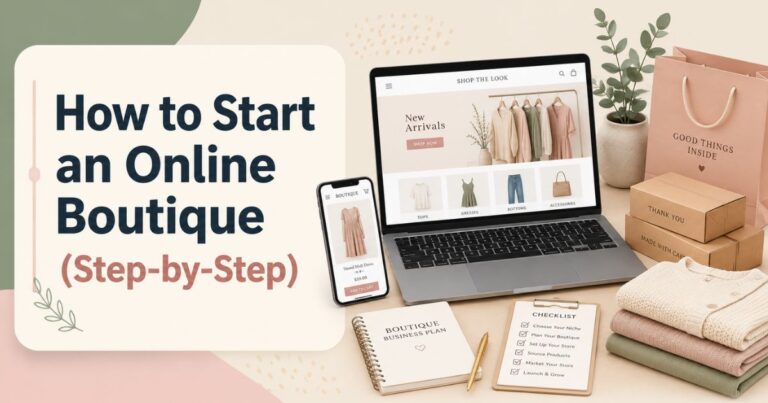
An online boutique is one of the most accessible businesses to start: low upfront cost, no storefront, and platforms that let you launch in a weekend. But “easy to start” isn’t “easy to profit” — the winners nail a niche, price with discipline, and manage inventory and sales tax properly. This guide walks the full path: how to start, what it costs, whether it’s profitable, licensing, a 9-step launch plan, your-own-store vs marketplaces, inventory vs dropshipping, and the Florida-specific rules. It’s part of our broader how to start a business step-by-step guide, and it pairs closely with our hub on running an online store.
Figures below are 2026 benchmarks and ranges that vary by sourcing model and market; legal and tax specifics are verified against primary sources but should be confirmed for your state.
Table of Contents
- 1 How do you start an online boutique?
- 2 How much does it cost to start an online boutique?
- 3 Is an online boutique profitable?
- 4 Do you need a license to start an online boutique?
- 5 How to start an online boutique in 9 steps
- 5.1 Step 1: Choose your niche and products
- 5.2 Step 2: Source your products
- 5.3 Step 3: Register your business and get an EIN
- 5.4 Step 4: Choose your e-commerce platform
- 5.5 Step 5: Build your store and brand
- 5.6 Step 6: Set pricing and manage inventory
- 5.7 Step 7: Handle sales tax and compliance
- 5.8 Step 8: Market on social media
- 5.9 Step 9: Launch and fulfill orders
- 6 Own online store vs selling on a marketplace
- 7 Holding inventory vs dropshipping and print-on-demand
- 8 Tools and apps for online boutiques
- 9 Starting an online boutique in Florida
- 10 Frequently Asked Questions About Starting an Online Boutique
How do you start an online boutique?
Starting an online boutique means choosing a niche, sourcing products, registering your business, building a store on a platform like Shopify, and marketing to your target audience. The typical path runs niche and product research → sourcing (wholesale, private label, handmade, or print-on-demand) → LLC and EIN → store build and branding → pricing and inventory setup → sales-tax registration → social-media marketing → launch and fulfillment.
The appeal is the low barrier: you can launch a real storefront for a few thousand dollars (or a few hundred with print-on-demand), reach customers nationwide, and run it from home. The challenge is standing out — apparel and accessories are crowded, so a focused niche and a distinct brand matter more than the tech. Because you’re selling physical goods across state lines, two back-office pieces deserve attention from day one: an LLC to protect your personal assets, and a plan for sales-tax compliance as you grow. Nail the niche and the numbers, and the platform is the easy part.
How much does it cost to start an online boutique?
A lean online boutique commonly costs $2,000–$5,000 to launch, covering initial inventory, an e-commerce subscription, branding, product photography, and starter marketing. A bare-bones store built on print-on-demand or dropshipping — which carries no upfront inventory — can start for under $500. On the higher end, a serious first-90-days launch with a premium brand and real ad budget runs $5,000–$10,000+.
Here’s where the money goes for a typical inventory-based boutique:
- Initial inventory: $1,000–$5,000 (start with 30–50 SKUs in small quantities to test what sells).
- E-commerce platform: ~$39/month for Shopify Basic ($29/month on annual billing), plus ~2.9% + 30¢ payment processing per sale.
- Domain: $10–$20/year.
- Branding & logo: $0–$500 (a freelancer, not a $2,000 agency, at launch).
- Product photography: $0 (DIY) to $500+.
- Starter marketing / ad testing: $300–$1,000 to gather real demand data.
- Apps & email: $0–$150/month (keep it minimal early).
The biggest budgeting mistake is overspending on branding and premium apps before validating that anyone wants the product. Spend on samples and a small ad test first; scale the store only once a product proves it sells. If you need capital, the SBA’s startup-cost worksheet helps you build a realistic line-item budget before you commit.
Is an online boutique profitable?
Yes, an online boutique can be profitable, with apparel and accessory sellers typically targeting 40–60% gross margins through keystone pricing (roughly doubling the wholesale cost). Net profit is thinner, because advertising, returns, shipping, and platform fees eat into that gross margin — so disciplined pricing and inventory turnover, not just markup, determine whether a boutique makes money.
Your sourcing model sets the ceiling. Wholesale buying (through marketplaces or trade shows) yields 40–55% gross margins: a dress sourced at $15 sells for $30–$40, though shipping and ad costs then eat $8–$12 per unit. Dropshipping and print-on-demand require almost no inventory investment but cut margins to 15–30%, because the supplier takes a cut. The profit killers are predictable: overspending on ads relative to average order value, high return rates, slow-moving inventory that ties up cash, and inventory shrinkage (2–5% from damage, loss, and returns). Boutiques that win keep a tight, fast-turning SKU list and watch the ratio of customer-acquisition cost to average order value closely. (Figures are industry benchmarks; results vary widely by niche, pricing, and marketing.)
Do you need a license to start an online boutique?
You don’t need a special “boutique license,” but you generally need three things to sell legally: a business registration (an LLC is recommended), an EIN from the IRS, and a sales-tax permit (also called a seller’s permit) from your state. A resale certificate — which you get after registering — lets you buy inventory from wholesalers without paying sales tax, since the end customer pays it instead.
Requirements vary by state and city. Most online boutiques need to register their business entity, get a free EIN from the IRS, and obtain a state sales-tax/seller’s permit before making sales. Some cities also require a home-occupation permit if you store inventory at home, and a few limit how much stock you can keep in a residential zone. Because rules differ, confirm your specific state and city requirements before launching — and for the operational side of selling online, see our hub on running an online store.
How to start an online boutique in 9 steps
You can start an online boutique in nine steps: choose a niche, source products, register and get an EIN, choose a platform, build your store, set pricing and inventory, handle sales tax, market on social media, and launch. Here’s each step — what it is, why it matters, how to do it, and the mistake to avoid.
Step 1: Choose your niche and products
Your niche is the specific segment you’ll serve — a focused apparel or accessory category (e.g. modest workwear, plus-size activewear, handmade jewelry) rather than “clothing” broadly. It matters because a tight niche makes marketing cheaper and your brand memorable in a crowded market. Validate demand before committing: check search interest, competitor stores, and social engagement in the niche. The common mistake is going too broad — a general clothing store competes with everyone and stands out to no one.
Step 2: Source your products
Sourcing is how you get inventory: wholesale marketplaces, private-label manufacturers, handmade production, or print-on-demand. It matters because sourcing sets your margins, minimum order sizes, and brand control. Register for a resale certificate so you can buy wholesale tax-free, order samples from every new supplier to check quality and sizing before a bulk buy, and start with 30–50 SKUs in small quantities to test. The mistake is over-ordering one style before you know it sells; buy small, reorder what moves, and negotiate Net-30 terms once you have a track record.
Step 3: Register your business and get an EIN
Register your business as an LLC for liability protection and get a free EIN from the IRS. It matters because an LLC separates your personal assets from business liabilities (product issues, debts), and the EIN lets you open business banking, buy wholesale, and file taxes. File with your state’s Secretary of State (fees range $50–$500), then get your EIN directly from IRS.gov in minutes. Compare entity options in our guide to choosing a business structure. The mistake is mixing personal and business finances, which undermines both your books and your liability protection.
Step 4: Choose your e-commerce platform
Your platform is where your store lives. Hosted platforms like Shopify (the most popular choice, holding roughly a third of the US e-commerce platform market) are built for non-technical founders, with Shopify Basic at $39/month ($29 on annual billing) plus about 2.9% + 30¢ per transaction. It matters because your platform affects your costs, design flexibility, and how easily you can run the store. Compare subscription cost, payment-processing fees, themes, and built-in features. The mistake is over-buying — start on the entry plan and a free theme; upgrade only when sales volume makes the lower transaction fees of a higher tier pay for themselves.
Step 5: Build your store and brand
Building your store means designing it, writing product pages, adding quality photos, and setting up a smooth checkout. It matters because your store is your salesperson — clear photos, honest descriptions, sizing details, and an easy checkout directly drive conversion and reduce returns. Use a clean theme, shoot consistent product images (good lighting matters more than an expensive camera), and make the checkout frictionless on mobile. The mistake is cluttered design and poor product photos, which erode trust and tank conversion no matter how good the product is.
Step 6: Set pricing and manage inventory
Pricing and inventory management determine your margins and cash flow. Most boutiques use keystone pricing — a 2x to 2.5x markup on wholesale cost — targeting 40–60% gross margin, then adjust for shipping and ad costs. It matters because underpricing quietly destroys profitability, and dead inventory ties up cash. Track inventory turnover, reorder fast movers, and discount slow sellers to free capital. The mistake is pricing only to “beat” competitors instead of covering your true per-unit costs (product, shipping, fees, ads, returns) plus margin.
Step 7: Handle sales tax and compliance
Sales-tax compliance means collecting and remitting tax where you’re legally required to. You must collect in your home state and in any state where you cross economic nexus — commonly $100,000 in sales or 200 transactions in a year (thresholds vary; some states are higher). It matters because failing to register where you have nexus triggers back taxes and penalties. Register for a sales-tax permit in each nexus state, configure your platform’s tax settings, and file on your assigned schedule. See our guide to small business taxes. The mistake is ignoring nexus as you grow — set a quarterly reminder to review your state-by-state obligations.
Marketing an online boutique lives on visual social platforms — Instagram and TikTok — plus email and influencer partnerships. It matters because boutiques are discovery-driven; customers find you scrolling, not searching. Post consistently, use short-form video, build an email list from day one (email is your owned, algorithm-proof channel), and partner with micro-influencers in your niche. See our guide to marketing your business. The mistake is relying on a single platform’s algorithm; capture emails so you own the relationship with your customers.
Step 9: Launch and fulfill orders
Launch means going live and reliably getting orders to customers — shipping, returns, and customer service. It matters because fulfillment speed and a clear return policy drive reviews and repeat business, which are cheaper than constant new-customer acquisition. Set up shipping (real rates or free-shipping-built-into-price), a straightforward return policy, and fast, friendly customer service. The mistake is a vague or hostile return policy; in apparel, returns are inevitable, so make them smooth to protect your reputation and repeat sales.
Own online store vs selling on a marketplace
Selling on your own store (Shopify) versus a marketplace (Etsy, Amazon) is a trade-off between control and reach: your own site gives you lower per-sale fees, full brand control, and customer data, while a marketplace gives you built-in traffic but takes fees and owns the customer relationship. Many boutiques use both. The table compares them.
| Factor | Your own store | Marketplace (Etsy/Amazon) |
|---|---|---|
| Fees | Monthly subscription + ~2.9% processing | Listing + higher per-sale commissions |
| Brand control | Full — your design, your rules | Limited — marketplace’s template |
| Customer data | You own it (email, remarketing) | Marketplace owns the relationship |
| Traffic/reach | You must drive it | Built-in shopper traffic |
| Best for | Building a brand and repeat customers | Early traffic, testing, extra sales channel |
The common strategy: use a marketplace for initial discovery and validation, but build your own store as the home base where you control branding, keep customer emails, and earn higher margins. Relying only on a marketplace leaves you exposed to fee hikes and policy changes you can’t control — your own store is the asset you actually own.
Holding inventory vs dropshipping and print-on-demand
Holding inventory versus dropshipping/print-on-demand is the core sourcing decision: holding stock means higher upfront cost but better margins and control, while dropshipping and print-on-demand mean almost no upfront cost but thinner margins and less control over quality and shipping. The table compares them.
| Factor | Holding inventory | Dropshipping / POD |
|---|---|---|
| Upfront cost | Higher — buy stock ($1,000–$5,000+) | Low — pay only after a sale |
| Gross margin | Higher (40–55%) | Lower (15–30%) |
| Control | Full — quality, packaging, speed | Limited — supplier controls it |
| Fulfillment | You (or a 3PL) ship it | Supplier ships directly |
| Best for | Brand-builders wanting margin | Testing ideas with minimal risk |
A practical hybrid many boutiques use: start with print-on-demand or dropshipping to test which products and niches resonate with minimal risk, then transition winners to held inventory to capture better margins and control the customer experience. Dropshipping lowers the barrier to entry; holding inventory is where sustainable margins usually live.
Can you start an online boutique with no money?
Almost — you can start an online boutique with very little money using print-on-demand or dropshipping, which require no upfront inventory. Combine that with a platform free trial and free social-media marketing, and you can launch for under a few hundred dollars. The trade-off is thinner margins (15–30%) and less control. You’ll still need some budget for a domain, samples, and basic ad testing to validate demand.
Do you need an LLC for an online boutique?
You don’t legally need an LLC to start an online boutique — you can operate as a sole proprietor — but an LLC is strongly recommended. It separates your personal assets (home, savings) from business liabilities like product-related claims or debts, and it adds credibility with suppliers. LLC filing costs $50–$500 depending on your state. Many owners start as sole proprietors and form an LLC as sales grow.
How much do boutique owners make?
Online boutique owners’ income varies enormously by traffic, margins, and niche — from a few hundred dollars a month as a side hustle to six figures for established brands. Because net margins after ads, returns, and fees are often modest, income depends heavily on sales volume and pricing discipline. Many boutiques take time to become profitable; most Shopify stores reach break-even in roughly 4–8 months with sound unit economics.
Tools and apps for online boutiques
Useful boutique tools are widely available, and none of the mentions here are sponsored — this section is purely editorial. The categories worth knowing, by job:
- Store platform: a hosted e-commerce platform (Shopify and peers) runs the storefront, checkout, and product catalog.
- Payments: the platform’s built-in payment processor (or a gateway) handles cards; using the native processor usually avoids an extra transaction fee.
- Email marketing: an email tool to capture subscribers and run welcome and abandoned-cart flows — your highest-ROI owned channel.
- Social scheduling & design: tools to plan Instagram/TikTok posts and create graphics without a designer.
- Inventory & sales tax: inventory tracking to manage SKUs and turnover, and sales-tax automation to calculate and file across nexus states.
Don’t over-buy apps before launch — a store platform, an email tool, and a social account cover the basics until volume justifies more; app bloat quietly erodes margins. As you grow, see our guide to day-to-day small business management for systematizing operations.
Starting an online boutique in Florida
Starting an online boutique in Florida means forming an LLC through Sunbiz for $125, registering with the Florida Department of Revenue for a sales-tax certificate, and collecting 6% state sales tax plus the county discretionary surtax on taxable sales shipped to Florida customers. Florida’s lack of a state income tax means more of your profit stays with you than in most states — a real advantage for an owner.
The key Florida compliance detail is sales tax. Florida’s economic nexus threshold is $100,000 in prior-calendar-year sales into the state (Florida uses a sales-dollar threshold and, unlike many states, has no separate 200-transaction trigger), per the Florida Department of Revenue. If you’re based in Florida, you register and collect from the start on sales to Florida buyers; if you’re out of state, you register once you cross $100,000 in Florida sales. Registering online with the FL DOR is free. You’ll collect the 6% state rate plus the destination county’s surtax on taxable items shipped within Florida (clothing is generally taxable in Florida). Form your LLC at Sunbiz ($125, annual report $138.75 by May 1) and see our guide to starting a business in Florida. (Educational, not tax advice — verify current thresholds and rates at FloridaRevenue.com.)
Frequently Asked Questions About Starting an Online Boutique
Here are quick, standalone answers to the most common questions about starting an online boutique.
How much does it cost to start an online boutique?
A lean online boutique commonly costs $2,000–$5,000 to start, covering initial inventory, an e-commerce subscription (around $39/month), branding, product photos, and starter marketing. A print-on-demand or dropshipping store with no upfront inventory can launch for under $500. A premium, ad-funded first-90-days launch runs $5,000–$10,000+. Inventory and marketing are the biggest variables.
Do I need a business license to sell online?
You don’t need a special license to sell online, but you generally need to register your business, get an EIN from the IRS, and obtain a state sales-tax or seller’s permit before making sales. A resale certificate lets you buy wholesale inventory tax-free. Some cities also require a home-occupation permit if you store inventory at home. Requirements vary by state and city.
Is an online boutique profitable?
Yes, online boutiques can be profitable, typically targeting 40–60% gross margins through keystone pricing. Net profit is thinner after advertising, returns, shipping, and platform fees, so pricing discipline and inventory turnover matter more than markup alone. Wholesale sourcing yields the best margins (40–55%); dropshipping is easier but thinner (15–30%). Profitability depends on volume and cost control.
What is the best platform for an online boutique?
For most beginners, a hosted platform like Shopify is the best choice — it’s built for non-technical founders, holds roughly a third of the US e-commerce market, and starts at $39/month ($29 on annual billing). Hosted platforms handle hosting, security, and checkout so you can focus on products and marketing. Compare subscription cost, transaction fees, and design flexibility before committing.
Where do boutiques buy their clothes?
Boutiques buy clothes from wholesale marketplaces and trade shows, private-label manufacturers, handmade producers, or print-on-demand suppliers. Wholesale gives the best margins (40–55%) but requires upfront buying and a resale certificate; print-on-demand and dropshipping need no inventory but yield thinner margins. Most boutiques order small test quantities first, then reorder what sells and negotiate better terms over time.