
Key Takeaways
- Startup cost: ~$2,000–$10,000 home-based; $10,000–$30,000 for a full professional kit — gear is the biggest expense.
- No special license: photography needs no professional license — just register the business; drone work requires an FAA Part 107 certificate.
- Profit margins: roughly 25–50%, with wedding and commercial niches at the higher end — pricing packages correctly is what decides it.
- Insurance is required by venues: general liability runs about $200–$350/year; add equipment coverage for your gear.
- Florida: no state income tax; form an LLC via Sunbiz for $125; sales tax generally applies to tangible products like prints and albums.
- Best first step: pick one niche and build a tight portfolio — clients book proof, not promises.
Photography is one of the most accessible businesses to start — you can launch from home with gear you may already own — but turning a camera into a profitable business takes a niche, real pricing, and marketing. This guide walks the full path in 9 steps, with verified 2026 costs, equipment guidance, and the pricing math that decides whether you make money. It’s a companion to our national how to start a business step-by-step guide.
Gear prices and figures below are 2026 market ranges, not quotes, and tax figures are verified against the IRS — but this is educational, not tax or legal advice, so confirm current details with the primary source or a licensed professional.
Table of Contents
- 1 How do you start a photography business?
- 2 How much does it cost to start a photography business?
- 3 Is a photography business profitable?
- 4 What equipment do you need to start a photography business?
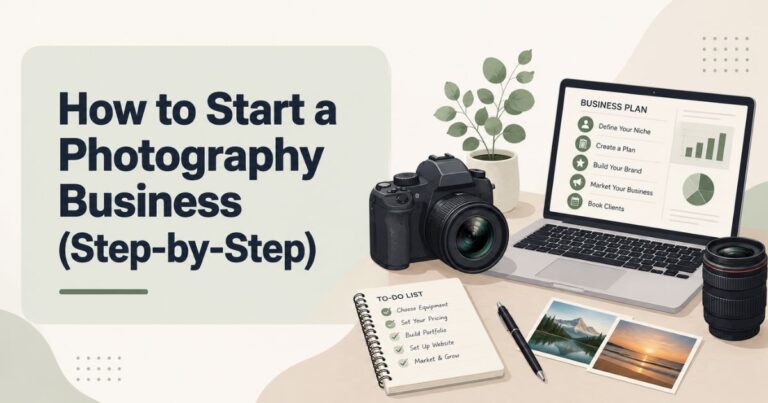
- 5 How to start a photography business in 9 steps
- 5.1 Step 1: Pick your niche
- 5.2 Step 2: Build your skills and portfolio
- 5.3 Step 3: Register your business and get an EIN
- 5.4 Step 4: Buy your camera gear and software
- 5.5 Step 5: Set your pricing and packages
- 5.6 Step 6: Get business insurance before your first shoot
- 5.7 Step 7: Build a website and online presence
- 5.8 Step 8: Market and land your first clients
- 5.9 Step 9: Set up accounting and handle taxes
- 6 Photography niches compared (wedding, portrait, commercial, real estate)
- 7 Home-based vs studio photography business
- 8 Tools and software for photographers
- 9 Starting a photography business in Florida
- 10 Frequently Asked Questions About Starting a Photography Business
How do you start a photography business?
Starting a photography business means choosing a niche, building a portfolio, registering your business, buying gear, setting package pricing, getting insured, and marketing to book clients. Most photographers start part-time and home-based, build a body of work and a client base, then scale into full-time (and sometimes a studio) as bookings grow.
The path is a clear sequence: pick a specialty (weddings, portraits, real estate, product, headshots), build a portfolio that proves you can deliver it, register an LLC and get a free EIN, assemble a minimum viable gear kit, calculate your cost of doing business and set tiered packages, get liability and equipment insurance, build a portfolio website and social presence, and market for your first clients. The creative skill gets you in the door; the business steps — pricing, insurance, marketing, and bookkeeping — decide whether it’s a hobby or a living. The 9 steps below cover the whole process in order.
How much does it cost to start a photography business?
Starting a photography business commonly costs about $2,000–$10,000 for a home-based launch and $10,000–$30,000 for a fuller professional setup with premium gear and a studio. The single biggest cost is camera equipment; after that come insurance, editing software, a website, and business registration. You can start at the low end by buying used gear and running from home.
Here’s a realistic first-year breakdown (verify current gear prices, which move):
- Camera body: $800–$2,200 (capable mirrorless; more for full-frame pro bodies)
- Lenses (1–2 versatile): $300–$2,500
- Lighting kit: $200–$850
- Backup body: the price of a second (often used) camera — essential for paid work
- Computer + editing software: a capable computer, plus the Adobe Photography Plan at roughly $120–$180/year (Lightroom + Photoshop)
- Business registration: LLC filing (varies by state; $125 in Florida) + free EIN
- Insurance: general liability ~$200–$350/year, plus equipment coverage
- Website + branding: $100–$1,000+ depending on DIY vs custom
The smart move for a first launch is a minimum viable kit bought partly used, keeping cash for insurance, a website, and marketing. See our business loans and financing guide if you need to fund the initial gear purchase — though many photographers bootstrap with what they can afford and upgrade as bookings pay for it.
Is a photography business profitable?
A photography business can be profitable, with net margins typically running about 25–50% — wedding and commercial photography sit at the higher end, while saturated markets like basic portraits run lower. Profitability comes down to two things: pricing packages high enough to cover the full cost of doing business (not just shoot time), and controlling the hours you sink into editing.
The math most beginners miss: a photograph’s cost isn’t just the two hours of shooting — it’s the editing time (often 2–3× the shoot), gear depreciation, insurance, software, mileage, marketing, and taxes. A photographer who charges “$150 for a two-hour session” and spends six more hours editing, driving, and delivering is often earning less than minimum wage. The profitable operators price by the total cost of doing business plus profit, sell packages and add-ons (prints, albums, extra images) rather than hourly rates, and specialize in a niche where clients pay for expertise. These margin figures are benchmarks; your actual profit depends on pricing discipline and volume.
What equipment do you need to start a photography business?
To start a photography business you need a dependable camera body, one or two versatile lenses, a basic lighting kit, a backup body, a computer, and editing software. You do not need every piece of gear on day one — a focused minimum viable kit lets you deliver professional results and add specialized equipment as paid work funds it.
The core kit and 2026 price ranges (verify current prices):
- Camera body: $800–$2,200 — a capable APS-C or full-frame mirrorless body handles most professional work
- Lens(es): $300–$2,500 — a versatile zoom (like a 24-70mm) or a fast prime covers most shoots; add specialty lenses later
- Lighting kit: $200–$850 — a speedlight or basic strobe kit with a modifier
- Backup body: a second camera is non-negotiable for paid work (weddings especially) — gear fails, and “sorry, my camera broke” isn’t an option at a once-in-a-lifetime event
- Computer + storage: a machine that can handle large RAW files, plus reliable backup drives
- Editing software: the Adobe Photography Plan (Lightroom + Photoshop) at roughly $120–$180/year, or alternatives like Capture One or Affinity Photo
Buying quality used gear from reputable dealers is the single best way to get professional capability while preserving cash — camera bodies and lenses hold up well, and last-generation pro gear often outperforms new entry-level equipment for less money.
How to start a photography business in 9 steps
Here is the complete path from picking a niche to landing your first paying clients. Each step covers what it is, why it matters, how to do it, and the common mistake to avoid.
Step 1: Pick your niche
Picking a niche means specializing in one type of photography rather than shooting everything.
- Why it matters: “photographer” competes with everyone, while “real estate photographer in [city]” or “brand product photographer” competes with few and commands higher rates — and specialization builds a coherent portfolio and referral network faster.
- How to do it: match your interest and skill to local demand and income potential; common niches include weddings, portraits, real estate, product/e-commerce, headshots, and events.
- Common mistake: staying a generalist to “keep options open,” which dilutes your portfolio and marketing and keeps your rates low.
Step 2: Build your skills and portfolio
Building your portfolio means creating a tight body of work that proves you can deliver in your niche — before clients ask.
- Why it matters: clients hire on evidence, not promises; a focused portfolio of 15–30 strong images in your niche beats a scattered collection.
- How to do it: practice deliberately, organize styled shoots, offer a few free or discounted sessions to build your book, and second-shoot for established photographers to gain real-event experience.
- Common mistake: showing every photo you’ve ever taken — curate ruthlessly to only your best, most on-niche work, since your portfolio’s weakest image sets your perceived level.
Step 3: Register your business and get an EIN
Registering your business makes it official and protects you legally.
- Why it matters: an LLC separates your personal assets from business liability (relevant when you’re handling clients’ once-in-a-lifetime events and expensive gear), and an EIN lets you open a business bank account and avoid using your SSN.
- How to do it: register an LLC with your state, get a free EIN from the IRS (never pay a third party for the number itself), and open a business bank account to keep finances clean.
- Common mistake: operating informally under your own name and commingling money, which undermines liability protection and makes taxes a nightmare. See our guide to choosing a business structure.
Step 4: Buy your camera gear and software
Buying gear means assembling your minimum viable kit without overspending.
- Why it matters: gear is your biggest startup cost, and it’s easy to blow your budget on equipment you don’t yet need instead of on insurance, a website, and marketing.
- How to do it: buy a capable body, one or two versatile lenses, a basic lighting kit, and a backup body — much of it used from reputable dealers — plus editing software (the Adobe Photography Plan runs ~$120–$180/year).
- Common mistake: “gear acquisition syndrome” — buying expensive equipment to feel professional instead of investing in the skills and marketing that actually book clients. Clients hire the photographer, not the camera.
Step 5: Set your pricing and packages
Setting your pricing means calculating your true cost of doing business, then pricing packages to cover it plus profit.
- Why it matters: underpricing is the number-one reason photography businesses fail — a rate that ignores editing time, gear depreciation, insurance, and taxes quietly loses money on every job.
- How to do it: add up your annual costs and desired salary, divide by realistic billable shoots to find your baseline, then build tiered packages (not just hourly rates) with add-ons like prints and albums; require a 25–50% retainer to book a date.
- Common mistake: pricing by “what feels fair” or matching a cheap competitor instead of your actual cost of doing business — raise prices as demand and skill grow.
Step 6: Get business insurance before your first shoot
Photography insurance protects your business, your gear, and your ability to work at professional venues.
- Why it matters: a guest tripping over your light stand or a dropped camera can cost thousands, and many venues (especially wedding venues) require proof of general liability before they’ll let you work.
- How to do it: get general liability coverage (roughly $200–$350/year for a photographer) plus equipment coverage for your gear, and add professional liability if you shoot high-stakes events.
- Common mistake: booking a wedding and discovering the venue requires a certificate of insurance you don’t have. See our business insurance types and costs guide for what photographers actually need.
Step 7: Build a website and online presence
Building your online presence means creating the portfolio website and profiles clients use to find and vet you.
- Why it matters: photography is a visual business bought on visual proof — a professional portfolio site and an active local presence are how most clients discover and trust you.
- How to do it: build a clean portfolio website (a photography-focused website builder makes this easy), set up a Google Business Profile for local search, and maintain an active Instagram or other visual platform showing recent work.
- Common mistake: relying only on social media with no owned website — you don’t control the platform, and a portfolio site is what converts serious inquiries into bookings.
Step 8: Market and land your first clients
Marketing means actively getting your first bookings through referrals, social proof, and local networking.
- Why it matters: the first clients are the hardest and generate the referrals and reviews that make later marketing easier.
- How to do it: tell your network you’re open for business, offer an introductory rate to build reviews, network with complementary vendors (wedding planners, realtors, event venues), and post consistently in your niche.
- Common mistake: waiting passively for clients to find you instead of proactively reaching out and building vendor relationships. See our marketing your business guide for the full playbook.
Step 9: Set up accounting and handle taxes
Setting up accounting means tracking income and expenses and handling taxes from day one.
- Why it matters: photography has significant deductible costs (gear, software, mileage, insurance, home office), and clean books both lower your tax bill and show you whether you’re actually profitable.
- How to do it: use accounting software, track every expense, and know the key write-offs — Section 179 lets you deduct the full cost of qualifying gear the year you buy it, and business mileage is deductible at the 2026 IRS rate of 72.5 cents per mile. Set aside money for self-employment tax and pay quarterly estimates.
- Common mistake: mixing personal and business money and losing deductions. See our small business taxes guide for the details.
Photography niches compared (wedding, portrait, commercial, real estate)
Your niche shapes your gear, pricing, demand, and income ceiling, so choosing deliberately matters. Weddings pay the most per job but carry the highest pressure and gear demands; portraits are accessible but competitive; commercial and product work pays well with steadier hours; real estate is high-volume and repeatable. The table compares the main niches.
| Niche | Demand | Gear needs | Typical pricing | Income potential | Effort / pressure |
|---|---|---|---|---|---|
| Wedding | Strong, seasonal | High (backup gear essential) | $2,000–$6,000+/event | High | Very high — one-shot events |
| Portrait / family | Broad, steady | Moderate | $150–$600/session | Moderate | Moderate |
| Commercial / product | Steady (B2B) | Moderate–high (lighting) | $500–$5,000+/project | High | Moderate — repeatable |
| Real estate | High volume | Moderate (wide lens, drone) | $150–$500/property | Moderate–high (volume) | Lower — fast turnaround |
| Headshots / branding | Growing | Low–moderate | $150–$500/session | Moderate | Lower — studio-controlled |
The bottom line: choose the niche that matches your skill, your local demand, and the lifestyle you want. Weddings and commercial work have the highest income ceilings but very different demands (weekend, high-pressure events vs. weekday, repeatable projects). Many photographers combine two complementary niches — for example, weddings plus portraits, or real estate plus commercial — to smooth out seasonality and income.
Home-based vs studio photography business
Most photographers start home-based and add a studio only when demand justifies the overhead. A home-based business has minimal fixed costs and maximum flexibility but limits certain work; a commercial studio enables controlled, higher-end shoots but adds significant monthly rent. The right choice depends on your niche and volume.
| Factor | Home-Based | Studio |
|---|---|---|
| Overhead | Very low (no rent) | High — monthly studio rent |
| Flexibility | High — shoot on location | Fixed space; controlled environment |
| Best niches | Weddings, real estate, on-location portraits | Product, headshots, studio portraits |
| Client perception | Fine for on-location work | More premium for studio-based work |
| Risk | Low — scales with bookings | Higher — fixed cost regardless of bookings |
| Best for | Starting out; location-based niches | Established photographers with steady studio demand |
The bottom line: start home-based to keep overhead near zero and prove your business, then consider a studio only when your niche requires it (product, headshots, controlled portraits) and your booking volume comfortably covers the rent. Many photographers bridge the gap by renting studio space by the hour or day when a specific job needs it, avoiding a fixed monthly cost until it’s clearly justified.
Can you start a photography business with no experience?
Yes, you can start a photography business with no formal experience, but you need to build real skill and a portfolio first. Practice deliberately, take styled or free shoots to create a body of work, and second-shoot alongside established photographers to learn how paid events run. Clients hire on demonstrated ability, so a strong portfolio matters far more than credentials or a degree.
Do you need a license to be a photographer?
No special professional license is required to be a photographer in the U.S. You do need standard business registration (an LLC or sole proprietorship) and, depending on your city, a local business tax receipt or permit. One key exception: if you offer drone photography commercially, you must hold an FAA Part 107 Remote Pilot Certificate. Selling tangible products may also require a sales-tax permit.
How much should I charge for photography?
Beginning photographers often charge $25–$75 per hour or $150–$400 per session, scaling to package prices of $500–$3,000+ as skill and demand grow (weddings run higher). The key is pricing by your full cost of doing business — including editing time, gear, insurance, and taxes — plus profit, not just shoot time. Sell tiered packages with add-ons rather than a flat hourly rate.
Tools and software for photographers
Several categories of tools handle the business and editing side of photography.
- Editing software — the Adobe Photography Plan (Lightroom + Photoshop, ~$120–$180/year) is the industry standard; Capture One and Affinity Photo are alternatives.
- Client management — studio-management platforms handle contracts, invoices, scheduling, and workflow in one place.
- Online galleries — client-gallery platforms deliver, proof, and sell images (prints and digital downloads) to clients.
- Booking & websites — photography-focused website builders combine a portfolio site with booking and e-commerce.
- Accounting — small-business bookkeeping software tracks income, expenses, mileage, and quarterly taxes.
Running the business side well is its own skill — our guide to day-to-day small business management covers the operations that keep a solo photography business organized and profitable.
Starting a photography business in Florida
Starting a photography business in Florida requires no special photography license — just standard business registration — and the state’s tax climate is favorable, with no personal income tax on your profits. Forming an LLC through Sunbiz costs $125, with a $138.75 annual report each year, and you’ll want a local business tax receipt from your city or county.
Two Florida-specific points matter for photographers. First, sales tax: Florida generally does not tax photography services, but it does tax the sale of tangible products — prints, albums, canvases, and digital files delivered as a product can be taxable, so if you sell physical or downloadable products you’ll likely need to register for and collect Florida’s 6% sales tax (plus any county surtax). Because the rules on digital goods and bundled service-plus-product packages are nuanced, confirm your specific situation with the Florida Department of Revenue. Second, drone work requires an FAA Part 107 Remote Pilot Certificate anywhere in the U.S., Florida included. Our starting a business in Florida guide walks the full entity, EIN, and local-licensing setup.
Frequently Asked Questions About Starting a Photography Business
Here are quick, sourced answers to the most common questions about starting a photography business.
How much does it cost to start a photography business?
Starting a photography business commonly costs about $2,000–$10,000 for a home-based launch, covering a camera body, a lens or two, basic lighting, a computer, editing software, insurance, and a website. A fuller professional setup with premium gear and a studio runs $10,000–$30,000. Buying quality used gear and starting from home keeps costs at the low end.
Do you need a license to be a photographer?
No special professional license is required to be a photographer. You do need standard business registration (an LLC or sole proprietorship) and possibly a local business tax receipt, plus a sales-tax permit if you sell tangible products like prints. The main exception is drone photography, which requires an FAA Part 107 Remote Pilot Certificate to operate commercially.
Is a photography business profitable?
Yes, a photography business can be profitable, with net margins typically running about 25–50% — wedding and commercial photography reach the higher end. Profitability depends almost entirely on pricing packages to cover your full cost of doing business (including editing time, gear, and insurance) plus profit, rather than underpricing by charging only for shoot time.
What camera do I need to start a photography business?
To start a photography business, you need a capable full-frame or advanced APS-C mirrorless camera body (roughly $800–$2,200), paired with one or two versatile lenses. You don’t need the most expensive body on the market — a solid mid-range mirrorless camera handles most professional work. A second, backup body is essential once you shoot paid events like weddings.
How do I get my first photography clients?
Get your first photography clients through referrals, social proof, and local networking: tell your personal network you’re open, offer an introductory rate to build reviews, set up a Google Business Profile for local search, and network with complementary vendors like wedding planners and realtors. Styled shoots and an active, niche-focused social presence help attract inquiries early on.