Key Takeaways
- Single adult: ~$3,700/month on the living-wage model; closer to $4,000+ at market rent. Needs ~$53,000/year pre-tax (realistically $60k+).
- Family of four: ~$8,700/month with two kids in daycare (~$6,800 once school-age); needs ~$117,000/year combined.
- Rent: a 1-bedroom averages roughly $2,000–$2,400/month; HUD’s FY2026 Fair Market Rent for Broward is $1,900 (1BR) and $2,333 (2BR) — well above Orlando.
- Taxes: no Florida state income tax; Broward sales tax is 7%; groceries and prescriptions exempt.
- The big cost driver: coastal home insurance runs roughly $5,000–$11,000+/year, plus separate flood insurance — among the heaviest burdens in the U.S.
- Where it fits: a high-cost South Florida market — modestly cheaper than Miami, but well above Orlando, Tampa, and Jacksonville.
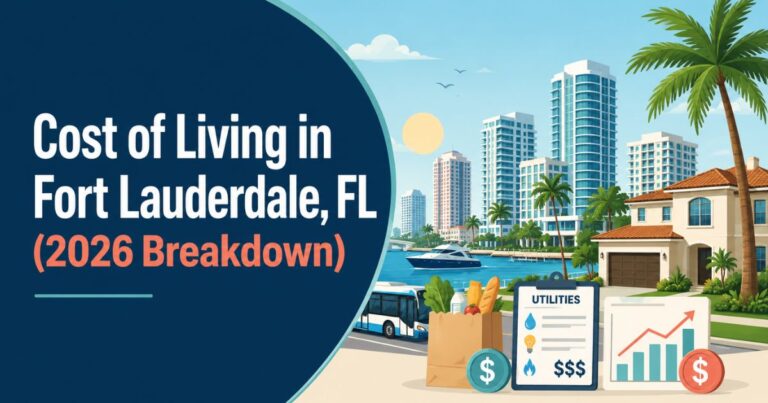
The cost of living in Fort Lauderdale, Florida is high by any measure — this is premium South Florida coastline, and the price reflects it. This guide breaks down what it actually costs to live in Fort Lauderdale (Broward County, in the Miami–Fort Lauderdale–Pompano Beach metro) in 2026: the all-in monthly numbers, the salary you need, a category-by-category breakdown, neighborhood prices, the tax picture, and how Fort Lauderdale compares to Miami, Orlando, and Tampa. If you’re considering a move to launch something here, pair this with our guide to starting a business in Florida.
Every figure below is sourced, and because cost-of-living numbers change, this content is educational, not financial advice — confirm the current figures against the primary sources for your own situation.
Table of Contents
- 1 How much does it cost to live in Fort Lauderdale, Florida?
- 2 What salary do you need to live comfortably in Fort Lauderdale?
- 3 Is Fort Lauderdale, Florida an expensive place to live?
- 4 Is the cost of living in Fort Lauderdale higher than the national average?
- 5 What is the cost of living in Fort Lauderdale by category?
- 5.1 How much does housing cost in Fort Lauderdale? (rent & home prices)
- 5.2 How much are utilities in Fort Lauderdale?
- 5.3 How much do groceries and food cost in Fort Lauderdale?
- 5.4 How much does transportation cost in Fort Lauderdale?
- 5.5 How much does healthcare cost in Fort Lauderdale?
- 5.6 How much is childcare in Fort Lauderdale?
- 6 How much do taxes cost in Fort Lauderdale, Florida?
- 7 What are the cheapest and most expensive neighborhoods in Fort Lauderdale?
- 8 How does Fort Lauderdale’s cost of living compare to other Florida cities?
- 9 How can you lower your cost of living in Fort Lauderdale?
- 10 Is Fort Lauderdale a good place to live and work?
- 11 Frequently Asked Questions About the Cost of Living in Fort Lauderdale
How much does it cost to live in Fort Lauderdale, Florida?
Living in Fort Lauderdale costs a single adult roughly $3,700 per month (about $44,800 a year in after-tax living expenses), and a family of four with two young children roughly $8,700 per month, according to the MIT Living Wage estimate for Broward County. The single-adult figure breaks down to about $1,750 housing, $644 transportation, $395 food, $227 healthcare, and the rest across utilities, internet, and other essentials.
One important caveat: MIT’s model uses a conservative HUD-based housing figure of about $1,750/month, but actual market rent for a 1-bedroom in Fort Lauderdale runs closer to $2,000–$2,400. Use real market rent and a realistic single-adult budget is often $4,000+ per month. The family-of-four total is driven largely by childcare and a bigger housing footprint — strip out daycare (once kids reach school age) and it falls to roughly $6,800 per month. Broward County is home to about 1.95 million people, with a median household income near $78,000 countywide (closer to $83,000 within the city of Fort Lauderdale).
What salary do you need to live comfortably in Fort Lauderdale?
To live comfortably in Fort Lauderdale, a single adult needs roughly $53,000 per year before taxes on the living-wage model, a couple with no kids about $69,700 combined, and a family of four around $117,000 combined, based on MIT Living Wage figures for Broward County. Because market rents run above the model’s housing line, a single adult who wants real breathing room should target closer to $65,000–$75,000.
The math is the standard affordability framework. Keep housing near 30% of gross income and split the rest with something like 50/30/20 — 50% needs, 30% wants, 20% savings and debt. At Fort Lauderdale’s market 1-bedroom rent of roughly $2,000–$2,400, the 30% rule implies an income of about $80,000–$96,000 to carry that rent comfortably on a single salary — which is why many single renters here take roommates or live in western Broward. Florida’s lack of a state income tax helps: the same gross salary delivers more take-home pay than in an income-tax state. Before committing, build a monthly budget against real Fort Lauderdale prices.
Is Fort Lauderdale, Florida an expensive place to live?
Fort Lauderdale is an expensive place to live — it’s a high-cost South Florida market that sits well above the national average, below Miami but materially pricier than Orlando, Tampa, and Jacksonville. Composite cost-of-living estimates put the metro roughly 20–24% above the U.S. average, with housing as the main driver.
What makes Fort Lauderdale costly isn’t groceries or healthcare (both run near or below the national average) — it’s housing and insurance. This is dense, low-elevation coastline with hurricane, storm-surge, king-tide, and flood exposure, which produces some of the heaviest homeowners and flood insurance premiums in the country. A buyer is paying both a premium home price and a premium to insure it. (Composite index figures here are estimates from private cost-of-living indexes such as C2ER/COLI, not a government primary source.)
Is the cost of living in Fort Lauderdale higher than the national average?
Fort Lauderdale’s cost of living is significantly higher than the national average — roughly 20–24% above the U.S. baseline of 100, driven overwhelmingly by housing. The Zillow Home Value Index for Fort Lauderdale is about $521,000, roughly 40% above the U.S. typical home value, and the all-types median rent (~$2,950) runs about 40% above the national median.
When you split the index into housing versus everything else, housing (rent, home prices, and especially insurance) accounts for almost all of the gap. Fort Lauderdale is dense South Florida coastline with wind, flood, and king-tide exposure, so homeowners and flood insurance together form one of the heaviest cost lines in any Broward budget. Non-housing categories — groceries, healthcare, and taxes (no state income tax) — generally run at or below the national norm, which keeps the overall premium from being even larger.
What is the cost of living in Fort Lauderdale by category?
Fort Lauderdale’s cost of living breaks down across housing, utilities, groceries, transportation, healthcare, childcare, and taxes. The table shows estimated monthly costs for a single adult and a family of four, drawn from the MIT Living Wage model for Broward County (annual figures converted to monthly), with each category discussed underneath.
| Category | Single adult / mo | Family of 4 / mo | vs. U.S. average |
|---|---|---|---|
| Housing (rent) | ~$1,750 | ~$2,345 | Well above |
| Utilities (electric, water, internet) | ~$300–$400 | ~$400–$500 | Above (A/C) |
| Groceries / food at home | ~$395 | ~$1,155 | Slightly above |
| Transportation | ~$644 | ~$1,080 | Above (auto insurance) |
| Healthcare | ~$227 | ~$760 | At / below |
| Childcare | $0 | ~$1,842 | High (pre-VPK) |
| Taxes (income + sales share) | ~$667 | ~$1,098 | Below (no income tax) |
| All-in monthly total | ~$3,700 | ~$8,700 | Well above average |
This category table is the best snapshot of a Fort Lauderdale budget. The single-adult housing line is conservative; using market rent pushes the all-in single figure toward $4,000+. The family-of-four total assumes two young children in daycare; for school-age kids, drop the childcare line and the total falls to roughly $6,800/month. These are educational estimates — your actual costs depend on neighborhood, household size, and insurance profile.
How much does housing cost in Fort Lauderdale? (rent & home prices)
Housing in Fort Lauderdale averages about $2,000–$2,400 for a 1-bedroom and roughly $2,700–$3,000 for a 2-bedroom apartment, while the typical home value sits near $521,000. HUD’s official FY2026 Fair Market Rents for Broward County — the 40th-percentile benchmark — are $1,737 (studio), $1,900 (1BR), $2,333 (2BR), $3,216 (3BR), and $3,810 (4BR), all well above Orlando.
On the market side (Zillow, Redfin, and RentCafe data for 2026, which are non-primary), apartment averages run roughly $2,100 (studio), $2,400 (1BR), $3,000 (2BR), and $3,900 (3BR), with an all-types median near $2,800–$2,950. For buyers, the Zillow Home Value Index is about $521,000, the Redfin median sale price is closer to $565,000–$582,000, and Broward County’s median sits around $469,000. Condos are cheaper (median ~$412,000), single-family homes higher (~$605,000), and waterfront or Las Olas properties often exceed $900,000. On a $521,000 home with 20% down at current rates, principal and interest run roughly $2,500/month before taxes and insurance.
The defining Fort Lauderdale cost is insurance. This is dense, low-elevation coastline with wind, flood, and king-tide exposure — among the heaviest homeowners and flood insurance burdens in the state — so insurance is a top cost driver, not a footnote. Homeowners premiums for $300,000 dwelling coverage range roughly $5,000 to $11,000+ a year depending on roof age, elevation, and wind-mitigation features, and many properties also need separate flood insurance (NFIP averages around $800–$940/year statewide, far more in high-risk coastal zones). Budget for both before buying.
How much are utilities in Fort Lauderdale?
Utilities in Fort Lauderdale run about $300–$400 a month for a one-to-two-person household, including electricity, water, sewer, trash, and internet. Electricity is the largest piece: with air conditioning running nearly year-round in South Florida’s climate, energy bills here average around $200–$230 a month and climb in the summer peak.
Most of Fort Lauderdale is served by Florida Power & Light (FPL) for electricity, with water and sewer billed locally. Budget roughly $150–$230 for electricity, $70–$100 for water/sewer/trash, and $65–$75 for home internet. As across Florida, summer cooling is the swing factor — an efficient A/C system and a well-sealed unit make a meaningful difference on the electric bill.
How much do groceries and food cost in Fort Lauderdale?
Groceries in Fort Lauderdale cost a single adult about $395 a month and a family of four roughly $1,100–$1,200, based on the MIT Living Wage food-at-home estimate for Broward County. Local grocery prices run slightly above the national average (Publix dominates, with Whole Foods and Trader Joe’s in key areas), and Florida helps by exempting unprepared groceries and prescription drugs from sales tax — only prepared foods, candy, and soft drinks are taxed.
Dining out adds up fast in a tourist-and-nightlife city: a casual sit-down meal runs $20–$35 per person, so a household that eats out a few times a week can easily add $400–$600 to the monthly food line. Cooking at home is the easiest lever for trimming a Fort Lauderdale budget.
How much does transportation cost in Fort Lauderdale?
Transportation in Fort Lauderdale costs a typical single adult about $644 a month once you include a car payment, gas, maintenance, and insurance — because the city is largely car-dependent, with an average Broward commute near 29 minutes. That said, Fort Lauderdale has more transit options than most Florida metros.
Broward County Transit (BCT) buses charge $2.00 per one-way ride (free transfers; a 31-day pass is $70). Tri-Rail, the commuter train, links Broward with Miami-Dade and Palm Beach, with distance-based fares from $2 one-way to $9.25 round trip. Brightline offers fast intercity service to Miami, West Palm Beach, and Orlando (priced for trips, not daily commuting), the free Sun Trolley and Riverwalk Water Trolley circulate downtown, and the privately run Water Taxi serves the waterways. Still, most households need a car. The bigger budget pressure is auto insurance: Florida premiums are among the highest in the nation, though 2026 reforms have started easing them.
How much does healthcare cost in Fort Lauderdale?
Healthcare in Fort Lauderdale costs an individual roughly $227 a month and a family of four about $760 in typical out-of-pocket and premium-share spending, per the MIT Living Wage model for Broward County — generally at or below the national average. Actual costs depend heavily on your employer plan or marketplace coverage.
Access is strong: Fort Lauderdale is served by major systems including Broward Health, Memorial Healthcare System, Holy Cross Health, and Cleveland Clinic Florida in nearby Weston, so hospitals and specialist care are well-distributed. As anywhere, the single biggest determinant of your healthcare cost is whether you have employer-sponsored insurance versus buying your own on the marketplace.
How much is childcare in Fort Lauderdale?
Childcare in Fort Lauderdale is the biggest swing in any family budget: full-time infant care runs roughly $1,100–$1,500 a month in Broward County, and the MIT model puts two young children in care at about $1,842 a month combined — making daycare the second-largest household expense after housing for many families.
Relief arrives at age four. Florida’s Voluntary Prekindergarten (VPK) program is free for every four-year-old in the state regardless of income, providing 540 instructional hours during the school year (or 300 in summer), and can save a family $5,000–$8,000 a year per child. Many families still pay for “wraparound” care to cover hours outside the free VPK block. Enroll through the Early Learning Coalition of Broward County. Childcare rates vary widely by provider, so confirm current pricing directly — this is the line most worth shopping around.
How much do taxes cost in Fort Lauderdale, Florida?
Fort Lauderdale residents pay no state income tax — Florida is one of nine states without one — and a combined sales tax of 7% (6% state plus a 1% Broward County discretionary surtax). Groceries and prescription drugs are exempt, and the county surtax applies only to the first $5,000 of any single item.
For homeowners, the other major tax is property tax. Broward County’s effective property tax rate runs roughly 1.0%–1.1% of market value — about $5,200–$5,700 a year on a $521,000 home before exemptions (verify your exact millage with the Broward County Property Appraiser, as it varies by city and taxing district). Owner-occupants who make the home their permanent residence can claim Florida’s Homestead Exemption, which shields up to $50,000 of assessed value (saving roughly $750–$1,100/year) and triggers the Save Our Homes cap that limits annual assessed-value increases to 3% or CPI, whichever is lower. A statewide ballot amendment in November 2026 could raise the homestead exemption substantially, but it is not yet law — treat current rules as the baseline. Business owners should also review the Florida sales tax for businesses rules, which differ from consumer purchases.
What are the cheapest and most expensive neighborhoods in Fort Lauderdale?
Fort Lauderdale’s neighborhoods span a very wide range — a 1-bedroom can run from around $1,100 in budget pockets to well over $3,000 along the beach and downtown. The table maps representative areas with approximate 1-bedroom rents and character. (Rents are 2026 market data from RentCafe and Rent.com — non-primary sources that shift month to month.)
| Neighborhood | Approx. 1BR rent | Character & commute |
|---|---|---|
| Melrose Park | ~$1,100–$1,300 | Budget; west of downtown, car needed |
| Lauderdale Park / Edgewood | ~$1,500–$1,550 | Budget; central, near I-95 |
| South Middle River / Poinsettia Heights | ~$1,600–$1,700 | Budget; up-and-coming, near downtown |
| Sunrise / Lauderhill / Tamarac (western Broward) | ~$1,600–$1,900 | Budget-mid; suburban, 20–30 min commute |
| Flagler Village | ~$2,600 | Premium; walkable arts district, downtown |
| Coral Ridge | ~$2,540 | Premium; near beach, residential |
| Las Olas / downtown / Tarpon River | ~$3,100–$3,400 | Premium; walkable, no car needed |
The most expensive owned homes cluster in waterfront enclaves like Rio Vista, Victoria Park, Harbor Beach, and the beachfront condo corridor, where prices commonly exceed $900,000. For buyers prioritizing space and price, western Broward communities like Plantation, Sunrise, and Davie offer median home prices around $400,000–$500,000 — the trade-off being a 20–40 minute commute to the beach or downtown. If you’re comparing across the state, see how Fort Lauderdale lines up with sibling cities below.
How does Fort Lauderdale’s cost of living compare to other Florida cities?
Fort Lauderdale is modestly cheaper than Miami but well above Orlando and Tampa — placing it among the most expensive metros in the state. The table compares the four cities across rent, home value, and sales tax (rent and home values are Zillow market data for 2026; sales tax is the combined county rate).
| City (county) | Median rent (all types) | Typical home value | Combined sales tax |
|---|---|---|---|
| Fort Lauderdale (Broward) | ~$2,950 | ~$521,000 | 7.0% |
| Miami (Miami-Dade) | ~$3,285 | ~$582,000 | 7.0% |
| Orlando (Orange) | ~$2,050 | ~$376,000 | 6.5% |
| Tampa (Hillsborough) | ~$2,195 | ~$385,000 | 7.5% |
Who each city fits: Miami for a global, beachfront big-city economy at the highest price; Fort Lauderdale for South Florida coastal living and a strong marine/finance/tourism job market at a slight discount to Miami; Orlando for a central, lower-tax metro with far cheaper housing; and Tampa for a Gulf-coast mid-size feel that’s also much cheaper than the southeast coast. Fort Lauderdale and Miami both carry the heaviest insurance load; Orlando and Tampa are materially lighter.
Fort Lauderdale vs Miami: which is cheaper to live in?
Fort Lauderdale is modestly cheaper than Miami — overall living costs run roughly 9% lower, driven by housing. Miami’s median all-types rent (~$3,285) is about $335 a month higher than Fort Lauderdale’s (~$2,950), and Miami’s typical home value (~$582,000) is about $61,000 higher than Fort Lauderdale’s (~$521,000), with comparable properties often $70,000–$150,000 more in Miami. Both counties charge 7% sales tax and both carry steep coastal insurance, so the gap is real but not dramatic. For a deeper side-by-side, see our breakdown of the cost of living in Miami.
Fort Lauderdale vs Orlando: which is cheaper to live in?
Orlando is significantly cheaper than Fort Lauderdale. Fort Lauderdale’s all-types median rent (~$2,950) runs about $900 a month higher than Orlando’s (~$2,050) — over $10,000 a year — and Fort Lauderdale’s typical home value (~$521,000) is roughly $145,000 higher than Orlando’s (~$376,000). Fort Lauderdale also has a higher sales tax (7% vs. 6.5%) and far steeper coastal home and flood insurance than inland Orlando. Orlando wins clearly on cost. Compare the full picture in our cost of living in Orlando guide.
Fort Lauderdale vs Tampa: which is cheaper to live in?
Tampa is notably cheaper than Fort Lauderdale overall. Fort Lauderdale’s median rent (~$2,950) runs about $755 a month higher than Tampa’s (~$2,195), and its typical home value (~$521,000) is roughly $136,000 higher than Tampa’s (~$385,000). The one line where Tampa is higher is sales tax (7.5% vs. Broward’s 7%), but Fort Lauderdale’s much higher housing and southeast-coast insurance more than offset that. Tampa offers Gulf-coast living at a meaningful discount. See the full comparison in our cost of living in Tampa guide.
Is Fort Lauderdale cheaper than Miami?
Yes, slightly. Fort Lauderdale’s overall cost of living runs about 9% below Miami’s, driven by housing — median rent is roughly $335/month lower (~$2,950 vs. ~$3,285) and comparable homes cost $70,000–$150,000 less. Both are high-cost South Florida markets with 7% sales tax and steep coastal insurance, so the gap is modest, not dramatic.
Is Fort Lauderdale expensive to live in?
Yes — Fort Lauderdale is expensive, roughly 20–24% above the U.S. average overall. Housing leads it: the typical home value (~$521,000) is about 40% above the national norm, and the city carries some of the nation’s highest homeowners and flood insurance costs. Groceries and healthcare run closer to average, and there’s no state income tax, which softens the total.
Can you live in Fort Lauderdale on $60,000 a year?
Living in Fort Lauderdale on $60,000 a year is tight for a single adult and difficult for a family. It clears the ~$53,000 living-wage baseline, and Florida’s no-income-tax take-home helps, but market 1-bedroom rent of $2,000–$2,400 eats a large share — leaving little for savings. A single renter can manage it with roommates or a budget neighborhood; a family cannot.
Is $80,000 a good salary in Fort Lauderdale?
Yes — $80,000 is an adequate salary for a single adult in Fort Lauderdale, though not luxurious given high rents. With no state income tax, $80,000 yields roughly $64,000–$66,000 in take-home pay, comfortably above the living-wage line and able to cover a market 1-bedroom near the 30% rule. For a couple or family, it stretches less far here than in cheaper Florida metros.
Do you need a car in Fort Lauderdale?
Mostly yes — you generally need a car in Fort Lauderdale. The city is largely car-dependent, with an average commute near 29 minutes. Broward County Transit buses, Tri-Rail, Brightline, the free Sun Trolley, and the Water Taxi cover some corridors and downtown well, so car-free living is feasible in walkable areas like Las Olas — but for most households a car is still necessary.
How can you lower your cost of living in Fort Lauderdale?
You can lower your Fort Lauderdale cost of living with moves that target the biggest line items — housing and, above all, insurance. The most effective levers:
- Target a sub-median neighborhood. Choosing western Broward (Sunrise, Lauderhill, Tamarac) or budget pockets (Melrose Park, South Middle River) over the beach and downtown can cut rent by $800–$1,500 a month.
- Shop your insurance hard — this is the biggest lever here. Fort Lauderdale homeowners premiums vary by thousands of dollars between carriers; with 2026 rate reductions filed across Florida, re-shopping at renewal (and adding wind-mitigation upgrades, impact windows, and a newer roof) can save thousands. Compare NFIP and private flood policies separately.
- Claim the Homestead Exemption if you buy. It shields up to $50,000 of assessed value and locks in the 3% Save Our Homes cap — file with the Broward County Property Appraiser by March 1.
- Budget for summer A/C. Cooling drives the FPL bill; an efficient system and a sealed unit cut it meaningfully.
- Use Tri-Rail, BCT, or the Sun Trolley to drop a car. Along the rail and transit corridors, replacing a second vehicle removes a payment, insurance, gas, and maintenance from the budget.
For a broader toolkit, see our guide to practical ways to save money. When setting up everyday accounts, it can also help to compare the best banks in Florida for low fees.
Is Fort Lauderdale a good place to live and work?
Fort Lauderdale is a good place to live and work, with a diverse coastal economy and the no-income-tax appeal that draws businesses and remote workers across South Florida. Its signature industry is marine and yachting — Port Everglades and the Fort Lauderdale International Boat Show anchor a globally significant marine economy — alongside tourism and hospitality, finance, technology, and healthcare (Broward Health, Memorial Healthcare, Cleveland Clinic Florida), with substantial spillover from the broader Miami metro. Unemployment typically runs low.
For workers, the combination of no state income tax, a strong job base, and a slight discount to Miami makes Fort Lauderdale attractive — particularly for remote employees whose salaries are set by even higher-cost markets. For founders, the marine, tourism, and finance clusters plus a wealthy consumer base make it a viable launch city; see where it ranks among the best cities to start a business in Florida. The main trade-offs are the high housing and insurance costs and the car dependence covered above.
Frequently Asked Questions About the Cost of Living in Fort Lauderdale
Here are quick, sourced answers to the most common questions about what it costs to live in Fort Lauderdale, Florida.
How much money do you need to live comfortably in Fort Lauderdale?
To live comfortably in Fort Lauderdale, a single adult needs roughly $53,000 a year before taxes on the living-wage model — realistically $60,000–$75,000 at market rents — and a family of four about $117,000 combined, per MIT Living Wage estimates for Broward County. Florida’s lack of a state income tax stretches each salary further than in income-tax states.
What is the average rent in Fort Lauderdale in 2026?
The average rent in Fort Lauderdale in 2026 is about $2,000–$2,400 for a 1-bedroom and roughly $2,700–$3,000 for a 2-bedroom apartment, with the all-types median near $2,800–$2,950. HUD’s official FY2026 Fair Market Rent for Broward County is $1,900 (1BR) and $2,333 (2BR). Rents are well above Orlando and slightly below Miami. (Market figures are non-primary.)
Why is Fort Lauderdale so expensive?
Fort Lauderdale is expensive mainly because of housing on limited coastal land, strong South Florida and out-of-state migration demand, and the nation’s heaviest insurance costs. Dense, low-elevation coastline with hurricane, storm-surge, and flood exposure pushes homeowners and flood insurance among the highest in the U.S., and home prices run about 40% above the national average.
Is it cheaper to live in Fort Lauderdale or Miami?
Fort Lauderdale is cheaper than Miami, by roughly 9% overall. The savings come mostly from housing — median rent runs about $335/month lower (~$2,950 vs. ~$3,285), and comparable homes cost $70,000–$150,000 less. Both cities charge 7% sales tax and carry steep coastal insurance, so daily expenses like groceries are similar.
Is Fort Lauderdale more affordable than the rest of Florida?
No — Fort Lauderdale is among the pricier Florida metros, not more affordable than the rest of the state. It’s modestly cheaper than Miami but well above Orlando, Tampa, and Jacksonville on both rent and home prices, and it carries some of the state’s heaviest insurance costs. Western Broward suburbs offer the most relief within the area.