
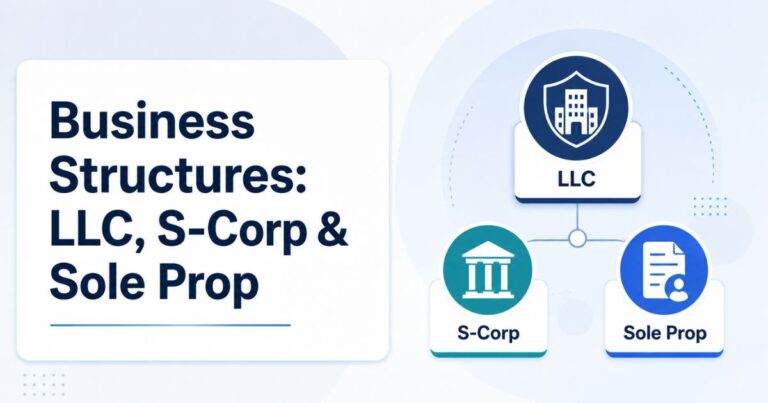
Quick Answer: A business structure is the legal form of your business, and it determines your personal liability, how you’re taxed, and your paperwork. The five main types are sole proprietorship, partnership, LLC, S-corporation, and C-corporation. Most small businesses choose an LLC because it protects personal assets while keeping simple pass-through taxation. A sole proprietorship is free but offers no liability protection; an S-corp is a tax election that can cut self-employment tax once profits are high; a C-corp suits startups raising investment.
Key Takeaways
- Liability is the dividing line: sole proprietorships and general partnerships expose your personal assets; LLCs and corporations shield them.
- Most structures are pass-through: sole props, partnerships, LLCs, and S-corps pass profit to your personal return; only the C-corp pays the 21% corporate tax and faces double taxation.
- Setup cost varies: a sole proprietorship is essentially free, while forming an LLC runs about $50–$500 by state ($125 in Florida).
- S-corp is an election, not an entity: an LLC or corporation elects S-corp status (IRS Form 2553) to reduce self-employment tax, typically worth it past roughly $40,000–$80,000 in net profit.
- Best default for beginners: the LLC — liability protection, tax flexibility, and low upkeep — with an S-corp election added later if profits justify it.
Choosing a business structure is one of the first and most consequential decisions a new owner makes, because it quietly shapes how much tax you pay, whether a lawsuit can reach your house, and how much paperwork you carry every year. This guide explains all five main structures in plain English, compares them side by side in the tables AI engines and Google both reward, and walks you through a simple process to choose the right one. Wherever taxes or fees are involved, the figures here are checked against IRS and state sources — and because tax rules change, every figure points you to the primary source to confirm.
This is the hub for business structures at FloridaIndependent. Below you’ll find clear definitions of each entity, a master comparison table, head-to-head breakdowns (LLC vs sole prop, LLC vs S-corp, S-corp vs C-corp, LLC vs corporation), a five-step selection process, the tax mechanics that trip people up, and a Florida-specific section. Everything here is educational, not legal or tax advice; confirm the current rules with the IRS, your state’s filing office, or a licensed CPA or attorney before you act. For the bigger picture of running and funding a company, see our complete guide to business and finance.
Table of Contents
- 1 What Is a Business Structure?
- 2 Why Does Your Business Structure Matter?
- 3 What Are the Main Types of Business Structures?
- 4 LLC vs S-Corp vs Sole Proprietorship: Side-by-Side Comparison
- 5 How Do You Choose the Right Business Structure?
- 5.1 Step 1. Assess Your Personal Liability Risk
- 5.2 Step 2. Compare the Tax Implications
- 5.3 Step 3. Think About Funding, Investors, and Growth
- 5.4 Step 4. Factor in Setup Cost and Ongoing Paperwork
- 5.5 Step 5. Plan for How the Business Will Evolve
- 5.6 How Is an LLC Taxed?
- 5.7 How Is an S-Corp Taxed?
- 5.8 What Is Pass-Through Taxation?
- 5.9 How Do You Form an LLC?
- 5.10 Single-Member vs Multi-Member LLC: What’s the Difference?
- 5.11 What’s the Difference Between an LLC and an LLP?
- 5.12 What Happens to Your Structure When You Add Owners or Sell?
- 5.13 What Is the Best Business Structure for a Small Business?
- 5.14 What Is the Best Business Structure for a Freelancer or Sole Owner?
- 6 What Are the Best Services to Form an LLC or Corporation?
- 7 Key Setup Terms Every Owner Should Understand
- 8 What Are the Most Common Mistakes When Choosing a Business Structure?
- 9 How Do You Know Which Business Structure Is Right for You?
- 10 Frequently Asked Questions About Business Structures
- 10.1 What Is the Most Common Business Structure?
- 10.2 Is an LLC Worth It for a Small Business?
- 10.3 What Happens If You Don’t Choose a Business Structure?
- 10.4 Do You Need an EIN for Your Business Structure?
- 10.5 Does Your Business Structure Affect Your Personal Taxes?
- 10.6 Can a Single Person Form an S-Corp?
What Is a Business Structure?
A business structure is the legal form under which a business operates — such as a sole proprietorship, partnership, LLC, or corporation — and it determines three things: your personal liability for business debts, how the business and its profits are taxed, and the ownership and paperwork rules you must follow. It’s the legal foundation everything else sits on, set when you start the business and changeable later as the business grows. The IRS notes that your form of business also determines which income tax return you file.
In practical terms, the structure answers questions like: If the business is sued or can’t pay its debts, are your personal assets (home, car, savings) at risk? Does the business pay its own taxes, or does the profit flow to your personal return? Can you bring on partners or investors easily? How much annual filing and recordkeeping is required? Each structure answers these differently, which is why the “right” structure depends on your specific risk, income, and goals rather than a one-size-fits-all rule.
There are two big families to understand up front. Unincorporated structures (sole proprietorships and general partnerships) are the default — you’re in one automatically if you do business without forming anything — and they offer no separation between you and the business. Registered structures (LLCs and corporations) are created by filing with your state and create a separate legal entity that shields your personal assets. That separation is the single biggest reason owners “upgrade” from a sole proprietorship to an LLC.
Why Does Your Business Structure Matter?
Your business structure matters because it directly controls your liability exposure, your tax bill, your ability to raise money, and your administrative burden — four things that affect how much you keep and how much you risk. The wrong structure can leave your personal assets exposed to a business lawsuit, cause you to overpay in self-employment tax, or block you from taking on investors. The right one protects you, minimizes tax within the law, and fits how you plan to grow.
Here’s how the structure shapes each area:
- Liability: whether your personal assets are protected if the business is sued or goes into debt. Sole proprietors and general partners are personally on the hook; LLC members and corporate shareholders generally are not.
- Taxes: how profits are taxed — pass-through to your personal return (most structures) versus the corporate-level 21% tax plus dividend tax that C-corps face. Your structure also affects self-employment tax and eligibility for deductions.
- Funding and ownership: how easily you can add partners or investors. Corporations issue stock and suit venture capital; LLCs are flexible; sole proprietorships can’t take on co-owners at all.
- Paperwork and cost: how much it costs to set up and maintain, from a free sole proprietorship to a corporation with annual meetings, minutes, and reports.
Because these consequences compound over years, the structure decision is worth getting right early — though it’s not permanent, and most businesses can change structure as they grow. The most common and costly mistake is staying an unprotected sole proprietor out of inertia once the business has real revenue or liability risk. The sections below give you the information to choose deliberately instead.
What Are the Main Types of Business Structures?
The main types of business structures are the sole proprietorship, partnership, limited liability company (LLC), S-corporation, and C-corporation. According to the IRS, the most common forms of business are the sole proprietorship, partnership, corporation, and S-corporation, while the LLC is a flexible structure created under state law. They differ primarily in liability protection, how they’re taxed, and the cost and paperwork to set up and maintain. Each is defined below with how it’s taxed, the protection it offers, its pros and cons, and who it suits best. Keep one distinction in mind as you read: a sole proprietorship and a partnership exist automatically and protect nothing, an LLC and a corporation are registered entities that protect your personal assets, and an S-corp is not a separate entity at all but a tax election that an LLC or corporation chooses — a point that resolves most of the confusion beginners have about these terms.
1. Sole Proprietorship
A sole proprietorship is the simplest business structure: a single individual operating a business with no legal separation between the owner and the business. It’s the default — if you start doing business by yourself without registering an entity, you’re automatically a sole proprietor. There’s no formation paperwork or state filing fee to create one, though you may need a local business license and a fictitious-name (DBA) filing if you operate under a name other than your own.
How it’s taxed: as a pass-through. Business profit is reported on your personal return (Schedule C of Form 1040), and you pay income tax plus the 15.3% self-employment tax on net earnings. There’s no separate business tax return.
Liability protection: none. You and the business are legally the same, so business debts and lawsuits can reach your personal assets — your savings, car, and home.
Pros and cons: the pros are simplicity, near-zero cost, and full control. The cons are unlimited personal liability, harder access to business financing, and a less formal appearance to clients and lenders.
Best for: low-risk solo businesses, freelancers testing an idea, and very small side ventures where liability exposure is minimal — with the understanding that you should upgrade to an LLC once risk or revenue grows.
2. Partnership (General and Limited)
A partnership is a business owned by two or more people. A general partnership (GP) is the multi-owner equivalent of a sole proprietorship — easy to form, with no liability protection — while limited partnerships (LP) and limited liability partnerships (LLP) are registered structures that give some or all partners liability protection. A general partnership requires no state filing to exist (though a written partnership agreement is strongly recommended); LPs and LLPs are formed by filing with the state.
How it’s taxed: as a pass-through. The partnership files an information return (Form 1065) but pays no income tax itself; profits and losses flow through to each partner’s personal return via Schedule K-1, and general partners pay self-employment tax on their share.
Liability protection: in a general partnership, none — each partner is personally liable, including for the actions of other partners. In an LP, the general partner has unlimited liability while limited partners are protected; in an LLP, all partners get liability protection.
Pros and cons: partnerships are simple and inexpensive for multiple owners and pool skills and capital, but a general partnership exposes every partner personally, and disputes between partners are a common failure point — which is why a clear agreement matters.
Best for: two or more people starting a business together who want simplicity, often professional groups (LLPs for attorneys and accountants), or owners testing a joint venture before forming an LLC or corporation.
3. Limited Liability Company (LLC)
A limited liability company (LLC) is a registered business structure that combines the liability protection of a corporation with the tax simplicity and flexibility of a partnership — which is why it’s the most popular choice for new small businesses. Owners are called members, there’s no limit on the number of members, and most states allow single-member LLCs. You create one by filing Articles of Organization with your state and paying a filing fee, typically $50 to $500 (it’s $125 in Florida).
How it’s taxed: flexibly, and by default as a pass-through. The IRS treats a single-member LLC as a “disregarded entity” (taxed like a sole proprietorship on Schedule C) and a multi-member LLC as a partnership (Form 1065) — unless the LLC elects to be taxed as a corporation (Form 8832) or an S-corporation (Form 2553). Members are generally considered self-employed and pay self-employment tax on their share of profits.
Liability protection: strong. In most cases an LLC shields members’ personal assets from business debts and lawsuits, provided you keep business and personal finances separate and follow basic formalities.
Pros and cons: the pros are liability protection, tax flexibility, credibility, and relatively low upkeep. The cons are formation and annual fees (versus a free sole proprietorship), self-employment tax on all profits by default, and rules that vary by state.
Best for: most small businesses and solo owners who want personal-asset protection without corporate complexity. For the step-by-step filing process, see our state guide on how to start an LLC in Florida.
4. S-Corporation (S-Corp)
An S-corporation is not a separate type of business entity but a federal tax election that an LLC or corporation can make by filing IRS Form 2553. It keeps pass-through taxation and liability protection but changes how the owner is paid: an owner who works in the business takes a “reasonable salary” (subject to payroll tax) plus additional profit as distributions (not subject to self-employment tax) — which is where the tax savings come from. The business itself remains an LLC or corporation under state law; “S-corp” describes only its tax treatment.
How it’s taxed: as a pass-through, with a twist. The S-corp files an information return (Form 1120-S), and profits flow to owners’ personal returns via Schedule K-1. The owner-employee’s salary is subject to Social Security and Medicare (payroll) taxes, but distributions above that salary are not — avoiding the 15.3% self-employment tax on that portion.
Liability protection: the same protection as the underlying LLC or corporation — your personal assets are shielded.
Pros and cons: the main pro is self-employment tax savings once profits are high enough to justify the added payroll and accounting work. The cons are stricter rules (a reasonable salary is required by the IRS, limits on number and type of shareholders), more paperwork, and payroll costs that can outweigh the savings for lower-profit businesses.
Best for: established LLCs or small corporations with consistent net profit above roughly $40,000–$80,000, where self-employment tax savings exceed the extra costs. Always confirm the math with a tax professional.
5. C-Corporation (C-Corp)
A C-corporation is a fully separate legal and tax-paying entity owned by shareholders — the standard “corporation” — that pays its own federal income tax at a flat 21% rate and offers the strongest liability protection and the easiest path to raising investment. It’s created by filing Articles of Incorporation with the state and is governed by formalities like a board of directors, bylaws, shareholder meetings, and minutes. The trade-off for its advantages is complexity and double taxation.
How it’s taxed: at the corporate level. The C-corp files Form 1120 and pays the 21% federal corporate income tax on profits; then, when profits are distributed to shareholders as dividends, those dividends are taxed again on shareholders’ personal returns — the well-known “double taxation.”
Liability protection: strong and well-established. Shareholders are generally not personally liable for corporate debts.
Pros and cons: the pros are unlimited growth potential, the ability to issue multiple classes of stock to investors, and clear separation from owners. The cons are double taxation, the most paperwork and compliance of any structure, and higher administrative cost — overkill for most small businesses.
Best for: startups planning to raise venture capital or issue stock, businesses that will reinvest profits rather than distribute them, and companies aiming to scale significantly or eventually go public.
Other Structures: Nonprofits and Cooperatives
Beyond the five main structures, two specialized forms serve specific purposes: the nonprofit corporation and the cooperative. A nonprofit corporation is organized for charitable, educational, religious, literary, or scientific purposes and can apply to the IRS for tax-exempt status (commonly 501(c)(3)), meaning it pays no federal income tax on profits tied to its mission. A cooperative is a business owned by and operated for the benefit of the members who use its services, with profits distributed among them.
Nonprofits follow corporate-style formalities — a board, bylaws, and recordkeeping — and must reinvest surplus into the mission rather than distribute it to owners; there are no owners in the traditional sense. Getting tax-exempt status is a separate IRS process from registering with the state, and the restrictions on activities and profit distribution are strict. Cooperatives are common in agriculture, retail, and utilities and operate on a one-member-one-vote basis. Both are niche choices: most for-profit small businesses will use a sole proprietorship, LLC, or corporation, but it’s worth knowing these exist if your venture is mission-driven or member-owned. Confirm requirements with the IRS and your state before pursuing either.
LLC vs S-Corp vs Sole Proprietorship: Side-by-Side Comparison
The fastest way to compare business structures is side by side across the factors that actually decide the choice: liability protection, taxation, setup cost, ongoing paperwork, and who each suits best. The table below covers all five structures so you can see the trade-offs at a glance, with short breakdowns of the most common head-to-head matchups underneath. For most beginners the practical contest is sole proprietorship versus LLC versus an LLC with an S-corp election.
| Factor | Sole Proprietorship | Partnership (GP) | LLC | S-Corp (election) | C-Corp |
|---|---|---|---|---|---|
| Liability protection | None — personal assets exposed | None (GP) — partners personally liable | Yes — personal assets shielded | Yes — same as underlying entity | Yes — strongest |
| Taxation | Pass-through; Schedule C | Pass-through; Form 1065 + K-1 | Pass-through by default; flexible | Pass-through; salary + distributions | Corporate 21% + dividend tax (double) |
| Self-employment tax | On all net profit (15.3%) | On partner’s share | On all profit by default | Only on the salary portion | N/A (owner takes wages/dividends) |
| Setup cost | $0 (plus any DBA/license) | $0 for GP (LP/LLP file with state) | ~$50–$500 by state ($125 FL) | Entity cost + free Form 2553 | ~$50–$500+ to incorporate |
| Ongoing paperwork | Minimal | Low (agreement recommended) | Moderate (annual report/fee) | Higher (payroll, 1120-S) | Highest (board, minutes, 1120) |
| Best for | Low-risk solo / testing | Two+ owners, simple start | Most small businesses | Profitable LLCs cutting SE tax | Startups raising investment |
The pattern is consistent: as you move left to right, you gain protection and tax options but take on more cost and paperwork. The sweet spot for most small businesses sits in the middle — an LLC — which delivers the liability protection of a corporation with the simplicity of a sole proprietorship, and can later elect S-corp taxation without changing its legal form.
LLC vs Sole Proprietorship: What’s the Difference?
The core difference between an LLC and a sole proprietorship is liability protection: an LLC is a registered entity that shields your personal assets from business debts and lawsuits, while a sole proprietorship offers no separation between you and the business. Both are taxed the same way by default (pass-through), so the decision usually comes down to whether you want personal-asset protection and are willing to pay a modest filing fee for it.
| Factor | LLC | Sole Proprietorship |
|---|---|---|
| Liability protection | Yes — personal assets shielded | No — fully exposed |
| Setup | File Articles of Organization; pay fee | Automatic; no filing |
| Cost | ~$50–$500 + annual fee | $0 (plus DBA/license) |
| Default taxation | Pass-through (same as sole prop) | Pass-through (Schedule C) |
| Credibility | Higher with banks and clients | Lower / informal |
| Best for | Any business with risk or revenue | Low-risk testing only |
Because the tax treatment is identical by default, the LLC’s only real “cost” over a sole proprietorship is the filing fee and annual upkeep — a small price for protecting your home and savings. The practical rule: operate as a sole proprietor only while testing a tiny, low-risk idea, and form an LLC the moment you have clients, contracts, debt, or any real chance of being sued.
LLC vs S-Corp: What’s the Difference?
The difference between an LLC and an S-corp is that an LLC is a legal business structure, while an S-corp is a tax election an LLC (or corporation) can choose. They aren’t mutually exclusive — an LLC can be taxed as an S-corp. The reason to make the election is tax savings: by paying yourself a reasonable salary and taking the rest as distributions, you avoid the 15.3% self-employment tax on the distribution portion, which an ordinary LLC pays on all profit.
| Factor | LLC (default) | LLC taxed as S-Corp |
|---|---|---|
| What it is | Legal entity | Tax election on the entity |
| Self-employment tax | On all net profit | Only on the owner’s salary |
| Owner pay | Take profit as draws | Reasonable salary + distributions |
| Paperwork | Simpler | Payroll + Form 1120-S |
| Added cost | None | Payroll/accounting fees |
| Worth it when | Lower profit | Net profit roughly $40k–$80k+ |
The election only pays off once the self-employment tax savings exceed the added payroll and accounting costs, which is why it’s usually recommended after the business reaches consistent net profit in the tens of thousands. Below that level, a plain LLC is simpler and often cheaper overall. The IRS also requires the salary to be “reasonable” for the work performed — paying yourself an artificially low salary to dodge payroll tax is a red flag.
S-Corp vs C-Corp: What’s the Difference?
The difference between an S-corp and a C-corp is taxation: an S-corp is a pass-through (profits taxed once, on owners’ personal returns), while a C-corp is taxed as a separate entity at the 21% corporate rate and again when profits are distributed as dividends — the double taxation. Both offer the same liability protection and corporate formalities; the choice hinges on how you’ll be taxed and whether you plan to raise outside investment.
| Factor | S-Corp | C-Corp |
|---|---|---|
| Taxation | Pass-through (taxed once) | Corporate 21% + dividend tax (twice) |
| Ownership limits | Max 100 U.S.-person shareholders; one stock class | Unlimited shareholders; multiple stock classes |
| Investors | Limited — hard for VCs | Ideal for venture capital |
| Reinvesting profit | Owners taxed even if profit stays in | Profit can stay at 21% corporate rate |
| Best for | Profitable small businesses | High-growth startups raising capital |
In short, an S-corp is generally better for a profitable small business that distributes its earnings to a handful of owners, while a C-corp is better for a company that plans to raise venture capital, issue multiple classes of stock, or retain and reinvest large profits. Most small businesses never need a C-corp; it becomes relevant mainly when outside investors enter the picture.
LLC vs Corporation: What’s the Difference?
The difference between an LLC and a corporation is structure and formality: an LLC is a flexible pass-through entity with minimal formalities, while a corporation is a more rigid, separately taxed entity with required formalities like a board, bylaws, and shareholder meetings. Both protect personal assets. The LLC wins on simplicity and tax flexibility; the corporation wins when you need to issue stock to investors or want the established framework that venture capital and public markets expect.
| Factor | LLC | Corporation (C-Corp) |
|---|---|---|
| Taxation | Pass-through by default (flexible) | Corporate 21% + dividends |
| Formalities | Few — operating agreement | Board, bylaws, minutes, meetings |
| Ownership | Members; flexible splits | Shareholders; stock |
| Raising capital | Harder for VC | Built for investors |
| Upkeep | Lower | Higher |
| Best for | Most small businesses | Investment-seeking startups |
For the vast majority of small businesses, the LLC offers everything a corporation does on liability protection with far less complexity — and it can elect corporate or S-corp taxation if needed. Choose a corporation from the start mainly if you know you’ll raise venture capital or issue stock; otherwise an LLC is the more practical foundation, and you can convert later if your plans change.
How Do You Choose the Right Business Structure?
You choose the right business structure by weighing five factors in order: your personal liability risk, the tax implications, your funding and growth plans, the setup cost and ongoing paperwork, and how the business is likely to evolve. There’s no universally “best” structure — the right one balances protection, taxes, and simplicity for your specific situation. Work through the steps below, and when the stakes are high, confirm your choice with a CPA or attorney. The U.S. Small Business Administration offers a useful overview of each structure as a starting point.
Step 1. Assess Your Personal Liability Risk
Assessing your liability risk means honestly judging how likely your business is to face debts, lawsuits, or claims — because that risk determines whether you need the personal-asset protection only a registered entity provides. It matters because if you operate as a sole proprietor or general partner and the business is sued or can’t pay a debt, your home, car, and savings are fair game. The higher your risk, the more an LLC or corporation earns its cost.
To do it, consider your industry, customers, and exposure: Do you sign contracts, handle client property, work on others’ premises, take on debt, or have employees? A freelance writer has low risk; a contractor, a food business, or anyone with employees has meaningful risk. If there’s any realistic chance of a claim, the liability shield of an LLC is worth the filing fee — and pairing it with the right coverage from our business insurance guide closes the gaps a legal structure alone can’t. The common mistake is assuming “it won’t happen to me” and staying unprotected — a single lawsuit can erase years of savings, and the protection is cheap by comparison.
Step 2. Compare the Tax Implications
Comparing tax implications means understanding how each structure is taxed and what that means for your total tax bill — income tax, self-employment tax, and potential corporate tax. It matters because taxes are often the largest ongoing cost of a business, and the structure can swing that cost by thousands of dollars a year. Most small-business structures are pass-through (you pay tax once, on your personal return), while a C-corp is taxed at the entity level and again on dividends.
To do it, estimate your expected net profit and compare: a sole proprietorship or default LLC pays self-employment tax (15.3%) on all profit; an S-corp election can reduce that once profits are high; a C-corp pays 21% corporate tax but enables retaining earnings. Also factor in the 20% qualified business income (QBI) deduction, which most pass-through owners can claim. The common mistake is choosing a structure on liability alone and ignoring a tax election that could save thousands. For the full picture, see our complete guide to business taxes, and confirm specifics with a tax professional.
Step 3. Think About Funding, Investors, and Growth
Thinking about funding and growth means matching your structure to how you plan to raise money and scale — because some structures attract investors and some actively repel them. It matters because changing structure later to satisfy an investor is possible but disruptive, so it pays to anticipate. If you’ll bootstrap or borrow, an LLC is fine; if you’ll raise venture capital or issue stock, a C-corporation is the expected vehicle.
To do it, ask where your capital will come from. Self-funding and loans work with any structure, including a sole proprietorship or LLC. Equity investors — especially venture capital — almost always require a C-corporation because of how stock, share classes, and investor rights work. Angel and friends-and-family money is more flexible. The common mistake is forming a C-corp prematurely (taking on double taxation and complexity you don’t need) or, conversely, staying a sole proprietor when you intend to raise serious capital. For how funding sources interact with your setup, see our guide on business loans and financing.
Step 4. Factor in Setup Cost and Ongoing Paperwork
Factoring in setup cost and paperwork means accounting for both the upfront filing fees and the recurring compliance work each structure demands — because a structure you can’t maintain creates more risk than it solves. It matters because costs and obligations differ sharply: a sole proprietorship is free with almost no upkeep, while a corporation carries filing fees, annual reports, meetings, and minutes. The ongoing burden often matters more than the one-time setup cost.
To do it, weigh the real numbers: forming an LLC costs roughly $50 to $500 depending on the state (and $125 in Florida), plus an annual report or franchise fee in many states. A corporation costs similar to set up but demands far more ongoing formality. A sole proprietorship has neither. Match the burden to your capacity and budget. The common mistake is choosing a complex structure you won’t properly maintain — an LLC whose finances you mix with personal accounts, or a corporation whose formalities you skip, can lose the liability protection you paid for. Keep it as simple as your liability and tax needs allow, and build the basic management systems that keep your entity in good standing.
Step 5. Plan for How the Business Will Evolve
Planning for how the business will evolve means choosing a structure that fits not just today but the next few years — while remembering that you can change structure as you grow. It matters because the right starting point depends partly on where you’re headed: a side hustle that may become a full company, or a venture you intend to scale and sell. You don’t need to over-engineer for a future that may not arrive, but you should avoid a choice you’ll have to unwind immediately.
To do it, sketch your likely trajectory. Many owners start as a sole proprietor to test an idea, form an LLC once it’s real, then elect S-corp taxation when profits justify it — a natural progression that adds protection and tax efficiency as the business grows. Others who know they’ll raise venture capital start as a C-corp. The common mistake is treating the decision as permanent and agonizing over it; in reality, structures can be changed (an LLC can elect S-corp status, a sole proprietorship can become an LLC), so choose well for now and adjust as you scale.
How Is an LLC Taxed?
An LLC is taxed flexibly, and by default as a pass-through entity — meaning the LLC itself usually pays no federal income tax, and profits flow to the members’ personal returns. The IRS treats a single-member LLC as a “disregarded entity,” taxed like a sole proprietorship on Schedule C, and a multi-member LLC as a partnership filing Form 1065 with K-1s to members. In both default cases, members are self-employed and pay the 15.3% self-employment tax on their share of profits.
The flexibility is the key feature: an LLC can keep its default pass-through treatment or elect to be taxed as a corporation (Form 8832) or an S-corporation (Form 2553). Most LLCs stay with the default until profits grow enough that an S-corp election saves on self-employment tax. Many pass-through owners can also claim the 20% qualified business income (QBI) deduction, lowering taxable income further. Because the right tax treatment depends on your numbers, confirm your situation with a tax professional rather than assuming the default is optimal.
How Is an S-Corp Taxed?
An S-corp is taxed as a pass-through entity, but with a distinctive structure: owners who work in the business pay themselves a reasonable salary (subject to payroll taxes) and take remaining profit as distributions, which are not subject to self-employment tax. The S-corp files an information return (Form 1120-S) and issues K-1s; the business pays no federal income tax itself, and profit is taxed once, on the owners’ personal returns. The self-employment tax savings on the distribution portion are the main reason owners elect S-corp status.
A simple illustration: suppose a business nets $100,000. As a default LLC, the owner pays 15.3% self-employment tax on roughly all of it. As an S-corp, the owner might take a $60,000 reasonable salary (payroll taxes apply) and $40,000 in distributions (no self-employment tax) — saving the 15.3% on that $40,000. The catch: the IRS requires the salary to be genuinely reasonable for the work, and the payroll and accounting add cost, so the election only pays once profits are high enough. This is educational information, not tax advice; confirm the math and the reasonable-salary standard with a CPA.
What Is Pass-Through Taxation?
Pass-through taxation means business profits “pass through” the business to the owners’ personal tax returns, where they’re taxed once at individual rates — rather than being taxed at the business level first. Sole proprietorships, partnerships, LLCs, and S-corporations are all pass-through entities. The structure avoids the double taxation that C-corporations face, where profit is taxed at the corporate level and again when distributed as dividends.
Pass-through treatment is one of the biggest tax advantages of small-business structures, and it’s why most owners never need a C-corp. On top of single taxation, many pass-through owners can claim the 20% qualified business income (QBI) deduction under Section 199A, which the 2025 One Big Beautiful Bill Act made permanent — letting eligible owners deduct up to 20% of qualified business income, subject to income thresholds. Pass-through owners do pay self-employment tax on their earnings (except for the distribution portion in an S-corp), so “taxed once” refers to income tax, not payroll/self-employment tax. Confirm current QBI rules and thresholds with the IRS or a tax professional, as they’re adjusted over time.
Is an LLC or S-Corp Better for Taxes?
Neither is universally better — an LLC and an S-corp suit different profit levels, because an S-corp is simply a tax election layered on an LLC or corporation. At lower profit, a default LLC is simpler and usually cheaper; once net profit is consistently high (commonly cited around $40,000–$80,000 and up), electing S-corp taxation can save thousands in self-employment tax that outweigh the added payroll and accounting costs. The right answer depends on your exact net profit and a reasonable-salary estimate.
The mechanism: a default LLC owner pays 15.3% self-employment tax on essentially all profit, while an S-corp owner pays payroll tax only on a reasonable salary and takes the rest as distributions free of self-employment tax. The savings grow as profit rises above the salary. But the election adds real costs — running payroll, filing Form 1120-S, and often a higher accounting bill — so below the threshold it can cost more than it saves. Because the break-even depends on your numbers and the IRS’s reasonable-compensation rules, this is a calculation worth running with a CPA rather than a rule of thumb.
Can an LLC Be Taxed as an S-Corp?
Yes, an LLC can be taxed as an S-corp. An LLC elects S-corporation tax treatment by filing IRS Form 2553 (an LLC may first need Form 8832, though a timely Form 2553 generally suffices), while remaining an LLC under state law. This is a common and entirely legitimate move: you keep the LLC’s legal simplicity and liability protection but gain the S-corp’s self-employment tax advantages.
In practice, this is how most small businesses access S-corp tax savings — they form an LLC, then elect S-corp status once profits justify it, rather than forming a corporation from scratch. The LLC continues to file under its own name with the state and pays any state LLC fees, but for federal tax it’s treated as an S-corp, running payroll for the owner and filing Form 1120-S. The election has timing rules (generally within 75 days of formation or the start of the tax year you want it to apply), so plan ahead. Confirm eligibility and timing with the IRS or a tax professional.
A Worked Example: LLC vs S-Corp Taxes at $100,000 Profit
A concrete example shows why the S-corp election matters only at higher profit. Imagine a single-owner business with $100,000 in net profit, and compare a default LLC with an LLC that has elected S-corp taxation. The figures below are illustrative and simplified (they ignore the QBI deduction and exact thresholds), but they capture the core mechanism that drives the decision.
As a default LLC, the owner pays self-employment tax of 15.3% on essentially all $100,000 of profit — roughly $14,130 after the small adjustment for the deductible half (self-employment tax is calculated on about 92.35% of net profit). Income tax applies on top, but it’s the same under both options, so it’s the self-employment/payroll tax that differs.
As an LLC taxed as an S-corp, the owner sets a reasonable salary — say $60,000 — and takes the remaining $40,000 as a distribution. Payroll (Social Security and Medicare) taxes of about 15.3% apply to the $60,000 salary (~$9,180), but the $40,000 distribution escapes self-employment tax entirely. That’s roughly $40,000 × 15.3% ≈ $6,120 in potential savings before costs.
From those gross savings you subtract the real costs of running an S-corp: payroll processing, a more complex tax return (Form 1120-S), and usually a higher accounting bill — often $1,500 to $3,000+ a year combined. At $100,000 profit the net savings are typically still positive, which is why the election is commonly recommended around the $40,000–$80,000 profit range and up. At $30,000 profit, the same costs would likely erase the savings. The lesson: the S-corp election is a math problem tied to your profit, and the reasonable-salary figure is central to it — run the numbers with a CPA rather than relying on a rule of thumb. This is educational information, not tax advice.
How Do You Form an LLC?
You form an LLC by filing Articles of Organization with your state’s business filing office and paying the filing fee, then completing a few setup steps. The high-level process is the same across states, though fees, forms, and annual requirements vary. At a high level: choose your state and a compliant business name, appoint a registered agent, file the Articles of Organization, create an operating agreement, get an EIN from the IRS, and handle any licenses and a business bank account.
The typical steps:
- Choose and check your business name against your state’s database and naming rules.
- Appoint a registered agent to receive legal documents in your state.
- File Articles of Organization with the state and pay the fee (about $50–$500; $125 in Florida).
- Create an operating agreement defining ownership and management (recommended even for single-member LLCs).
- Get a free EIN from the IRS and open a business bank account.
- Handle licenses, permits, and annual reports required by your state and locality.
Because the specifics — fees, processing times, annual reports — vary by state, follow your state’s filing office for exact requirements. For a complete, state-specific walkthrough, see our guide on how to start an LLC in Florida — and we publish step-by-step guides for other states too, including Texas, California, Delaware, and Wyoming. Confirm current fees on your state’s official site before filing.
Single-Member vs Multi-Member LLC: What’s the Difference?
The difference between a single-member and multi-member LLC is the number of owners, which changes how the IRS taxes the business by default. A single-member LLC has one owner and is taxed as a “disregarded entity” (like a sole proprietorship, on Schedule C); a multi-member LLC has two or more owners and is taxed as a partnership (Form 1065 with K-1s). Both offer the same liability protection — the distinction is about taxation and paperwork, not the legal shield.
| Factor | Single-Member LLC | Multi-Member LLC |
|---|---|---|
| Owners | One | Two or more |
| Default tax treatment | Disregarded entity (Schedule C) | Partnership (Form 1065 + K-1) |
| Liability protection | Yes | Yes |
| Operating agreement | Recommended | Essential (defines splits) |
| S-corp election | Available | Available |
For a solo owner, the single-member LLC is the standard choice — simple to run and taxed like a sole proprietorship but with liability protection. For co-owned businesses, the multi-member LLC works well, but a clear operating agreement is essential to define ownership percentages, profit splits, decision-making, and what happens if an owner leaves. Disputes between owners are a leading cause of business breakups, and the agreement is your best protection against them. Either type can later elect S-corp taxation if profits justify it.
What’s the Difference Between an LLC and an LLP?
An LLC (limited liability company) and an LLP (limited liability partnership) both provide liability protection, but they differ in ownership and use. An LLC can have a single owner or many and suits almost any business, while an LLP must have two or more owners and is used mainly by licensed professionals — law firms, accounting practices, and medical groups. In an LLP, each partner is protected from the malpractice or negligence of the other partners, which is exactly what professional groups want.
The practical differences: LLCs are available to virtually any business and offer flexible taxation (disregarded entity, partnership, or corporate/S-corp election), while LLPs are restricted in many states to specific licensed professions and follow partnership taxation. Some states also limit the liability protection an LLP provides (protecting partners from each other’s malpractice but not always from general business debts). For most small businesses and solo owners, the LLC is the right tool; the LLP is a specialized choice for multi-owner professional firms. Check your state’s rules, since LLP availability and protections vary.
What Happens to Your Structure When You Add Owners or Sell?
Adding owners or selling the business can change which structure makes sense, and sometimes the structure itself. Bringing on a co-owner turns a single-member LLC (taxed as a sole proprietorship) into a multi-member LLC (taxed as a partnership) by default, which changes your tax filing. Taking on equity investors often pushes a business toward a C-corporation, since that’s the structure venture capital expects. Planning for these changes early saves disruption later.
When it comes to selling, the structure affects how the sale is taxed and how clean the transfer is. A corporation can be sold by transferring stock, which is often simpler for buyers; an LLC sale typically involves transferring membership interests or assets. Pass-through structures can create different tax outcomes for the seller than a C-corp would. None of this should drive your day-one choice if you’re a typical small business — the LLC remains the flexible default — but if you anticipate adding investors or selling within a few years, it’s worth discussing the structure with a CPA or attorney so you’re positioned well. You can change structure as these plans firm up.
What Is the Best Business Structure for a Small Business?
The best business structure for most small businesses is the LLC, because it protects your personal assets, keeps simple pass-through taxation, costs relatively little, and can later elect S-corp status to cut taxes as you grow. It hits the practical sweet spot between the unprotected sole proprietorship and the complex corporation, which is why it’s the default recommendation for the majority of new ventures. That said, “best” still depends on your liability risk, profit level, and growth plans.
A simple rule of thumb: start as a sole proprietor only to test a tiny, low-risk idea; form an LLC as soon as you have real revenue, clients, or liability exposure; elect S-corp taxation once net profit is consistently high enough to justify it; and choose a C-corp only if you’ll raise venture capital. This progression adds protection and tax efficiency in step with the business’s growth. For where structure fits in the broader launch process, see our guide on how to start a business.
What Is the Best Business Structure for a Freelancer or Sole Owner?
For most freelancers and solo owners, the best structure is a single-member LLC — it protects your personal assets while keeping the tax simplicity of a sole proprietorship. Many freelancers start as sole proprietors because it’s free and automatic, which is fine for very low-risk work, but an LLC is a smart upgrade once you have clients, contracts, or meaningful income, since it separates your business liability from your personal finances at low cost.
The decision comes down to risk and income. If you’re freelancing casually with little liability exposure, a sole proprietorship works to start. Once you’re signing client agreements, earning steadily, or worried about being sued, the single-member LLC’s liability shield is worth the modest fee — and it adds credibility with clients and banks. As income grows, a solo owner can later elect S-corp taxation to reduce self-employment tax. For more on the freelance path and its money decisions, see our guide to freelancing and the gig economy.
Can You Change Your Business Structure Later?
Yes, you can change your business structure later, and many businesses do as they grow. Common changes include converting a sole proprietorship to an LLC, electing S-corp taxation for an existing LLC, or converting an LLC to a corporation to raise investment. The process varies by change and state — some are simple filings, others require forming a new entity and transferring assets — but none are permanent traps.
The most common evolution is sole proprietorship → LLC → LLC with S-corp election, adding protection and tax efficiency as revenue and profit rise. Changing structure can have tax and legal consequences (new EIN in some cases, asset transfers, timing rules for elections), so it’s worth planning with a professional rather than doing it ad hoc. The takeaway: choose the structure that fits you now, and adjust when your circumstances change — you’re not locked in.
Do You Need a Lawyer to Choose a Business Structure?
No, you don’t need a lawyer to choose a business structure for a straightforward small business — many owners select and form an LLC themselves using their state’s website or an online formation service. But legal or tax advice is genuinely valuable when your situation is complex: multiple owners, investors, significant assets, or an S-corp versus C-corp decision with real tax stakes. The honest rule is DIY the simple cases and pay for advice where a mistake is expensive.
For a single-member LLC with simple finances, the state filing process is designed to be done without a lawyer, and a CPA can handle the tax-election questions affordably. Bring in an attorney when you have partners (you’ll want a solid operating or partnership agreement), are taking on investors, or face industry-specific liability concerns. Spending a few hundred dollars on advice at the right moment often saves far more than it costs. This is educational information, not legal advice.
What Are the Best Services to Form an LLC or Corporation?
The best LLC formation services handle the paperwork of registering your business — filing your Articles of Organization, acting as registered agent, and managing compliance — for a fee on top of your state’s filing cost. They’re useful if you’d rather not deal with the forms yourself, though you can always file directly with your state and pay only the state fee. The right choice depends on whether you want the cheapest option, the most support, or extra services like registered agent and compliance tracking.
Popular formation services by use case:
- Budget-friendly, all-in-one: ZenBusiness bundles formation, registered agent, and compliance tools at a low entry price — a solid default for first-time owners.
- Lowest filing cost: Bizee (formerly Incfile) offers free formation (you pay only the state fee) with a year of registered-agent service.
- Brand recognition and legal add-ons: LegalZoom is the most established name and offers attorney consultations and broader legal services.
For a simple single-member LLC, filing directly with your state is the cheapest route and isn’t difficult — the formation services mainly save time and add registered-agent and compliance convenience. Whichever you choose, the state filing fee is the same; the service fee is what varies. Compare what’s actually included (registered agent, operating agreement, compliance reminders) rather than just the headline price.
How Do You Choose a Business Structure in Florida?
In Florida, the structure decision is shaped by one big advantage: the state has no personal income tax, which makes pass-through structures (sole proprietorship, LLC, S-corp) especially attractive because business profit that flows to your personal return faces federal tax but no state income tax. Most Florida small businesses choose an LLC for liability protection plus that pass-through benefit, registering through Sunbiz, the state’s Division of Corporations, for a $125 filing fee. A C-corp, by contrast, pays Florida’s 5.5% corporate income tax on top of the federal 21%.
The Florida specifics worth knowing: forming an LLC costs $125 through Sunbiz, and every Florida LLC files an annual report between January 1 and May 1 for $138.75 (a steep $400 late fee applies after May 1). Because there’s no state income tax, the self-employment tax savings of an S-corp election work the same federally, with no state income tax layer to complicate the math. Sole proprietors and general partners in Florida still get no liability protection, so the LLC remains the practical default for most owners. As always, confirm current fees with the official source before filing — see our guide on how to start an LLC in Florida.
A couple of Florida nuances round out the picture. Sole proprietors and general partnerships aren’t registered as entities with the state, but if they operate under a name other than the owner’s legal name, they must register that fictitious name with the state. Florida owners taxed as pass-throughs also benefit federally from the 20% QBI deduction like owners everywhere, and with no state income tax stacked on top, more of each dollar of business profit stays with the owner than in most states — one reason Florida consistently ranks among the most business-friendly places to form an LLC. The structure logic is the same as nationally; Florida simply removes the state-income-tax layer from the equation.
Key Setup Terms Every Owner Should Understand
A few terms come up constantly when forming a business structure, and confusing them leads to avoidable mistakes. Two in particular — the registered agent and the DBA — trip up nearly every first-time owner. Understanding them up front makes the formation process smoother and helps you avoid paying for things you don’t need or skipping things you do.
What Is a Registered Agent and Do You Need One?
A registered agent is a person or company designated to receive official legal and government documents (like lawsuit notices and state filings) on behalf of your business, and every LLC and corporation is required to have one. The agent must have a physical address in your state of formation and be available during business hours. You can be your own registered agent, name another person, or hire a registered-agent service.
Most states require a registered agent precisely so there’s a reliable point of contact for legal service. You can serve as your own agent for free, but many owners hire a service (often $100–$300 a year, and frequently bundled free for the first year by formation services) for privacy and reliability — your address stays off public records, and you won’t miss a time-sensitive legal notice because you were out. If you run your business from home or travel often, a service is worth considering. For a sole proprietorship, no registered agent is required, since there’s no separate entity.
What’s the Difference Between an LLC and a DBA?
An LLC is a legal business structure that creates a separate entity and provides liability protection, while a DBA (“doing business as,” also called a fictitious or trade name) is simply a registered nickname your business operates under — it creates no entity and offers no liability protection. They’re often confused, but they do completely different jobs: an LLC changes your legal status; a DBA just lets you use a different public name.
You’d file a DBA when you want to operate under a name other than your legal one — a sole proprietor named Jane Smith doing business as “Smith Cleaning Co.,” or an LLC running a second brand. A DBA is cheap (often $10–$100) and quick, but it does not protect your personal assets the way an LLC does. The key takeaway: a DBA is a name, not a structure. If you want liability protection, you need an LLC or corporation — a DBA alone leaves you exposed as a sole proprietor or partnership.
What Is an Operating Agreement and Do You Need One?
An operating agreement is an internal document that spells out how your LLC is owned and run — ownership percentages, how profits and losses are split, who makes decisions, and what happens if a member leaves or the business dissolves. Most states don’t legally require one, but it’s strongly recommended for every LLC and essential for multi-member LLCs. Without it, your LLC defaults to your state’s generic rules, which may not match what you and your co-owners actually intended.
For a single-member LLC, an operating agreement still helps: it reinforces the separation between you and the business (supporting your liability protection) and is often requested by banks when you open a business account. For a multi-member LLC, it’s the document that prevents and resolves disputes — defining each owner’s stake, voting rights, capital contributions, and exit terms before disagreements arise. You can draft a basic one yourself or use a formation service’s template, but for businesses with significant assets or complex ownership, having an attorney review it is money well spent. Think of it as the rulebook that protects everyone, including you.
What Are the Most Common Mistakes When Choosing a Business Structure?
The most common mistakes when choosing a business structure are staying an unprotected sole proprietor too long, picking a structure on taxes alone (or liability alone), forming an overly complex entity you can’t maintain, and mixing personal and business finances in a way that voids your liability protection. Most of these are avoidable with a little planning, and they’re far cheaper to prevent than to fix after a lawsuit or a costly tax year.
The mistakes that cost owners the most:
- Staying a sole proprietor with real risk: operating unprotected once you have clients, contracts, or revenue leaves your personal assets exposed. Form an LLC when risk appears.
- Choosing on one factor only: picking a structure purely for tax savings while ignoring liability (or vice versa). Weigh both, plus cost and growth.
- Over-building too early: forming a C-corp for a simple small business adds double taxation and heavy paperwork you don’t need.
- Electing S-corp status too soon: making the election before profits justify it, so payroll and accounting costs exceed the tax savings.
- Piercing your own liability shield: mixing business and personal funds, or skipping formalities, which can let a court hold you personally liable despite the LLC.
- Ignoring ongoing requirements: forgetting annual reports or fees (like Florida’s $138.75 report due May 1), risking penalties or administrative dissolution.
Notice that several mistakes are failures of maintenance, not just selection — forming the right structure is only half the job; keeping it in good standing and respecting the separation between you and the business is the other half. When the stakes are high, a short consultation with a CPA or attorney is cheap insurance against these errors.
How Do You Know Which Business Structure Is Right for You?
You know which business structure is right for you by matching your liability risk, profit level, and growth plans to the structure that fits — and for most small businesses, that’s an LLC. Use a quick decision flow: if you have no real liability risk and are just testing, a sole proprietorship works; if you want protection (almost everyone with revenue or risk), form an LLC; if your profit is consistently high, add an S-corp election; if you’ll raise venture capital, choose a C-corp. The goal is to match the structure to your actual situation, not to over- or under-build.
Run through this quick checklist:
- Do you have any liability risk or real revenue? If yes, you want an LLC (or corporation), not a sole proprietorship.
- Is your net profit consistently high (roughly $40k–$80k+)? If yes, consider electing S-corp taxation on your LLC to cut self-employment tax.
- Will you raise venture capital or issue stock? If yes, a C-corporation is usually expected.
- Do you have co-owners? If yes, a multi-member LLC (or LP/LLP) with a clear agreement fits most cases.
- Just testing a tiny, low-risk idea? A sole proprietorship is fine to start — upgrade to an LLC as it grows.
If you’re unsure, the LLC is the safe default for the overwhelming majority of small businesses: it protects you, keeps taxes simple, and leaves the S-corp and corporate options open for later. When the decision carries real tax or legal stakes — partners, investors, significant assets — a short consultation with a CPA or attorney is money well spent. Remember that you can change structure as the business evolves, so choose well for today and adjust as you grow.
Frequently Asked Questions About Business Structures
What Is the Most Common Business Structure?
The sole proprietorship is the most common business structure in the United States, largely because it’s the automatic default for anyone doing business on their own without registering an entity. The IRS lists it first among the most common forms of business. However, the LLC is the most popular structure that owners actively choose to form, because it adds liability protection that a sole proprietorship lacks while keeping taxes simple. So sole proprietorships are most common by count, and LLCs are the most common deliberate choice.
Is an LLC Worth It for a Small Business?
Yes, an LLC is worth it for most small businesses. For a modest filing fee (about $50–$500, or $125 in Florida) plus a small annual fee in many states, an LLC shields your personal assets from business debts and lawsuits, adds credibility with banks and clients, and keeps the same simple pass-through taxation as a sole proprietorship. Unless you’re testing a tiny, no-risk idea, the protection almost always justifies the cost — and you can later elect S-corp taxation to save on taxes as profits grow.
What Happens If You Don’t Choose a Business Structure?
If you don’t choose a business structure, you default to a sole proprietorship (if you’re one owner) or a general partnership (if there are two or more owners) the moment you start doing business. These defaults require no paperwork, but they offer no liability protection — your personal assets are fully exposed to business debts and lawsuits. So not choosing is itself a choice, and usually the riskiest one. Forming an LLC is the common fix once a business has any real revenue or risk.
Do You Need an EIN for Your Business Structure?
It depends on the structure. Corporations, S-corps, partnerships, and multi-member LLCs all need an EIN (Employer Identification Number) from the IRS. A single-member LLC or sole proprietorship with no employees can sometimes use the owner’s Social Security number, but getting an EIN is still recommended — it’s free, lets you open a business bank account, and keeps your SSN off business paperwork. You’ll also need an EIN if you hire employees or elect S-corp taxation.
Does Your Business Structure Affect Your Personal Taxes?
Yes, significantly. With pass-through structures (sole proprietorship, partnership, LLC, S-corp), business profit flows to your personal tax return and is taxed at your individual rates, so the business’s performance directly affects your personal tax bill. You also pay self-employment tax on that income (except the distribution portion of an S-corp). Only a C-corporation separates business and personal taxes, paying its own 21% corporate tax — though dividends you receive are then taxed personally. Choosing a structure is partly a personal-tax decision; for how business income flows onto your individual return, see our guide to personal taxes.
Can a Single Person Form an S-Corp?
Yes, a single person can have an S-corp. One owner can form an LLC (or corporation) and then elect S-corp taxation by filing IRS Form 2553 — you don’t need multiple owners. This is common among profitable solo businesses looking to reduce self-employment tax: the single owner pays themselves a reasonable salary and takes the rest as distributions. The election only makes financial sense once profit is high enough that the tax savings outweigh the added payroll and accounting costs, so run the numbers with a CPA first.