
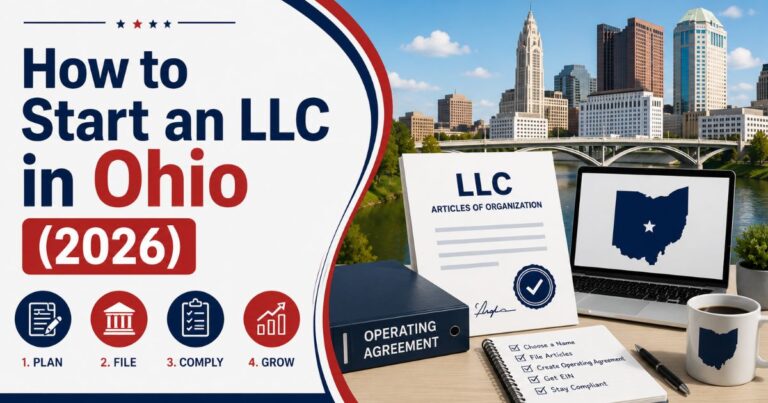
Key Takeaways
- Filing fee: $99 one-time for the Articles of Organization (Form 610) via Ohio Business Central.
- No annual report: Ohio charges $0/year — one of the few states with no annual report and no franchise tax.
- Statutory agent: required (Ohio’s term for a registered agent); no fee for your original agent, $25 to change later.
- CAT threshold raised: the Commercial Activity Tax now applies only above $6 million in Ohio gross receipts (raised from $150K), so most LLCs owe $0.
- Flat income tax from 2026: non-business income over $26,050 is taxed at a flat 2.75%, and the first $250,000 of business income is fully deducted.
- Best first step: search the name in the Secretary of State database, then file Form 610 online — most owners need no paid service.
Ohio is one of the cheapest states in the country to maintain an LLC: a one-time $99 filing fee and no annual report, no franchise tax, and no recurring state fee at all. The main thing you have to do after formation is keep a statutory agent on file. This guide covers the full picture — every fee, the 7 filing steps, the (lack of) annual requirements, and the taxes — with figures verified against the Ohio Secretary of State and Department of Taxation. It’s part of our guide to LLC vs S-corp vs sole proprietorship.
This content is educational, not legal or tax advice. Fees and rules change, so confirm every figure against the Ohio Secretary of State before you file.
Table of Contents
- 1 How do you start an LLC in Ohio?
- 2 How much does it cost to start an LLC in Ohio?
- 3 How long does it take to form an LLC in Ohio?
- 4 What are the annual requirements for a Ohio LLC?
- 5 How to start an LLC in Ohio in 7 steps
- 5.1 Step 1: Choose an Ohio LLC name
- 5.2 Step 2: Appoint a statutory agent
- 5.3 Step 3: File the Articles of Organization
- 5.4 Step 4: Create an operating agreement
- 5.5 Step 5: Get an EIN from the IRS
- 5.6 Step 6: Register for Ohio state taxes and licenses
- 5.7 Step 7: Open a business bank account and stay compliant
- 6 No annual report — and the Commercial Activity Tax
- 7 How is an Ohio LLC taxed?
- 8 LLC vs sole proprietorship in Ohio
- 9 Ohio LLC vs forming in Delaware, Wyoming, or Nevada
- 10 LLC formation options in Ohio
- 11 Ohio LLC vs Florida LLC: a cost comparison
- 12 Frequently Asked Questions About Starting an LLC in Ohio
How do you start an LLC in Ohio?
Starting an LLC in Ohio means choosing a compliant name, appointing a statutory agent, filing the Articles of Organization (Form 610) with the Ohio Secretary of State, and paying the $99 filing fee. That filing is what legally creates the LLC, and you can submit it online through Ohio Business Central.
From there, three things complete the setup: draft an operating agreement (not filed with the state but strongly recommended), get a free EIN from the IRS, and register with the Ohio Department of Taxation if you’ll collect sales tax or have employees. What makes Ohio unusual is what happens next: nothing recurring. There’s no annual report and no annual state fee, so once you’re formed, your only ongoing obligation to the state is keeping a valid statutory agent on file. Note Ohio’s terminology — it calls a registered agent a statutory agent. The 7 steps below walk the whole process in order.
How much does it cost to start an LLC in Ohio?
Starting an LLC in Ohio costs $99 to file the Articles of Organization — a one-time fee. Because Ohio requires no annual report and charges no recurring state fee, that $99 is essentially the entire mandatory cost of forming and maintaining the LLC, making a DIY filer’s realistic first-year total just $99.
Here’s the full cost breakdown:
| Cost item | Amount | When |
|---|---|---|
| Articles of Organization (Form 610) | $99 | At formation (one-time) |
| Annual report | $0 | Never — Ohio requires none |
| Statutory agent (original appointment) | $0 | At formation ($25 to change later) |
| EIN (IRS) | $0 | Anytime — free online |
| Operating agreement (DIY) | $0 | At formation |
| Statutory agent service (optional) | ~$100–$300/yr | Ongoing, if you hire one |
| Name reservation (optional) | $39 | Optional, before filing |
| Expedited processing (optional) | +$100 to +$300 | Optional, by speed tier |
| Realistic first-year total (DIY) | $99 |
If you need it fast, Ohio offers tiered expedited processing on top of the $99: +$100 for two-business-day, +$200 for one-business-day, and +$300 for four-hour service. Most filers don’t need these — standard processing is only a few business days. The only genuinely recurring cost most Ohio LLCs face is a statutory agent service, and only if you choose to hire one rather than serve as your own agent. Confirm current fees on the Secretary of State’s site before filing.
How long does it take to form an LLC in Ohio?
Forming an LLC in Ohio typically takes about 3–7 business days for standard processing, and online filings through Ohio Business Central are often approved faster — sometimes within about a business day. Processing times shift with filing volume, so treat these as typical rather than guaranteed.
If you’re on a deadline, Ohio’s expedited tiers can compress that dramatically: two-business-day for +$100, one-business-day for +$200, or four-hour service for +$300. For most new owners, standard processing is perfectly adequate and the expedite fees aren’t worth it. Because there’s no annual report to schedule afterward, once your LLC is approved your calendar is genuinely clear on the state-filing front — a nice contrast with states that tie you to an annual or biennial deadline. Check the Secretary of State’s site for current turnaround before committing to any date-dependent plan.
What are the annual requirements for a Ohio LLC?
Ohio has no annual requirements in the usual sense: there is no annual report and no recurring state filing fee for an LLC. This makes Ohio one of only a handful of states (alongside Arizona) where, once you’ve formed, you owe the state nothing on a recurring basis — you simply have to keep a valid statutory agent on file at all times.
That simplicity comes with one subtle risk. Because there’s no annual report to prompt a yearly review, it’s easy to let your statutory agent information go stale. If your agent resigns or moves and you don’t update it (Form 521, $25), your LLC can quietly fall out of good standing and, eventually, be cancelled — even though there was never a report to miss. So the Ohio discipline isn’t a deadline; it’s a habit: review your statutory agent once a year, keep your internal records current, and confirm any tax obligations (sales tax, municipal income tax, or the Commercial Activity Tax if you grow past $6 million in receipts). The absence of a report is a genuine convenience, not a reason to ignore the LLC entirely.
How to start an LLC in Ohio in 7 steps
Here is the complete filing path, from name to bank account. Each step covers what it is, why it matters, how to do it, and the common mistake to avoid.
Step 1: Choose an Ohio LLC name
Choosing your name means picking one that’s both available and legally compliant.
- Why it matters: Ohio rejects a filing whose name isn’t distinguishable from an existing entity, and a rejected filing costs you time.
- How to do it: your name must include “Limited Liability Company,” “LLC,” or “L.L.C.” and be distinguishable from existing entities — search the Secretary of State’s business database first. Name reservation is optional ($39, holds a name 180 days).
- Common mistake: assuming a name is clear because the domain is free. The state database is the check that matters for filing, and a separate trademark search is worthwhile before you build a brand.
Step 2: Appoint a statutory agent
A statutory agent is Ohio’s term for a registered agent — the person or company authorized to receive legal documents on your LLC’s behalf.
- Why it matters: Ohio requires one, and the agent must have a physical Ohio street address (no P.O. boxes) and be available during business hours.
- How to do it: you can serve as your own statutory agent, appoint another individual, or hire a commercial service (typically $100–$300/year). There’s no fee to name your original agent; changing agents later costs $25 (Form 521).
- Common mistake: using a P.O. box — Ohio rejects it, and the filing bounces. A commercial agent is also the standard way to keep your home address off the public record.
Step 3: File the Articles of Organization
Filing the Articles of Organization (Form 610) is what legally creates your LLC.
- Why it matters: until the Secretary of State accepts this filing, your LLC doesn’t exist and you have no liability protection.
- How to do it: file online through Ohio Business Central (fastest) or by mail, and pay the $99 fee; you’ll provide your LLC’s name, statutory agent and their signed acceptance, and an effective date.
- Common mistake: paying for expedited processing you don’t need — standard turnaround is only a few business days, so the +$100 to +$300 expedite fees are usually wasted on a routine formation.
Step 4: Create an operating agreement
An operating agreement is the internal contract governing how your LLC runs.
- Why it matters: Ohio does not require you to file one with the state, but without one, Ohio’s default statutory rules govern your business — which may not match what you and your partners intended. It also reinforces the separation between you and the LLC that underpins your liability protection, and banks often ask for it.
- How to do it: document ownership percentages, voting rights, profit distributions, management duties, and what happens if a member leaves or the LLC dissolves.
- Common mistake: multi-member LLCs skipping it and then having no agreed mechanism when owners disagree. See our guide to LLC vs S-corp vs sole proprietorship for how structure affects these terms.
Step 5: Get an EIN from the IRS
An EIN is your LLC’s federal tax ID, and it’s free from the IRS.
- Why it matters: you need it to open a business bank account, hire employees, and handle most tax filings, and it lets you avoid using your Social Security number on business paperwork.
- How to do it: apply on the official IRS website — the online application takes minutes and issues the number immediately.
- Common mistake: paying a third-party site for an EIN. The number itself is always free directly from the IRS; you only pay if you’re buying a broader formation package that bundles it as a convenience.
Step 6: Register for Ohio state taxes and licenses
Registering with the state means handling any tax and licensing obligations that apply to your LLC.
- Why it matters: Ohio became a flat-tax state on January 1, 2026 — non-business income over $26,050 is taxed at a flat 2.75% — and there’s no franchise tax. Ohio’s business-level Commercial Activity Tax only applies above $6 million in gross receipts, so most small LLCs owe none.
- How to do it: register for sales tax and withholding through the Department of Taxation if applicable, and check local requirements.
- Common mistake: overlooking municipal income tax — most Ohio cities levy their own (roughly 1.5%–3%), and LLC owners owe it on pass-through income, sometimes in more than one city (residence and where you operate). See our small business taxes guide.
Step 7: Open a business bank account and stay compliant
Opening a business bank account separates your personal and business finances — which is what actually preserves the liability protection you filed for.
- Why it matters: commingling funds is one of the main ways owners “pierce their own veil” and lose an LLC’s protection.
- How to do it: bring your Articles of Organization, EIN, and operating agreement to the bank. Because Ohio has no annual report, your “staying compliant” checklist is short: keep your statutory agent current and handle any tax filings.
- Common mistake: assuming “no annual report” means “no obligations at all” and letting the statutory agent lapse. Also line up coverage — see our business insurance types and costs guide, since an LLC limits liability but doesn’t pay claims (and Ohio requires workers’ comp coverage through the state fund once you have employees).
No annual report — and the Commercial Activity Tax
Two Ohio-specific points define the ongoing cost of an Ohio LLC, and both are good news for small businesses. First, Ohio charges no LLC annual report and no recurring state filing fee — a genuine, money-saving advantage that puts it among the most low-maintenance states in the country. You keep a statutory agent on file, and that’s the extent of your standing obligation to the Secretary of State.
Second, Ohio’s business-level tax is the Commercial Activity Tax (CAT), a gross-receipts tax — but the exclusion was raised dramatically, so it now only applies above $6 million in Ohio taxable gross receipts (it was $150,000 before 2024, then $3 million in 2024, then $6 million effective January 1, 2025). The practical effect: the vast majority of small LLCs owe $0 CAT and don’t even have to file a CAT return. Above the threshold, the rate is 0.26% on receipts over the exclusion.
| Ohio taxable gross receipts | CAT owed | CAT return required? |
|---|---|---|
| $6 million or less | $0 | No |
| Over $6 million | 0.26% on receipts above the exclusion | Yes — registration required |
Members still pay Ohio personal income tax on their share of the LLC’s profit, but here Ohio is generous too: the Business Income Deduction fully deducts the first $250,000 of business income, and business income above that is taxed at a flat 3%. Between no annual report, a $6M CAT floor, and the business-income deduction, Ohio is genuinely one of the most tax-efficient states for a small LLC. Confirm the current CAT threshold and income-tax details with the Ohio Department of Taxation, since these figures have changed repeatedly in recent years.
How is an Ohio LLC taxed?
An Ohio LLC is taxed as a pass-through entity by default at the federal level: a single-member LLC is a disregarded entity (reported on Schedule C), and a multi-member LLC is taxed as a partnership — profits flow to the owners’ personal returns, with an S-corp election available. At the state level, Ohio has no franchise tax, its Commercial Activity Tax applies only above $6 million in receipts, and the owner’s pass-through income faces Ohio’s flat 2.75% non-business income tax (2026) after the generous Business Income Deduction.
Three points matter for planning. First, self-employment tax (15.3%) still applies to active members’ earnings federally, on top of income tax. Second, Ohio’s Business Income Deduction is a real advantage — the first $250,000 of business income is fully deducted, and both the deduction and the flat 3% above it apply identically to sole proprietors and LLC members, so entity choice doesn’t change your Ohio rate. Third, watch municipal income taxes: most Ohio cities levy their own (roughly 1.5%–3%), and you may owe in more than one city. An S-corp election can reduce self-employment tax once profits are consistent, but it adds payroll complexity and is a CPA conversation. All of this is educational, not tax advice — confirm your situation with the Ohio Department of Taxation or a licensed CPA. Our small business taxes guide covers the federal side in depth.
LLC vs sole proprietorship in Ohio
For most Ohio owners the real choice is an LLC versus a sole proprietorship. A sole proprietorship is free and automatic but offers no liability protection; an LLC costs $99 once and then essentially nothing to maintain, while shielding your personal assets. Because Ohio’s ongoing cost is effectively zero, the calculation tilts toward an LLC for most real businesses.
| Factor | Sole Proprietorship | LLC |
|---|---|---|
| Formation cost | $0 | $99 (one-time) |
| Annual cost | $0 | $0 (no annual report) |
| Liability protection | None — personal assets exposed | Yes — separates personal & business |
| Taxes | Pass-through (+ Business Income Deduction) | Pass-through by default (same deduction) |
| Paperwork | Minimal | Articles only — no annual report |
| Credibility | Lower | Higher with banks and clients |
| Best for | Very small, low-risk side income | Real liability exposure, clients, or growth |
The bottom line: in Ohio, an LLC costs $99 once and then $0 a year, so the liability protection is about as cheap as it gets anywhere in the country. Because Ohio’s Business Income Deduction applies the same to sole proprietors and LLC members, forming an LLC doesn’t change your state tax — you’re buying liability protection and credibility, not a tax break. For any business with real liability, clients, or growth plans, that one-time $99 is easy to justify.
Ohio LLC vs forming in Delaware, Wyoming, or Nevada
Forming in Delaware, Wyoming, or Nevada rarely makes sense for an Ohio-based business — and Ohio is already so cheap to maintain that there’s essentially nothing to gain. If you live in Ohio and run your business from Ohio, you must register that out-of-state LLC as a foreign LLC in Ohio anyway, which means paying two states’ fees and maintaining two agents for no benefit.
| Factor | Ohio LLC | Out-of-state LLC (DE/WY/NV) doing business in OH |
|---|---|---|
| Formation fee | $99 | Home-state fee + OH foreign registration ($99) |
| Annual cost | $0 (no annual report) | Home-state annual fees + agent |
| Agents | One (in OH) | Two — one in each state |
| Franchise tax | None (CAT only above $6M) | Depends on state; still 2 filings |
| Privacy | Standard | Marginally better in WY/NV — but OH filings still exist |
| Net result | Simpler and cheaper | More cost, more paperwork, no benefit |
The bottom line: if you live and do business in Ohio, form in Ohio. A foreign LLC must register with the Ohio Secretary of State before transacting business in the state, so an out-of-state LLC operated from an Ohio home office ends up paying Ohio fees plus its home state’s — and Ohio’s $0 ongoing cost is already about as low as any state offers. Out-of-state formation makes sense only in narrow cases (a Delaware C-corp for venture funding, or a business with genuinely no Ohio nexus). For a normal Ohio small business, the home state is both cheapest and simplest.
Do you need a statutory agent for an Ohio LLC?
Yes, every Ohio LLC must have a statutory agent — Ohio’s term for a registered agent — with a physical Ohio street address (no P.O. boxes) available during business hours to receive legal documents. There’s no fee to appoint your original agent; changing agents later costs $25. You can serve as your own statutory agent, appoint another individual, or hire a commercial service for roughly $100–$300 a year.
Can a non-resident form an LLC in Ohio?
Yes, a non-resident can form an LLC in Ohio — there’s no residency or citizenship requirement. You do need a statutory agent with a physical Ohio street address, and you’ll get an EIN from the IRS. The same $99 filing fee, the absence of an annual report, and all other Ohio requirements apply exactly the same to non-resident owners.
Is an LLC worth it in Ohio?
An LLC is usually worth it in Ohio, because the cost is so low relative to the protection. Ohio is cheap to keep — a one-time $99 filing and $0 per year — with the Commercial Activity Tax only affecting businesses above $6 million in receipts. For any business with real liability or clients, that’s inexpensive personal-asset protection. Only a tiny, no-risk side income might not justify it.
LLC formation options in Ohio
There are three realistic ways to form an Ohio LLC, and they trade cost against convenience. This section is editorial only — no paid placements.
- DIY, direct with the state (cheapest). File Form 610 yourself through Ohio Business Central for $99. Ohio’s online system is straightforward, and for most simple, single-member LLCs this is all you need — and because there’s no annual report, there’s nothing to renew afterward.
- Statutory-agent service (privacy). If your main goal is keeping your home address off the public record, you can file yourself and pay only for a commercial statutory agent (~$100–$300/year). This is the one recurring cost some Ohio owners choose to take on.
- Full formation service (convenience). These companies file on your behalf and often bundle an agent and an operating-agreement template. You’re paying for convenience, not for anything you can’t do yourself — the $99 state fee is the same either way.
Be honest about which you’re buying. Filing directly with the Secretary of State is the cheapest path, and no service can reduce the $99 fee — which, since there’s no annual report, is very nearly the whole lifetime state cost of the LLC. If you’re weighing the whole launch process, our how to start a business step-by-step guide covers what comes before and after formation.
Ohio LLC vs Florida LLC: a cost comparison
Ohio and Florida are both affordable, business-friendly states, but they’re cheap in different ways. Ohio wins decisively on ongoing cost — no annual report versus Florida’s $138.75 — but Florida wins on income tax, since it has none while Ohio taxes pass-through income (after a generous deduction).
| Factor | Ohio | Florida |
|---|---|---|
| Formation fee | $99 | $125 |
| Annual report | None ($0) | $138.75 (due May 1) |
| Franchise tax | None (CAT only above $6M) | None |
| State income tax | Flat 2.75% (after $250k business-income deduction) | No personal income tax |
| Ongoing state cost | $0/year | $138.75/year |
| Typical first-year cost | $99 | $125 |
The bottom line: Ohio is cheaper to form and dramatically cheaper to maintain — $0 a year versus $138.75 — while Florida’s edge is the lack of any personal income tax, which can matter more for a highly profitable business. For a modest small business, Ohio’s zero ongoing cost is hard to beat; for a high-income owner, Florida’s no-income-tax structure may win. As always, this comparison only matters if you have a genuine choice about where you live and operate — you can’t form in one state on paper while running the business from another without triggering foreign registration in your home state. See our guide to how to start an LLC in Florida for the full Florida process.
Frequently Asked Questions About Starting an LLC in Ohio
Here are quick, sourced answers to the most common questions about Ohio LLCs.
How much does an LLC cost in Ohio?
An Ohio LLC costs $99 to file the Articles of Organization (Form 610) with the Secretary of State, filed online through Ohio Business Central. That’s essentially the entire cost — Ohio requires no annual report and charges no recurring state fee, so a DIY filer’s realistic total is just the one-time $99, as long as you keep a statutory agent on file.
Does Ohio require an LLC annual report?
No, Ohio does not require an LLC annual report, and there’s no recurring state filing fee — one of the few states (with Arizona) where ongoing state cost is effectively $0. Your only standing obligation is to keep a valid statutory agent on file. If your agent changes, update it promptly (Form 521, $25) to stay in good standing.
How long does it take to get an LLC in Ohio?
Getting an LLC in Ohio typically takes about 3–7 business days for standard processing, and online filings through Ohio Business Central are often approved faster. If you need it sooner, Ohio offers expedited processing: two-business-day for $100, one-business-day for $200, or four-hour service for $300, on top of the $99 filing fee.
Can I be my own statutory agent in Ohio?
Yes, you can be your own statutory agent in Ohio, provided you have a physical Ohio street address (not a P.O. box) and are available during normal business hours to receive legal documents. The trade-off is that your address becomes part of the public record, which is why many owners pay $100–$300 a year for a commercial statutory agent instead.
Do you need an operating agreement in Ohio?
Ohio does not require you to file an operating agreement with the state, but it’s strongly recommended, especially for multi-member LLCs. Without one, Ohio’s default statutory rules govern how your LLC operates, which may not match what the owners intended. An operating agreement sets ownership percentages, voting rights, profit distributions, and dissolution terms.