Key Takeaways
- Startup cost: ~$15,000–$30,000 leasing/power-only; $60,000–$120,000+ buying a truck — insurance and reserves are the biggest non-truck costs.
- Authority: the USDOT number is free; interstate operating authority costs a $300 FMCSA fee (now tied to your USDOT number under the Unified Registration System).
- Insurance: FMCSA requires $750,000 liability for general freight, but most brokers require $1 million + $100k cargo; new-authority premiums often run $8,000–$20,000+/year.
- Cash flow is the killer: brokers pay in 30–90 days, so many new carriers use freight factoring to bridge the gap.
- Florida: no state income tax; form an LLC via Sunbiz for $125 and register IRP/IFTA through FLHSMV.
- Best first step: nail your cost-per-mile and target lane in a business plan before spending a dollar on a truck.
Trucking moves the vast majority of U.S. freight, and starting your own carrier can turn a CDL into a real business — but the margin between profit and failure is thin, and it comes down to costs, compliance, and cash flow. This guide walks the full path in 12 steps, with verified 2026 costs, federal requirements, and the numbers that actually decide whether you make money. It’s a companion to our national how to start a business step-by-step guide.
Every fee and requirement below is verified against the FMCSA and IRS, but regulations and costs change — this is educational, not legal or tax advice, so confirm the current details on FMCSA.gov or with a licensed professional before you rely on them.
Table of Contents
- 1 How do you start a trucking business?
- 2 How much does it cost to start a trucking business?
- 3 Is a trucking business profitable?
- 4 What do you need to start a trucking business?
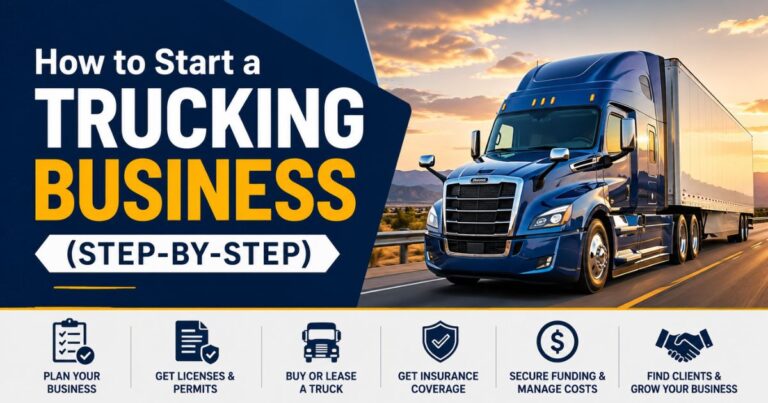
- 5 How to start a trucking business in 12 steps
- 5.1 Step 1: Write a business plan
- 5.2 Step 2: Choose a business structure and register
- 5.3 Step 3: Get your CDL (if you’ll drive)
- 5.4 Step 4: Get a USDOT number and operating authority
- 5.5 Step 5: File your BOC-3
- 5.6 Step 6: Get commercial truck insurance
- 5.7 Step 7: Buy or lease your truck
- 5.8 Step 8: Register for IFTA, UCR, and the Heavy Vehicle Use Tax
- 5.9 Step 9: Set up compliance
- 5.10 Step 10: Find loads
- 5.11 Step 11: Manage cash flow
- 5.12 Step 12: Track expenses and taxes
- 6 Owner-operator vs starting a fleet
- 7 Lease vs buy a truck
- 8 Trucking tools and services
- 9 Starting a trucking business in Florida
- 10 Frequently Asked Questions About Starting a Trucking Business
How do you start a trucking business?
Starting a trucking business means forming a legal entity, getting a USDOT number and operating authority from the FMCSA, meeting federal insurance requirements, filing a BOC-3 process-agent designation, and securing a truck and a way to find loads. Most new carriers start as a single owner-operator running one truck under their own authority, then decide later whether to grow into a fleet.
The path is a defined sequence, not a guess: plan the business and your cost-per-mile, register an LLC, get your CDL if you’ll drive, obtain your USDOT number and interstate authority, file your BOC-3 and insurance, buy or lease a truck, register for fuel and highway taxes, set up safety compliance, find loads, and manage cash flow. The federal steps (authority, insurance, BOC-3) gate when you can legally operate, while the business steps (truck, loads, bookkeeping) determine whether you profit. The 12 steps below cover the whole process in order.
How much does it cost to start a trucking business?
Starting a trucking business costs roughly $15,000–$30,000 in the first year if you lease a truck or run power-only, and $60,000–$120,000 or more if you buy a truck outright. The single biggest variable is the truck; after that, insurance and cash reserves dominate the budget. The federal registration itself is cheap: the USDOT number is free and interstate operating authority is a $300 FMCSA fee.
Here’s a realistic breakdown of first-year costs (verify current figures, as they move):
- Operating authority: $300 FMCSA fee (USDOT number free)
- BOC-3 process agent: $30–$100
- Commercial truck insurance: $8,000–$20,000+ in year one (new-authority premiums run high; often $700–$2,500+/month)
- Truck: $0 if leasing/power-only; a used semi typically runs $40,000–$80,000 to buy
- UCR, IFTA, Heavy Vehicle Use Tax (Form 2290): a few hundred to ~$550+ combined
- ELD, permits, plates (IRP): several hundred to a few thousand dollars
- Working-capital reserve: enough to cover 2–3 months of fuel, payments, and living costs while invoices are paid
The reserve is what most new carriers underestimate. Because brokers pay 30–90 days after delivery, you’ll pay for fuel and expenses long before you get paid — so undercapitalization, not lack of loads, is the most common early failure. See our business loans and financing guide for funding options if you’re buying equipment.
Is a trucking business profitable?
A trucking business can be profitable, but profit hinges entirely on the gap between your rate per mile (what you’re paid) and your cost per mile (what it costs to run), plus disciplined cash-flow management. Owner-operators often gross well into six figures, but fuel, insurance, truck payments, maintenance, and taxes consume most of it — net take-home varies widely and is far lower than the gross.
Illustrative economics (label these as examples, not guarantees): an owner-operator might gross $180,000–$250,000 a year running under their own authority, while cost per mile — fuel, maintenance, insurance, payments, tolls — commonly runs $1.50–$2.00+, leaving a net that swings from modest to strong depending on how tightly costs and deadhead miles are controlled. The carriers who succeed treat it as a numbers business: they know their cost per mile to the cent, refuse loads that don’t clear it, minimize empty miles, and use freight factoring to keep cash moving while broker payments lag 30–90 days. The ones who fail chase revenue without watching cost per mile.
What do you need to start a trucking business?
To start a trucking business you need a business entity, a CDL (only if you’ll drive), a USDOT number, interstate operating authority, FMCSA-compliant insurance, a BOC-3 filing, and a truck. Each is a distinct requirement, and the federal ones must be in place and active before you can legally haul for hire across state lines.
Here’s the full checklist:
- Business entity — usually an LLC, for liability protection
- CDL — a Commercial Driver’s License, if you’ll be driving (not required for a non-driving owner who hires CDL drivers)
- USDOT number — your federal safety identifier (free)
- Operating authority — federal permission to haul for hire ($300)
- Insurance — meeting FMCSA financial-responsibility minimums, filed by your insurer
- BOC-3 — a process-agent designation in every state you operate
- A truck — owned, financed, or leased (or a power-only arrangement)
Beyond these, you’ll register for fuel and highway taxes and set up safety compliance (covered in the steps). Note a major recent change: under the FMCSA’s Unified Registration System, new operating authority is now tied to your USDOT number rather than a separate MC number.
How to start a trucking business in 12 steps
Here is the complete path from business plan to your first paid load. Each step covers what it is, why it matters, how to do it, and the common mistake to avoid.
Step 1: Write a business plan
A trucking business plan defines your lane, your rates, your cost per mile, and your cash-flow plan.
- Why it matters: trucking lives or dies on cost per mile versus rate per mile, and a plan forces you to run those numbers before you commit capital.
- How to do it: pick a freight type and lane, research prevailing rates, calculate your true cost per mile (fuel, insurance, payment, maintenance, tolls, and your own pay), and model cash flow around 30–90-day broker payment.
- Common mistake: planning around gross revenue instead of net cost per mile. See our guide to writing a business plan for the structure.
Step 2: Choose a business structure and register
Choosing a structure means forming a legal entity, and most carriers pick an LLC for liability protection — trucking is a high-liability business, and an LLC separates your personal assets from a lawsuit or debt.
- Why it matters: one serious accident can generate claims far beyond your insurance, and a sole proprietorship exposes your home and savings.
- How to do it: register an LLC with your state, get an EIN from the IRS (free), and open a business bank account.
- Common mistake: operating as a sole proprietor to save the filing fee and leaving personal assets exposed. See our guide to choosing a business structure to compare options.
Step 3: Get your CDL (if you’ll drive)
A Commercial Driver’s License (CDL) is required to legally drive a commercial truck yourself.
- Why it matters: if you’re an owner-operator who drives, you must hold a valid Class A CDL (plus endorsements for specialized freight like hazmat or tankers); if you’re a non-driving owner, you don’t need one but must hire CDL-holding drivers.
- How to do it: complete FMCSA-required entry-level driver training (ELDT) at an approved provider, pass the knowledge and skills tests, and obtain your state CDL.
- Common mistake: assuming you need a CDL to own a trucking company — you only need it to drive.
Your USDOT number is your free federal safety identifier, and operating authority is your federal permission to haul for hire across state lines.
- Why it matters: you can’t legally run interstate for-hire freight without active authority, and it must show “Active” in FMCSA’s system before you take a load.
- How to do it: apply through the FMCSA registration system; the USDOT number is free, and interstate operating authority carries a $300 fee.
- Important 2026 change: under the Unified Registration System, the FMCSA has moved to using the USDOT number as the sole federal identifier (new applicants are no longer issued separate MC numbers; authority attaches to the USDOT number).
- Common mistake: booking a load before your authority is active — confirm status in FMCSA’s SAFER system first, and verify the current process on FMCSA.gov since registration is actively modernizing.
Step 5: File your BOC-3
A BOC-3 designates a process agent — someone authorized to accept legal documents on your behalf — in every state where you operate.
- Why it matters: the BOC-3 must be on file before your operating authority activates, so skipping it stalls your launch.
- How to do it: use a BOC-3 filing service (typically $30–$100) that maintains process agents nationwide; they file it with the FMCSA for you.
- Common mistake: overlooking the BOC-3 and wondering why authority won’t activate — it’s a separate, required filing that many new carriers forget.
Step 6: Get commercial truck insurance
Commercial truck insurance is both a legal requirement and your biggest ongoing cost. The FMCSA requires a minimum of $750,000 in auto liability for general freight ($1 million for oil and auto haulers, $1 million–$5 million for hazmat), and your insurer files proof (a BMC-91 with an MCS-90 endorsement) directly with the FMCSA.
- Why it matters: authority won’t activate without the filing, and most brokers require $1 million in liability plus $100,000 in cargo coverage before they’ll book you.
- How to do it: get quotes from trucking-specialist insurers, file the higher $1 million limit if you want broker loads, and keep the policy paid — a lapse revokes your authority.
- Cost: new-authority premiums commonly run $700–$2,500+ per month ($8,000–$20,000+ in year one). See our business insurance types and costs guide.
- Common mistake: buying only the $750,000 minimum and finding brokers won’t load you.
Step 7: Buy or lease your truck
Your truck is the largest single purchase, and you can buy, finance, or lease — or start with a power-only arrangement pulling someone else’s trailers.
- Why it matters: the truck decision drives your monthly costs and your risk; buying builds equity but ties up capital, while leasing preserves cash but costs more over time.
- How to do it: a reliable used semi typically runs $40,000–$80,000 to buy; leasing or power-only lets you start with little upfront and prove the business first.
- Common mistake: overbuying a truck before you’ve validated your lane and cash flow. See our business loans and financing guide for equipment funding, and weigh the lease-vs-buy trade-offs in the comparison below.
Step 8: Register for IFTA, UCR, and the Heavy Vehicle Use Tax
These are the fuel and highway taxes every interstate carrier must handle. IFTA (International Fuel Tax Agreement) reports and distributes fuel taxes across the states you drive; UCR (Unified Carrier Registration) is an annual federal registration; and the Heavy Vehicle Use Tax is paid to the IRS on Form 2290 for trucks over 55,000 pounds.
- Why it matters: missing any of these brings penalties and can jeopardize your registration.
- How to do it: register for an IFTA license and decals through your base state, pay UCR annually, and file Form 2290 with the IRS.
- Common mistake: forgetting IFTA quarterly filings, which carry penalties even in quarters you drove little.
Step 9: Set up compliance
Compliance means the safety systems the FMCSA requires from day one.
- Why it matters: new carriers face an 18-month new-entrant safety audit, and most failures come from missing paperwork, not unsafe driving.
- How to do it: install a compliant ELD (electronic logging device) for hours-of-service, enroll in a DOT drug-and-alcohol testing program (and the FMCSA Clearinghouse), keep your MCS-150 updated (every 24 months), and maintain driver-qualification and vehicle-inspection files.
- Common mistake: building compliance programs only when the audit notice arrives instead of before your first load.
Step 10: Find loads
Finding loads is how you generate revenue, and new carriers typically use load boards, direct broker relationships, or a dispatch service.
- Why it matters: empty trucks lose money, and your fill rate and deadhead miles directly determine profit.
- How to do it: use major load boards to find freight, build direct relationships with brokers and shippers for better rates, or hire a dispatch service (typically 5–10% of load revenue) to book for you.
- Common mistake: relying only on the cheapest load-board freight instead of building direct shipper relationships that pay more and stay consistent.
Step 11: Manage cash flow
Managing cash flow means bridging the gap between hauling a load and getting paid, which is often 30–90 days.
- Why it matters: you pay for fuel and expenses immediately but wait weeks or months for broker payment, and that gap sinks undercapitalized carriers.
- How to do it: many new carriers use freight factoring — selling invoices to a factoring company for immediate cash (typically a 1–5% fee) — to keep fuel in the tank while invoices clear.
- Common mistake: running out of cash mid-month despite a full load board, because payments haven’t arrived yet. Factoring costs money, but it’s often the difference between operating and parking the truck.
Step 12: Track expenses and taxes
Tracking expenses and taxes means keeping per-mile books and setting aside money for taxes from day one.
- Why it matters: trucking has heavy, deductible costs (fuel, maintenance, per-diem, depreciation), and clean records both lower your tax bill and tell you your true cost per mile.
- How to do it: use trucking-specific bookkeeping or accounting software, log every mile and expense, build a maintenance reserve, and set aside money for self-employment and income taxes (plus quarterly estimates).
- Common mistake: mixing business and personal money and losing track of deductions. See our small business taxes guide for the deduction and quarterly-payment details.
Owner-operator vs starting a fleet
The first strategic choice is whether to run as a single owner-operator or build a fleet with multiple trucks and hired drivers. An owner-operator has low overhead and full control but a hard income ceiling (one truck can only run so many miles); a fleet has a far higher income ceiling but demands much more capital, management, and risk. Most successful carriers start as owner-operators and scale deliberately.
| Factor | Owner-Operator (1 truck) | Fleet (multiple trucks) |
|---|---|---|
| Startup capital | Lower — one truck, one policy | Much higher — trucks, drivers, payroll |
| Income ceiling | Capped by one truck’s miles | High — scales with trucks |
| Management | You drive and run the business | You manage drivers, dispatch, HR, compliance |
| Risk | Lower absolute exposure | Higher — payroll and multiple assets |
| Best for | Starting out; proving the model | Experienced operators scaling up |
The bottom line: start as an owner-operator to learn the business with limited risk, then add trucks only once you have steady freight, systems, and reserves. Scaling to a fleet too early — before you’ve proven your lanes and cash flow with one truck — is a common way to convert a working owner-operator business into an unprofitable small fleet.
Lease vs buy a truck
Whether to lease or buy your truck comes down to upfront cash versus long-term cost and equity. Buying (usually financing) builds equity and costs less over the truck’s life but ties up capital and puts maintenance risk on you; leasing preserves cash and often bundles maintenance but costs more overall and builds no equity. For a first truck with limited capital, leasing or power-only lowers the risk of the launch.
| Factor | Lease | Buy (finance) |
|---|---|---|
| Upfront cost | Low — small or no down payment | High — down payment on a $40k–$80k truck |
| Monthly outlay | Predictable lease payment | Loan payment + maintenance |
| Equity | None (unless lease-to-own) | Builds equity; you own it eventually |
| Maintenance | Often included in lease | Your responsibility |
| Long-term cost | Higher overall | Lower overall if the truck lasts |
| Best for | Preserving cash; testing the business | Established carriers with capital |
The bottom line: lease or run power-only to start if cash is tight and you’re still proving your lanes; buy once you have capital and know the business will run. Be cautious with carrier “lease-to-own” programs that tie the truck to hauling for one company — they can look attractive but often leave the driver bearing the costs with little control, so read the terms carefully.
Do you need a CDL to start a trucking company?
You need a CDL only if you’ll drive the truck yourself. A non-driving owner can start and run a trucking company without a CDL by hiring CDL-licensed drivers. If you plan to be the driver, you must hold a valid Class A commercial driver’s license (plus any endorsements for specialized freight). Many owners start by driving and later hire drivers as they grow.
How much do owner-operators make?
Owner-operators often gross $180,000–$250,000 a year running under their own authority, but net take-home is far lower after fuel, insurance, truck payments, maintenance, and taxes — commonly landing somewhere in the $50,000–$100,000+ range depending on cost control. Profit depends far more on managing cost per mile and empty miles than on gross revenue. These figures are illustrative and vary widely.
Getting operating authority typically takes about 20–30 business days from application to active status, assuming you promptly file your BOC-3 and insurance and face no protests. The FMCSA application itself takes roughly 20 minutes, but there’s a mandatory waiting/vetting period. Don’t book loads against an expected date — wait until your authority shows “Active” in FMCSA’s system. Confirm current timelines on FMCSA.gov.
Trucking tools and services
Several categories of tools and services handle the operational side of a trucking business. These are listed by function for reference only — none are paid or affiliate placements.
- Load boards — where carriers find available freight to haul (major national boards list thousands of loads daily).
- Freight factoring — companies that advance cash on your invoices (typically a 1–5% fee) to bridge 30–90-day broker payment.
- ELD & compliance — electronic logging devices and compliance platforms for hours-of-service, IFTA, and driver files.
- Dispatch services — book loads and handle paperwork on your behalf, usually for 5–10% of load revenue.
- Trucking bookkeeping — per-mile accounting software built for fuel, maintenance, and per-diem tracking.
Running the day-to-day well is its own skill — our guide to day-to-day small business management covers the operations side that keeps a one-truck business from drowning in admin.
Starting a trucking business in Florida
Starting a trucking business in Florida means forming your entity through Sunbiz, registering for state fuel and vehicle programs through the FLHSMV, and deciding whether you’ll run interstate or Florida-only (intrastate) freight. Florida’s big advantage is tax: the state has no personal income tax, so your trucking profits face only federal tax. Forming an LLC through Sunbiz costs $125, with a $138.75 annual report each year.
The state-specific pieces matter. If you run interstate, you’ll get your USDOT number and federal operating authority from the FMCSA, then register for the International Registration Plan (IRP) apportioned plates and IFTA fuel-tax license through the Florida Highway Safety and Motor Vehicles (FLHSMV). If you’ll haul only within Florida (intrastate), you follow Florida’s own authority and insurance rules instead of federal interstate authority — and Florida can set its own insurance minimums, so confirm them with the FLHSMV. Our starting a business in Florida guide covers the entity setup, EIN, and local business-tax-receipt steps that apply to any Florida business. Verify current FLHSMV fees and IRP/IFTA requirements before you register, as they change.
Frequently Asked Questions About Starting a Trucking Business
Here are quick, sourced answers to the most common questions about starting a trucking business.
How much does it cost to start a trucking business?
Starting a trucking business costs roughly $15,000–$30,000 in the first year if you lease a truck or run power-only, and $60,000–$120,000 or more if you buy a truck. The USDOT number is free and operating authority is a $300 FMCSA fee; the biggest costs are the truck, insurance ($8,000–$20,000+ in year one), and a cash reserve to cover 30–90-day broker payment.
Do I need a CDL to own a trucking company?
You need a CDL only if you plan to drive the truck yourself. A non-driving owner can start and operate a trucking company without a commercial driver’s license by hiring CDL-licensed drivers. If you’ll be behind the wheel, you must hold a valid Class A CDL plus any endorsements your freight requires, such as hazmat or tanker endorsements.
How much insurance do truckers need?
The FMCSA requires a minimum of $750,000 in auto liability insurance for general freight carriers ($1 million for oil and auto haulers, and $1 million–$5 million for hazardous materials). However, most freight brokers require at least $1 million in liability plus $100,000 in cargo coverage before they’ll book you, so most new carriers carry the higher $1 million limit from day one.
To get your own operating authority, register with the FMCSA through its online system, pay the $300 fee, and get your USDOT number (free). Your insurer files proof of insurance, and you file a BOC-3 process-agent designation — both required before authority activates. Under the Unified Registration System, new authority is now tied to your USDOT number rather than a separate MC number.
Is trucking still profitable?
Trucking can still be profitable, but only with tight cost control and disciplined cash-flow management. Profit depends on the gap between your rate per mile and cost per mile (commonly $1.50–$2.00+), minimizing empty miles, and bridging 30–90-day broker payment with reserves or factoring. Carriers who know their cost per mile and refuse unprofitable loads succeed; those who chase gross revenue often don’t.