Key Takeaways
- License first: selling real estate for compensation requires a state sales-associate license — pre-license course, state exam, and activation under a broker.
- Cost to get licensed: roughly $270–$690 in Florida (course + $62.75 DBPR application + $36.75 exam + fingerprints); most states are similar.
- Timeline: about 8–14 weeks from enrolling to an active license in Florida.
- Income is commission-based: highly variable — many new agents earn little in year one; Florida agents average around $58,000, with top producers well into six figures.
- Ongoing costs are the real budget: brokerage splits/desk fees, MLS and REALTOR dues, E&O insurance, CRM, and marketing.
- Best first step: confirm your state’s requirements, enroll in the pre-license course, and start interviewing sponsoring brokers before you pass the exam.
Starting a real estate business has a low cost of entry but a steep learning curve: getting licensed is inexpensive, yet building a business that actually generates income takes lead generation, systems, and persistence. This guide covers becoming a real estate agent and running your own agent business — how to start, what it costs, whether it’s profitable, licensing, a 10-step plan, agent vs broker, franchise vs independent brokerage, and the Florida-specific path. (If you mean buying property to rent or flip rather than representing clients, see our guide to real estate investing instead.) It’s part of our broader how to start a business step-by-step guide.
Figures below are 2026 benchmarks and ranges that vary by state and market; licensing specifics are verified against primary sources but should be confirmed for your state.
Table of Contents
- 1 How do you start a real estate business?
- 2 How much does it cost to start a real estate business?
- 3 Is a real estate business profitable?
- 4 Do you need a license to start a real estate business?
- 5 How to start a real estate business in 10 steps
- 5.1 Step 1: Meet the requirements and choose your path
- 5.2 Step 2: Complete your pre-license course
- 5.3 Step 3: Pass the state licensing exam
- 5.4 Step 4: Activate under a sponsoring broker
- 5.5 Step 5: Join a brokerage, MLS, and REALTOR association
- 5.6 Step 6: Register your own business entity
- 5.7 Step 7: Budget your ongoing business costs
- 5.8 Step 8: Build your brand and lead generation
- 5.9 Step 9: Get your first clients and close deals
- 5.10 Step 10: Set up accounting and handle taxes
- 6 Real estate agent vs broker
- 7 Franchise brokerage vs independent brokerage
- 8 Tools and software for real estate agents
- 9 Starting a real estate business in Florida
- 10 Frequently Asked Questions About Starting a Real Estate Business
How do you start a real estate business?
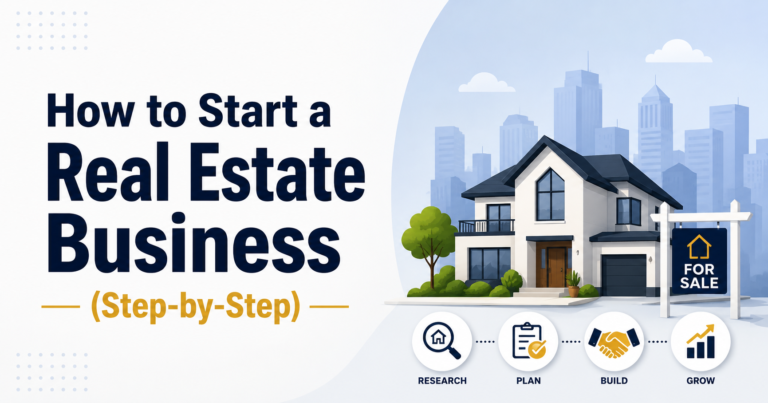
Starting a real estate business means getting licensed, activating under a sponsoring broker, forming your own business entity, and building lead generation to win clients. The typical path runs pre-license education → state licensing exam → activation under a licensed broker → joining an MLS and REALTOR association → forming your own LLC or PA → budgeting ongoing costs → building a brand and lead pipeline → closing your first deals.
There’s an important distinction up front: this is about becoming a real estate agent — representing buyers and sellers for a commission — which is different from real estate investing (buying property yourself for income and appreciation). The agent path has a low, regulated cost of entry but is fundamentally a sales business: your income depends entirely on generating leads and closing transactions, not on a salary. A new agent legally can’t work alone — you operate under a licensed broker who supervises your deals — but you still run your own book of business, brand, and expenses, which is why forming an entity and budgeting realistically matter from day one.
How much does it cost to start a real estate business?
Getting a real estate license is relatively cheap — in Florida, roughly $270–$690 for the required 63-hour pre-license course ($100–$400), the DBPR application ($62.75), the state exam ($36.75), and fingerprinting ($50–$90). Most states fall in a similar range. But the license is the small part; your first-year business costs are the real budget, and they run well into the thousands.
Plan for these recurring costs once you’re licensed:
- Brokerage costs: either a commission split (commonly 30/70 up to 100% with a monthly desk fee) or flat monthly desk fees — the single biggest variable in your economics.
- MLS access: roughly $20–$50/month, required to list and search properties.
- REALTOR association dues (optional): local, state, and national (NAR) dues run several hundred dollars a year if you choose to become a REALTOR.
- Errors & omissions (E&O) insurance: often a few hundred dollars a year (sometimes covered by the brokerage).
- Marketing & CRM: website, lead generation, signage, and a CRM — the discretionary spend that actually drives deals.
- Post-license education: Florida requires a 45-hour post-license course before your first renewal.
The biggest financial mistake new agents make is underbudgeting for the “gap” — the months between getting licensed and closing enough deals to cover these costs. Because commissions are irregular and often don’t arrive for the first few months, most new agents need a cash cushion of several months’ living expenses. Build your budget with the SBA’s startup-cost worksheet before you commit.
Is a real estate business profitable?
A real estate business can be very profitable, but income is commission-based and highly variable, so profitability depends on your lead generation, closings, and commission split — not a guaranteed salary. Many new agents earn little in their first year while building a pipeline, whereas established agents with a steady referral base and repeat clients regularly earn six figures. In Florida, agents average around $58,000 a year, with a wide spread from roughly $25,000 to $160,000+ depending on market and productivity.
The economics come down to a few levers. Real estate commissions are typically split multiple ways — between the listing and buyer sides, then between the agent and their broker — so your commission split and deal volume drive everything. A newer agent on a 50/50 split closing a handful of deals earns modestly; a top producer on a 90/10 or flat-fee split closing dozens earns substantially. The business rewards consistent lead generation and follow-up, and punishes agents who treat it as passive. Note that recent industry changes to how buyer-agent commissions are negotiated (following the 2024 NAR settlement) have made commission structures more variable, so build conservative assumptions. (Income figures are benchmarks; individual results vary enormously.)
Do you need a license to start a real estate business?
Yes — you need a state real estate license to represent buyers or sellers for compensation. In every U.S. state, you earn a sales-associate (salesperson) license by completing state-approved pre-license education, passing the state licensing exam, and activating under a licensed broker. You cannot legally practice real estate for pay, or work independently, without an active license.
The specifics vary by state but the structure is consistent: pre-license coursework (Florida requires 63 hours; some states require far more — Texas 180, California 135), a proctored state exam, a background check with fingerprinting, and mandatory affiliation with a sponsoring broker who supervises your transactions. A “REALTOR” is not a separate license — it’s a membership title for licensees who join the National Association of REALTORS and agree to its Code of Ethics. Because education hours, fees, and rules differ by state, always confirm your specific state’s requirements with its real estate commission before enrolling. The Florida section below shows exactly how one state’s process works.
How to start a real estate business in 10 steps
You can start a real estate business in ten steps: meet the requirements, complete pre-license education, pass the state exam, activate under a broker, join an MLS and association, register your own entity, budget ongoing costs, build lead generation, get your first clients, and set up accounting. Here’s each step — what it is, why it matters, how to do it, and the mistake to avoid.
Step 1: Meet the requirements and choose your path
Start by confirming you meet your state’s basic requirements — typically at least 18 years old, a high school diploma or GED, and a Social Security number — and decide your path. It matters because most people begin as a sales associate (working under a broker) and pursue a broker license later, after gaining experience. Check your state real estate commission’s requirements first. The common mistake is assuming you can work independently from day one; nearly every state requires new licensees to affiliate with a supervising broker.
Step 2: Complete your pre-license course
Complete your state-approved pre-license education — in Florida, the 63-hour FREC Course I. It matters because you cannot sit for the state exam without it, and the course teaches the principles, laws, and math the exam tests. Take it from a state-approved provider (online self-paced or in person), and pass the end-of-course exam (Florida requires 70%+). The mistake is choosing an unapproved course — only hours from a provider approved by your state commission count toward licensure, so verify approval before enrolling.
Step 3: Pass the state licensing exam
Pass your state’s licensing exam, administered by a testing vendor (Florida uses Pearson VUE). It matters because it’s the gateway to your license. Submit your license application and fingerprints first to get approved to test, then schedule and pass the exam (Florida’s is 100 questions, 3.5 hours, requiring a 75% score). Use an exam-prep product — the pass rate rewards preparation. The mistake is underestimating the exam; first-time pass rates vary widely, and each retake costs another exam fee, so study thoroughly before your first attempt.
Step 4: Activate under a sponsoring broker
Activate your license by affiliating with a licensed sponsoring broker — a sales associate legally cannot practice independently. It matters because the broker supervises your transactions, and their commission split, training, and support directly shape your early success. Interview several brokerages on split structure, desk fees, mentorship, lead provision, and culture before choosing. The mistake is picking a brokerage on commission split alone; for a new agent, training and mentorship often matter more than a few percentage points of split.
Step 5: Join a brokerage, MLS, and REALTOR association
Join your brokerage, gain access to the local MLS (Multiple Listing Service), and decide whether to join a REALTOR association. It matters because MLS access is essential to list and search properties, and it typically comes through your board or association membership. Budget MLS fees (~$20–$50/month) and, if you join, local/state/national REALTOR dues. The mistake is not factoring these recurring dues into your budget; they’re required costs of doing business, not optional extras, if you want full MLS and market access.
Step 6: Register your own business entity
Many agents form their own business entity — an LLC or, in some states, a professional association (PA) — to hold their real estate business, once their state and broker allow commissions to be paid to it. It matters for liability protection and tax flexibility as your income grows. Register with your state, get an EIN, and confirm your broker can pay your entity. Compare options in our guide to choosing a business structure. The mistake is assuming you need this on day one — many agents start as sole proprietors and form an entity once income justifies it.
Step 7: Budget your ongoing business costs
Budget realistically for the recurring costs of running an agent business: E&O insurance, MLS and association dues, marketing, a CRM, and brokerage desk/split fees. It matters because these costs continue whether or not you close a deal, and new agents routinely underestimate them. Total them monthly and ensure your cash cushion covers several months. See our guide to business insurance types and costs. The mistake is treating real estate as low-cost because the license is cheap — the ongoing business expenses, not the license, are what you must fund.
Step 8: Build your brand and lead generation
Lead generation is the engine of a real estate business — without a steady flow of prospects, nothing else matters. It matters because your income is entirely dependent on finding clients. Build a professional website and social presence, work your sphere of influence (everyone you know), ask for referrals, and consider “farming” a specific neighborhood. See our guide to marketing your business. The mistake is waiting passively for the brokerage to hand you leads; the most successful agents build their own consistent lead-generation system from week one.
Step 9: Get your first clients and close deals
Turn leads into your first closed transactions through consistent outreach and service. It matters because early closings build the reviews, referrals, and confidence that compound into a sustainable business. Start with your sphere of influence, host open houses, follow up relentlessly (most deals come from persistent follow-up, not first contact), and deliver excellent service so clients refer you. The mistake is weak follow-up; leads go cold fast, and a simple, disciplined follow-up system is what separates agents who close from those who don’t.
Step 10: Set up accounting and handle taxes
Set up accounting from your first commission: track income and expenses, and pay quarterly estimated taxes, because as an independent contractor no one withholds tax for you. It matters because agents owe self-employment tax (15.3%) plus income tax, and a surprise bill can be devastating. Separate business banking, log deductible expenses (mileage, marketing, dues, E&O), and set aside 25–30% of commissions for taxes. Once profit is steady, ask a CPA whether an S-corp election saves on self-employment tax. See our guide to small business taxes. The mistake is ignoring quarterly taxes and facing penalties.
Real estate agent vs broker
A real estate agent (sales associate) and a broker hold different licenses with different privileges: an agent must work under a supervising broker, while a broker holds a higher-level license that lets them work independently, open their own brokerage, and supervise agents. The table compares them.
| Factor | Agent (sales associate) | Broker |
|---|---|---|
| License level | Entry-level sales-associate license | Higher license (more education + experience) |
| Independence | Must work under a broker | Can work independently and own a brokerage |
| Requirements | Pre-license course + exam | Active experience + broker course + broker exam |
| Income potential | Commission split with broker | Keeps more; earns from supervised agents too |
| Supervises others | No | Yes — oversees sales associates |
The typical path is to license as a sales associate, work under a broker for the state-required experience period (often two years), then complete the broker pre-license course and exam to upgrade. Becoming a broker makes sense when you want independence, to keep more of your commissions, or to build a team — but many successful agents remain sales associates their entire careers.
Franchise brokerage vs independent brokerage
Choosing a franchise brokerage versus an independent one is a trade-off between brand and flexibility: a franchise offers a nationally recognized name, structured training, and systems, while an independent often offers higher commission splits, more personalized mentorship, and local flexibility. The table compares them.
| Factor | Franchise brokerage | Independent brokerage |
|---|---|---|
| Brand recognition | High — national name and marketing | Local — depends on reputation |
| Commission split | Often lower (brand + fees) | Often higher or flat-fee models |
| Training | Structured, standardized programs | Varies — can be more hands-on |
| Leads & systems | Established tools and referral networks | Varies by brokerage |
| Best for | New agents wanting structure and a known brand | Agents wanting higher splits and flexibility |
For a brand-new agent, the structure, training, and name recognition of a franchise can be worth a lower split while you learn. As you gain experience and your own lead pipeline, the higher splits of an independent (or a high-split national model) often become more attractive. The right choice depends on how much training and brand you need versus how much of each commission you want to keep.
How much do real estate agents make?
Real estate agents’ income is commission-based and varies widely — from very little in a first year while building a pipeline to six figures for established producers. In Florida, agents average around $58,000 a year, with a range from roughly $25,000 to over $160,000 depending on market, effort, and commission split. Because income depends on closings, it’s inconsistent, especially early on. Results vary enormously by individual.
How long does it take to become a real estate agent?
Becoming a real estate agent typically takes about 8–14 weeks, depending on how fast you complete the pre-license course and schedule the exam. In Florida, the 63-hour course can be finished in 2–6 weeks, followed by application processing (about 10 business days), exam scheduling, and broker activation. States with longer course requirements (like Texas or California) take longer. Your own pace is the biggest factor.
Is real estate a good business to start?
Real estate can be a good business to start, but it depends on your fit for it. The upsides are a low cost of entry, flexible schedule, and uncapped commission income. The downsides are variable, commission-only pay (no salary), high self-motivation requirements, and significant early lead-generation work. It suits self-driven people who can weather months of low income while building a client base — and it’s a poor fit for those needing steady, predictable pay.
Tools and software for real estate agents
Useful tools for real estate agents are widely available, and none of the mentions here are sponsored — this section is purely editorial. The categories worth knowing, by job:
- CRM (customer relationship management): the core tool for tracking leads, clients, and follow-ups — the single most important system for a commission business built on relationships.
- Lead generation: tools and platforms that surface buyer/seller leads, plus your own website and social presence for organic leads.
- Transaction management: software to manage the paperwork, deadlines, and e-signatures of each deal from contract to close.
- Marketing: design and social-scheduling tools, plus email, to stay top-of-mind with your sphere and past clients.
The highest-priority tool is a CRM with disciplined follow-up — most real estate income comes from staying in touch with your existing relationships. As you grow, see our guide to day-to-day small business management for building repeatable systems.
Starting a real estate business in Florida
Starting a real estate business in Florida means completing a 63-hour FREC-approved pre-license course, applying with the DBPR and submitting fingerprints, passing the Pearson VUE state exam (100 questions, 75% to pass), and activating under a Florida broker — a total of roughly $270–$690. Florida real estate licensing is governed by Chapter 475, Florida Statutes, and administered by the Florida Real Estate Commission (FREC) under the Department of Business and Professional Regulation.
Here’s the Florida-specific breakdown, verified against the DBPR/FREC: you must be 18+, hold a high school diploma or GED, and have a Social Security number (no residency or college-degree requirement). The unavoidable fees are small — the DBPR RE 1 application is $62.75 (note: the temporary 50% discount that made it lower expired July 1, 2025, and some sites still show an outdated $83.75), the Pearson VUE exam is $36.75 per attempt, and fingerprinting runs $50–$90 — while the 63-hour course ($100–$400) drives most of the cost difference. The full process typically takes 8–14 weeks. After licensing, you must complete a 45-hour post-license course before your first renewal. Florida has mutual recognition with about 10 states (letting some out-of-state licensees skip the course and take a shorter law exam). To run your own agent business, form an LLC or PA via Sunbiz ($125, annual report $138.75 by May 1), and enjoy Florida’s no state income tax on your commissions. See our guide to starting a business in Florida. (Educational, not legal advice — verify current fees and rules at MyFloridaLicense.com.)
Frequently Asked Questions About Starting a Real Estate Business
Here are quick, standalone answers to the most common questions about starting a real estate business.
How much does it cost to get a real estate license?
Getting a real estate license in Florida costs roughly $270–$690 all-in: the 63-hour pre-license course ($100–$400), the DBPR application ($62.75), the state exam ($36.75 per attempt), and fingerprinting ($50–$90). Most states fall in a similar range, though those requiring more course hours cost more. This covers only the license; ongoing business costs like brokerage fees and dues are separate.
How long does it take to become a real estate agent?
Becoming a real estate agent in Florida typically takes about 8–14 weeks from enrolling to holding an active license. The 63-hour pre-license course can be done in 2–6 weeks, followed by application processing (around 10 business days), scheduling and passing the Pearson VUE exam, and activating under a broker. Motivated candidates can move faster; states with longer course requirements take longer.
Do you need a license to sell real estate?
Yes, you need a state real estate license to sell real estate for compensation. You earn a sales-associate license by completing pre-license education, passing the state exam, and activating under a licensed broker who supervises your transactions. You cannot legally represent buyers or sellers for pay, or work independently, without an active license. Requirements vary by state.
How much do real estate agents make?
Real estate agents earn commission-based income that varies widely by market, effort, and experience. In Florida, agents average around $58,000 a year, ranging from roughly $25,000 for new agents to over $160,000 for top producers. Because pay is commission-only, income is inconsistent — especially in the first year — and depends heavily on lead generation and closings rather than a fixed salary.
What is the difference between an agent and a broker?
An agent (sales associate) holds an entry-level license and must work under a supervising broker, while a broker holds a higher-level license — requiring more education and experience — that allows them to work independently, open their own brokerage, and supervise agents. Brokers also keep more of their commissions. Most agents start as sales associates and may upgrade to a broker license later.