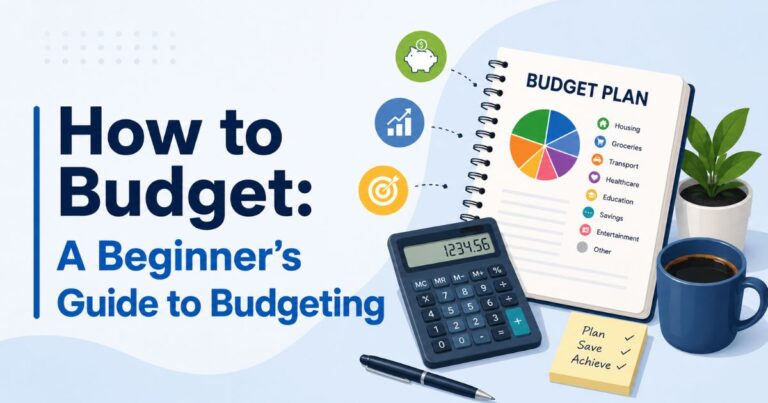
Quick Answer: A budget is a plan for how you’ll spend and save your money each month. To make one, calculate your monthly take-home income, list your fixed and variable expenses, set savings and debt goals, pick a method (the 50/30/20 rule is the simplest), track your spending, and review it monthly. The goal is simple: make sure your money going out is less than your money coming in, with room to save.
Key Takeaways
- The 50/30/20 rule — 50% needs, 30% wants, 20% savings and debt — is the easiest budget for beginners.
- Budgeting matters because about 37% of U.S. adults could not cover a $400 emergency with cash, per the Federal Reserve’s 2025 survey — a buffer most budgets are built to create.
- Average U.S. households spend roughly 33% on housing, 17% on transportation, and 13% on food (BLS), useful benchmarks for setting your own categories.
- Good free tools exist: Rocket Money, EveryDollar, and Goodbudget have free tiers; paid apps like YNAB ($109/yr) and Monarch ($99.99/yr) add automation.
- Best next step: track every dollar for one month, then build your first budget around what you actually spend.
Budgeting is the foundation of every other money goal — saving, paying off debt, investing, or just feeling in control of your finances. This beginner’s guide explains what a budget is and why it matters, walks you through making one in six steps, compares the five most popular budgeting methods with worked examples, and gives you a free template, a Florida cost-of-living section, and answers to the questions people ask most. Everything here is plain-English and backed by data, so you can start today.
This guide is part of our broader Personal Finance: Complete Guide to Managing Your Money. Budgeting is step one; the saving, debt, and investing guides build on it.
This article is educational and not financial advice. Everyone’s situation is different — use these methods as a starting point and adjust them to your own income, goals, and circumstances.
Table of Contents
- 1 What Is a Budget?
- 2 Why Is Budgeting Important?
- 3 How Do You Start a Budget?
- 4 How to Make a Budget in 6 Steps
- 5 What Are the Best Budgeting Methods?
- 6 Which Budgeting Method Is Right for You?
- 6.1 What Is the 50/30/20 Budget Rule?
- 6.2 What Is Zero-Based Budgeting?
- 6.3 How Does Envelope Budgeting Work?
- 6.4 How Do You Budget on a Low or Irregular Income?
- 6.5 How Much Should You Spend on Rent, Food, and Bills?
- 6.6 How Do You Stick to a Budget?
- 6.7 What Should Be Included in a Budget?
- 6.8 How Do You Budget as a Couple or Family?
- 6.9 What Are the Most Common Budgeting Mistakes?
- 6.10 How Does Budgeting Help You Save Money?
- 6.11 How Do You Budget to Pay Off Debt?
- 7 What Are the Best Budgeting Apps and Tools?
- 8 Free Budget Template and Example
- 9 How Do You Know If Your Budget Is Working?
- 10 Frequently Asked Questions About Budgeting
What Is a Budget?
A budget is a plan for how you’ll spend and save your money over a set period, usually a month. It compares the money coming in (your income) against the money going out (your expenses and savings), so every dollar has a purpose and you don’t spend more than you earn. At its simplest, a budget answers one question: where should my money go?
A budget isn’t about restriction — it’s about intention. Instead of wondering where your paycheck went, you decide in advance how much goes to rent, groceries, fun, and savings. That shift from reactive to proactive is what makes budgeting powerful: it turns vague money worry into a concrete plan you can follow and adjust.
Budgets come in many forms — a notebook, a spreadsheet, an app, or cash in envelopes — and use different methods, which we’ll compare below. What they share is the same core math: total income, minus total expenses, equals what’s left to save (or the gap you need to close). A good budget makes that math visible so you can act on it.
Why Is Budgeting Important?
Budgeting is important because it gives you control over your money, helps you reach financial goals, and reduces the stress of living without a plan. The clearest evidence of why it matters: according to the Federal Reserve’s 2025 Survey of Household Economics and Decisionmaking, only 63% of U.S. adults said they could cover an unexpected $400 expense with cash or its equivalent — meaning roughly 37% could not. A budget is the tool that builds the buffer to close that gap.
Beyond emergencies, budgeting delivers three concrete benefits:
- Control. A budget shows exactly where your money goes, so you can stop small leaks (subscriptions, takeout, impulse buys) that quietly add up to hundreds a month.
- Goals. Whether you’re saving for a house, an emergency fund, or a vacation, a budget turns “someday” into a monthly number you can actually hit.
- Less stress. Money is a leading source of anxiety; a plan replaces the dread of not knowing with the calm of knowing your bills are covered and your savings are growing.
The Fed’s data also shows the upside of planning: a majority of adults report spending less than their income in a typical month, which is exactly the margin a budget is designed to protect and grow. Budgeting won’t change your income overnight, but it changes how much of that income works for you instead of slipping away.
How Do You Start a Budget?
To start a budget, gather one month of income and spending information, choose a simple method like the 50/30/20 rule, and write down a plan for where each dollar will go. You don’t need special software — a notebook or a free spreadsheet works — and you don’t need to be perfect on the first try. The first month is mostly about seeing the truth of your finances clearly.
The fastest on-ramp is three moves: total your monthly take-home pay, total what you actually spent last month (your bank and card statements have this), and compare the two. That comparison tells you whether you have a surplus to save or a gap to fix — and that’s the starting point for everything else. The Consumer Financial Protection Bureau offers a free step-by-step budgeting guide and worksheets if you want a structured tool to begin.
The detailed six-step process below walks through exactly how to build a budget you can stick with.
How to Make a Budget in 6 Steps
To make a budget, calculate your monthly income, list your fixed and variable expenses, set your financial goals, choose a budgeting method, track your spending, and review and adjust each month. These six steps work for any income level and any method — they’re the practical core of budgeting. Follow them in order, because each one builds on the last.
Step 1. Calculate Your Monthly Income
This first step is figuring out your real monthly take-home pay — the money that actually lands in your account after taxes and deductions. It matters because budgeting against your gross (pre-tax) pay is the most common beginner mistake; you’ll plan to spend money you never actually receive.
How to do it: use your net income (after taxes, insurance, and retirement contributions), not gross. If you’re paid biweekly, multiply one paycheck by 26 and divide by 12 for a true monthly average. Include all reliable income — a second job, side gigs, child support, or benefits.
Common mistake: budgeting with gross income instead of net, which inflates what you think you can spend.
Tool/resource: your pay stub shows net pay directly; for irregular income, a simple spreadsheet that averages the last 6–12 months gives you a realistic baseline.
Step 2. List Your Fixed and Variable Expenses
This step is writing down everything you spend, split into fixed expenses (the same each month) and variable expenses (which change). It matters because you can’t manage what you don’t measure — and variable spending is usually where the surprises and the savings hide.
How to do it: pull last month’s bank and card statements and list every expense. Fixed costs include rent or mortgage, insurance, loan payments, and subscriptions; variable costs include groceries, gas, dining out, and entertainment. Don’t forget irregular bills (annual insurance, car registration) by dividing them into a monthly amount.
Common mistake: forgetting small recurring charges and occasional bills, which makes the budget look rosier than reality.
Tool/resource: a free expense-tracking app or a spending tracker pulls and categorizes transactions automatically, saving hours of manual sorting.
Step 3. Set Your Financial Goals
This step is deciding what your money is working toward — an emergency fund, paying off debt, a down payment, or retirement. It matters because a budget without goals is just bookkeeping; goals are what make you stick with it when spending gets tempting.
How to do it: set specific, time-bound targets (“save $1,000 for emergencies in 6 months” beats “save more”). Prioritize a starter emergency fund and any high-interest debt first, then layer in medium- and long-term goals. Build the savings amount into your budget as a non-negotiable line. Our guide on how to save money with practical tips that actually work can help you set realistic targets.
Common mistake: treating savings as “whatever’s left over” — which is usually nothing. Assign a savings number first.
Tool/resource: a goal-tracking feature in most budgeting apps (or a simple visual chart) keeps motivation high as you watch progress build.
Step 4. Choose a Budgeting Method
This step is picking a framework for organizing your budget — the 50/30/20 rule, zero-based budgeting, envelopes, pay-yourself-first, or the 60% solution. It matters because the right method matches your personality and makes budgeting feel sustainable instead of like a chore.
How to do it: match the method to how you think about money. Want the simplest start? Use 50/30/20. Want total control? Use zero-based. Struggle with overspending? Try envelopes. We break down all five methods, with worked examples, in the next section.
Common mistake: choosing a method that’s too complex to maintain, then quitting after two weeks. Start simple; you can always level up.
Tool/resource: most budgeting apps are built around a specific method — pick the app that matches the method you choose (more on apps below).
Step 5. Track Your Spending
This step is recording what you actually spend as the month goes on, then comparing it to your plan. It matters because a budget on paper means nothing if you don’t track against it — tracking is what turns a plan into a habit and catches overspending before it derails you.
How to do it: choose a tracking system you’ll actually use — a budgeting app that syncs automatically, a weekly spreadsheet review, or a daily notes log. Check in at least weekly so you can course-correct mid-month rather than discovering a problem after it’s too late.
Common mistake: setting a budget and never looking at it again until the money runs out.
Tool/resource: Apps like Rocket Money auto-track and categorize spending; a free spreadsheet works just as well if you prefer manual entry.
Step 6. Review and Adjust Each Month
This final step is reviewing how the month went and adjusting next month’s budget based on what you learned. It matters because no first budget is perfect — your real spending will differ from your plan, and the budget only works if it evolves with your life.
How to do it: at month’s end, compare planned vs. actual in each category. Where you overspent, decide whether to cut back or raise that category’s allocation (and trim elsewhere). Update for any income or life changes. Treat it as a living plan, not a one-time setup.
Common mistake: abandoning the budget after one over-budget month instead of adjusting. Overspending is information, not failure.
Tool/resource: a recurring monthly calendar reminder — even 20 minutes — keeps the review from slipping and compounds your progress over time.
What Are the Best Budgeting Methods?
The best budgeting methods are the 50/30/20 budget, zero-based budgeting, the envelope (cash stuffing) method, pay-yourself-first budgeting, and the 60% solution. They all answer the same question — where does my money go? — but organize the answer differently, so the best one is whichever you’ll actually stick with. Here’s how each works, with a short worked example using a $4,000 monthly take-home income (figures illustrative).
1. The 50/30/20 Budget
The 50/30/20 budget splits your after-tax income into three buckets: 50% for needs, 30% for wants, and 20% for savings and debt repayment. It’s the most popular method for beginners because it’s simple, flexible, and doesn’t require tracking every transaction.
Worked example ($4,000/month take-home): $2,000 to needs (rent, utilities, groceries, insurance, minimum debt payments), $1,200 to wants (dining out, streaming, hobbies, travel), and $800 to savings and extra debt payoff.
Pros: easy to understand and start, flexible, and built-in savings. Cons: the percentages may not fit high-cost-of-living areas (where needs often exceed 50%), and it’s less precise than tracking every dollar.
Best for: beginners, anyone who wants a low-maintenance budget, and people with fairly steady income.
2. Zero-Based Budgeting
Zero-based budgeting gives every dollar a job until your income minus your assigned expenses equals zero. It doesn’t mean you spend everything — savings and debt payments are “jobs” too — it means no dollar is left unassigned. This is the most thorough, hands-on method.
Worked example ($4,000/month): you assign $1,200 rent, $300 utilities, $500 groceries, $250 transportation, $400 debt, $600 savings, $300 dining, $200 personal, $250 misc., and so on until the last dollar is allocated and the balance reads $0.
Pros: maximum awareness and control, and it’s excellent for finding “leftover” money to redirect. Cons: time-intensive and requires diligent tracking, which can feel like a lot at first.
Best for: detail-oriented people, those trying to break a paycheck-to-paycheck cycle, and anyone who wants to squeeze the most out of every dollar.
3. The Envelope (Cash Stuffing) Method
The envelope method assigns cash to labeled envelopes for each spending category; when an envelope is empty, you stop spending in that category. The modern “cash stuffing” trend revives this approach, and digital versions replicate it with app-based envelopes.
Worked example: after paying fixed bills from your bank account, you withdraw cash for variable categories — say $500 groceries, $200 dining, $150 fun — into separate envelopes. When the dining envelope is empty on the 20th, dining out stops until next month.
Pros: extremely effective at curbing overspending because the limit is physical and visible. Cons: cash is inconvenient and less safe, and it doesn’t suit online or autopay bills.
Best for: people who consistently overspend, prefer tactile control, or want a hard stop on problem categories.
4. Pay-Yourself-First Budgeting
Pay-yourself-first budgeting flips the usual order: you set aside savings and debt payments the moment you’re paid, then spend whatever’s left. It prioritizes your goals over your spending, which is why it’s so effective at building wealth.
Worked example ($4,000/month): the day your paycheck lands, $800 automatically transfers to savings and extra debt payments. The remaining $3,200 covers all your living expenses — and because savings already happened, there’s no willpower required.
Pros: guarantees savings, requires little ongoing tracking, and harnesses automation. Cons: less granular control over spending categories, and it can backfire if you set the savings rate too high and overdraw.
Best for: people who want to save consistently without micromanaging, and anyone who can automate transfers.
5. The 60% Solution Budget
The 60% solution caps your committed expenses at 60% of gross income, then splits the remaining 40% across four savings-style buckets: 10% retirement, 10% long-term savings, 10% short-term savings, and 10% fun money. It’s built to keep your fixed obligations in check while funding multiple goals at once.
Worked example ($4,000/month, treated as the budgeting base): $2,400 for committed expenses (housing, food, bills, transportation), then $400 retirement, $400 long-term savings, $400 short-term savings, and $400 fun.
Pros: strong, multi-goal savings built in, and a clear ceiling on fixed costs. Cons: the 60% cap is hard to hit in high-cost areas, and it’s less common (fewer apps support it directly).
Best for: higher earners and disciplined savers who want to fund several goals simultaneously.
Which Budgeting Method Is Right for You?
The right budgeting method depends on your personality, your income stability, and how much time you want to spend managing money. There’s no single best method — the best one is the one you’ll keep using. Here’s a quick comparison to match a method to you:
| Method | How it works | Effort | Best for |
|---|---|---|---|
| 50/30/20 | 50% needs, 30% wants, 20% savings/debt | Low | Beginners, low maintenance |
| Zero-based | Every dollar gets a job (income − expenses = 0) | High | Detail-lovers, breaking paycheck-to-paycheck |
| Envelope / cash stuffing | Cash (or digital) limits per category | Medium | Overspenders, tactile control |
| Pay-yourself-first | Save first, spend the rest | Low | Consistent savers, automation fans |
| 60% solution | 60% expenses, 40% across savings buckets | Medium | Higher earners, multi-goal savers |
If you’re unsure, start with 50/30/20 — it’s the easiest to learn and you can always switch to a more detailed method later. The methods below get their own deeper explanations.
What Is the 50/30/20 Budget Rule?
The 50/30/20 budget rule is a guideline that allocates 50% of your after-tax income to needs, 30% to wants, and 20% to savings and debt repayment. Popularized by Senator Elizabeth Warren, it’s the most widely recommended starting framework because the percentages are easy to remember and apply.
Worked example with real figures: on a $3,500 monthly take-home income, the 50/30/20 rule gives you $1,750 for needs (housing, utilities, groceries, insurance, minimum debt payments), $1,050 for wants (restaurants, subscriptions, hobbies, travel), and $700 for savings and extra debt payments. If your needs exceed 50% — common in expensive areas — trim your wants bucket first, and treat the percentages as targets to work toward, not rigid rules.
What Is Zero-Based Budgeting?
Zero-based budgeting is a method where you assign every dollar of income a specific job until you have zero dollars left unallocated. “Zero” doesn’t mean a zero balance in your account — it means zero dollars left unplanned, with savings and debt payments counted as assigned jobs.
The process: start with your monthly income, then list every expense, savings goal, and debt payment, assigning dollars to each until the difference between income and assignments is exactly zero. If you have money left over, give it a job (more savings or debt); if you’re short, cut a category. This is the method behind apps like YNAB and EveryDollar, and it’s the most effective way to spot and redirect money you didn’t realize you had.
How Does Envelope Budgeting Work?
Envelope budgeting works by dividing your spending money into category “envelopes” and spending only what’s in each one — when an envelope is empty, you stop spending in that category until the next month. It enforces limits physically (with cash) or digitally (with app-based envelopes), which makes overspending hard to ignore.
The cash version: withdraw your variable-spending money and split it into labeled envelopes (groceries, gas, dining, fun). The digital version: apps like Goodbudget recreate envelopes on your phone, so you keep the discipline without carrying cash — useful since most bills and many purchases are now online or autopay. Either way, the rule is the same: the envelope is the limit.
How Do You Budget on a Low or Irregular Income?
To budget on a low or irregular income, base your budget on your lowest typical month, cover essential needs first, and save windfalls from higher-earning months to smooth out the lean ones. The challenge isn’t the method — it’s the unpredictability — so the strategy is to build in a buffer and prioritize ruthlessly.
Practical tactics for variable or tight income:
- Budget from your baseline. Use your lowest reliable monthly income as your planning number, not your best month.
- Cover the four walls first. Food, housing, utilities, and transportation come before anything else.
- Build a buffer fund. In good months, set aside extra to fund the slow months, so your budget stays steady.
- Use percentages, not fixed amounts. Allocate by percentage of whatever comes in, so the plan flexes with your income.
- Trim and prioritize. On a low income, focus first on essential needs and a small emergency cushion before discretionary spending.
Budgeting on a tight income is harder, but it’s also where a plan matters most — every dollar has to count, and a budget makes sure it does.
How Much Should You Spend on Rent, Food, and Bills?
A common guideline is to spend no more than 30% of your gross income on housing, 10–15% on food, and to keep total needs near 50% of take-home pay. These are starting points, not laws — what’s realistic depends heavily on where you live and what you earn.
For a reality check, here’s what U.S. households actually spend on average, according to the Bureau of Labor Statistics Consumer Expenditure Survey: housing takes about 33% of total spending, transportation about 17%, food about 13% (roughly 8% groceries, 5% dining out), healthcare about 8%, and personal insurance and pensions about 13%. If your housing is eating 45% of your budget, that’s a signal to either increase income or find cheaper housing — the single biggest lever in most budgets. Use these averages to sanity-check your own categories, then adjust for your local cost of living.
How Do You Stick to a Budget?
You stick to a budget by making it realistic, automating what you can, tracking spending regularly, and giving yourself room for fun. Most budgets fail not from bad math but from being too strict or too much work. Here are the tactics that make a budget last:
- Be realistic. A budget that bans all fun spending won’t survive the first weekend. Build in a “wants” category.
- Automate. Set up automatic transfers to savings and autopay for bills so good behavior happens without willpower.
- Track weekly. A quick weekly check-in catches overspending early, when you can still adjust.
- Use a method that fits you. If tracking every dollar feels impossible, switch to 50/30/20 or pay-yourself-first.
- Expect imperfect months. Overspending once isn’t failure — adjust and keep going.
- Keep the goal visible. A clear reason (debt-free, a house, peace of mind) makes the trade-offs worth it.
The CFPB’s free budgeting tools include practical tips for building the habit; the key is choosing a system simple enough that you’ll actually keep using it.
What Should Be Included in a Budget?
A complete budget should include all of your income and every category of spending, plus savings and debt payments. Leaving out irregular or “small” expenses is what causes budgets to break. Here are the standard categories to include:
- Income: take-home pay, side income, benefits, and any other reliable money in.
- Housing: rent or mortgage, property tax, HOA, and home insurance.
- Utilities: electricity, water, gas, internet, and phone.
- Food: groceries and dining out (track these separately).
- Transportation: car payment, gas, insurance, maintenance, or transit.
- Insurance and healthcare: health, auto, life insurance, and medical costs.
- Debt payments: credit cards, student loans, and personal loans.
- Savings: emergency fund, retirement, and specific goals.
- Personal and fun: subscriptions, hobbies, entertainment, and discretionary spending.
- Irregular/annual: registration, gifts, and annual premiums (divided into monthly amounts).
How Do You Budget as a Couple or Family?
To budget as a couple or family, combine your incomes and expenses into one shared plan, agree on goals together, and hold a regular money check-in. The hardest part of household budgeting usually isn’t the math — it’s communication and alignment on priorities.
A few keys to making it work: decide how you’ll structure money (fully joint, fully separate, or a hybrid with a shared account for joint bills); set shared goals you both buy into; divide responsibilities (one person may track while both decide); and schedule a brief, judgment-free monthly money meeting. For families, build in kid-related costs (childcare, activities, growing grocery bills) and consider giving each partner a small no-questions-asked personal allowance to reduce friction. Apps with multi-user access (like Monarch or Goodbudget) make shared tracking far easier.
Should You Budget Weekly or Monthly?
Budget monthly for the big picture and weekly for staying on track — most people benefit from doing both. A monthly budget matches how most bills are due, while weekly check-ins catch overspending before it compounds. Here’s how they compare:
| Factor | Weekly budgeting | Monthly budgeting |
|---|---|---|
| Best for | Tracking day-to-day spending | Planning bills and big-picture goals |
| Matches | Variable spending (groceries, gas) | Fixed bills (rent, loans) |
| Pace | Frequent, hands-on | Less frequent, strategic |
| Good for | Irregular income, overspenders | Steady income, set bills |
The simplest approach: set your budget monthly, then do a five-minute weekly review to make sure you’re on pace.
What Are the Most Common Budgeting Mistakes?
The most common budgeting mistakes are budgeting with gross instead of net income, forgetting irregular expenses, setting unrealistic limits, and not tracking actual spending. These are the errors that cause budgets to fail in the first month. Watch for:
- Using gross income. Budget with take-home pay, not pre-tax pay you never receive.
- Forgetting irregular bills. Annual insurance, registration, and gifts wreck budgets that ignore them — divide them into monthly amounts.
- Being unrealistically strict. A budget with no fun money won’t last; build in discretionary spending.
- Not tracking. A plan you never check against is just a wish. Track weekly.
- No emergency buffer. Without savings, one surprise expense blows up the whole budget.
- Giving up after one bad month. Adjust and continue; consistency beats perfection.
How Does Budgeting Help You Save Money?
Budgeting helps you save money by making your spending visible, so you can cut waste and redirect that money toward savings on purpose. When every dollar is tracked, the small leaks — unused subscriptions, frequent takeout, impulse buys — become obvious and easy to trim.
A budget also makes saving intentional rather than accidental. By assigning a savings amount as a fixed line (especially with pay-yourself-first or zero-based methods), you save before you have a chance to spend it. The result is consistent, automatic progress instead of hoping money is left at month’s end. For specific tactics to cut costs and grow your savings, see our guide on how to save money.
How Do You Budget to Pay Off Debt?
To budget to pay off debt, list your debts, cover your minimum payments as needs, then direct as much extra as possible to one target debt while maintaining a small emergency fund. A budget is what frees up that extra money and keeps the payoff on track.
A simple approach:
- List every debt with its balance, interest rate, and minimum payment.
- Keep a small starter emergency fund (around $1,000) so a surprise doesn’t send you back to the credit card.
- Pay all minimums, then throw extra at one debt — the highest-interest one (avalanche) to save the most money, or the smallest balance (snowball) for motivating quick wins.
- Roll each payoff forward: when one debt is gone, add its payment to the next.
- Cut a budget category temporarily to boost your payoff amount.
Our step-by-step guide to getting out of debt covers the snowball and avalanche methods in detail.
What Are the Best Budgeting Apps and Tools?
The best budgeting app depends on your method and whether you want automation or manual control — and several excellent options are free. Here are strong picks by use case (2026 pricing):
| Use case | App | Price (2026) | Notes |
|---|---|---|---|
| Zero-based budgeting | YNAB | $14.99/mo or $109/yr | Powerful, hands-on; 34-day free trial; free for students 1 year. |
| Zero-based, free option | EveryDollar | Free; Premium ~$79.99/yr | Ramsey “Baby Steps” workflow; free tier is manual entry. |
| Couples / automatic tracking | Monarch Money | $14.99/mo or $99.99/yr | Best for couples; popular Mint replacement; auto-sync. |
| Envelope method | Goodbudget | Free tier; Premium paid | Digital envelopes; free tier covers basic categories. |
| Free, subscription tracking | Rocket Money | Free (paid extras) | Best free all-rounder; finds and cancels subscriptions. |
| Free + investments | Empower | Free | Strong if you also want to track investments and net worth. |
| DIY / full control | Spreadsheet (Sheets/Excel) | Free | Endlessly customizable; more manual. |
Note: the popular Mint app shut down in March 2024, sending many users to Monarch, Rocket Money, or Empower. If you’re just starting, a free app or a simple spreadsheet is plenty — the best tool is the one you’ll consistently use.
Free Budget Template and Example
A budget template is a ready-made layout where you fill in your income, expenses, savings, and debt to see your full financial picture at a glance. Below is an original, filled-in monthly example you can copy into a spreadsheet — and you can download our free, blank version to start your own.
Here’s a filled-in monthly budget using the 50/30/20 framework on a $3,800 take-home income (illustrative):
| Category | Type | Budgeted |
|---|---|---|
| Take-home income | Income | $3,800 |
| Rent | Need | $1,250 |
| Utilities + internet | Need | $220 |
| Groceries | Need | $450 |
| Transportation | Need | $300 |
| Insurance | Need | $180 |
| Minimum debt payments | Need | $200 |
| Dining out + fun | Want | $500 |
| Subscriptions + hobbies | Want | $200 |
| Personal + misc. | Want | $140 |
| Emergency fund | Savings | $360 |
| Extra debt / retirement | Savings | $400 |
| Total assigned | $4,200 → adjust to $3,800 |
In this example the categories total more than the income, which is exactly what a template is for: it shows you the gap so you can trim (here, dining or extra debt) until your assigned total matches your $3,800. [Insert downloadable template link — free Google Sheets/Excel/PDF.]
How Do You Budget for the Cost of Living in Florida?
To budget for the cost of living in Florida, plan around Florida’s specific realities: no state income tax (which boosts take-home pay), but among the highest home and auto insurance costs in the nation. Those two factors reshape a Florida budget compared with most states — more money in your paycheck, but a bigger insurance line.
The big Florida-specific budget items: there’s no state income tax, so your take-home pay is higher than in many states (a real advantage). But Florida has the highest homeowners insurance premiums in the country — commonly several thousand dollars a year, and far more on the coast — so build a generous insurance line into your budget (confirm your own quote, since it varies widely by county and home). Auto insurance also runs above the national average. Housing costs vary sharply by metro, with coastal cities like Miami much pricier than inland areas. Because costs differ so much by city, budget against your specific area: see our city guides, starting with the cost of living in Miami, Florida, for real local housing and expense figures to plug into your budget.
How Do You Know If Your Budget Is Working?
Your budget is working if you’re consistently spending less than you earn, your savings are growing, your bills are paid on time, and you feel less stressed about money. A working budget isn’t one you follow perfectly — it’s one that moves you steadily toward your goals. Signs your budget is healthy:
- You spend less than you earn each month, with a surplus going to savings or debt.
- Your emergency fund is growing toward (and past) one month of expenses.
- Bills are paid on time without scrambling or overdrafting.
- Debt is shrinking, not growing.
- You feel in control, not anxious, about money.
If you’re regularly overspending, can’t save anything, or dread looking at your accounts, that’s a signal to adjust — usually by cutting your biggest flexible categories, increasing income, or switching to a more structured method like zero-based budgeting. A budget that needs tweaking isn’t failing; it’s doing its job by showing you what to fix.
Frequently Asked Questions About Budgeting
What Is the Simplest Way to Budget?
The simplest way to budget is the 50/30/20 rule: put 50% of your take-home pay toward needs, 30% toward wants, and 20% toward savings and debt. It requires no detailed tracking and only three categories, which makes it the easiest method to start and stick with. If even that feels like too much, start by simply saving a set amount the day you’re paid (pay-yourself-first) and spending the rest freely — automation does the work, and you can add detail later as the habit forms.
How Much Money Should You Have Left After Budgeting?
Ideally, you should have at least 20% of your take-home income left for savings and debt after covering needs and wants — that’s the savings target in the 50/30/20 rule. In a true zero-based budget, you have $0 unassigned, because savings is a category that already has its dollars. The key number isn’t what’s “left over” by accident, but what you intentionally direct to savings and debt: aim for 20% if you can, and build up from whatever you can manage now if money is tight.
Can Budgeting Really Help You Get Out of Debt?
Yes — budgeting is one of the most effective tools for getting out of debt, because it frees up money for extra payments and keeps you from adding new debt. A budget shows you exactly how much you can put toward debt each month and protects that amount from being spent elsewhere. Paired with a payoff strategy like the snowball (smallest balance first) or avalanche (highest interest first) method, a budget turns scattered minimum payments into a clear, accelerating path to debt-free. It’s the engine that makes any debt-payoff plan actually run.