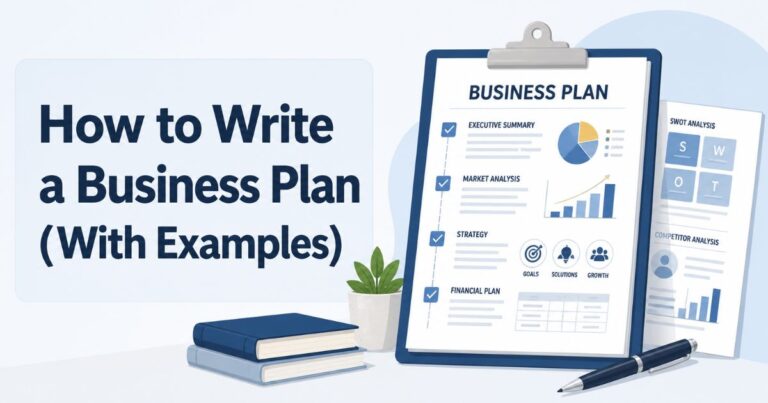
Quick Answer: A business plan is a written document that explains what your business does, who it serves, and how it will make money. To write one, work through nine core sections: executive summary, company description, market analysis, organization and management, products or services, marketing and sales, funding request, financial projections, and an appendix. A traditional plan runs roughly 15–30 pages; a lean one-page version can be drafted in about an hour.
Key Takeaways
- A traditional business plan covers 9 standard sections and typically runs 15–30 pages; a lean one-page plan can be written in about an hour.
- Planning pays off: a Harvard Business Review analysis of business-plan research found founders who write a formal plan are roughly 16% more likely to reach viability than otherwise-identical non-planners.
- Cost ranges widely: business-plan software runs about $15–$40/month, while hiring a professional writer usually costs $1,500–$5,000 (agencies and consultants, far more).
- Write the executive summary last, lead each section with a clear conclusion, and treat the plan as a living document you revise as you learn.
- Best for: first-time founders, anyone applying for a loan or grant, and founders pitching investors.
Writing a business plan means turning your idea into a structured document that proves the business can work — for you first, and for any lender or investor second. This guide walks through what a business plan is, the nine sections it should contain, a seven-step writing process, and full, filled-in examples for one-page, lean, and traditional formats. You’ll also get templates, a readiness checklist, software recommendations, and Florida-specific notes. Every figure here is sourced, and where numbers change by state or business, we point you to the primary source to confirm.
If you’re still deciding whether to launch at all, start with our broader walkthrough on how to start a business step by step, then come back here to build the plan itself.
Table of Contents
- 1 What Is a Business Plan?
- 2 Why Do You Need a Business Plan?
- 3 What Are the Types of Business Plans?
- 4 How Long Should a Business Plan Be?
- 5 What Are the Key Sections of a Business Plan?
- 6 How to Write a Business Plan Step by Step
- 6.1 Step 1. Research Your Market and Competitors
- 6.2 Step 2. Define Your Business and Value Proposition
- 6.3 Step 3. Detail Your Products, Services, and Operations
- 6.4 Step 4. Build Your Marketing and Sales Plan
- 6.5 Step 5. Create Your Financial Projections
- 6.6 Step 6. Write the Executive Summary Last
- 6.7 Step 7. Review, Refine, and Format the Plan
- 7 Business Plan Examples and Templates
- 7.1 One-Page Business Plan Example
- 7.2 Lean Startup Business Plan Example
- 7.3 Traditional Business Plan Example
- 7.4 How Do You Write an Executive Summary?
- 7.5 How Do You Write Financial Projections for a Business Plan?
- 7.6 How Do You Do a Market Analysis for a Business Plan?
- 7.7 What Are the Most Common Business Plan Mistakes?
- 8 What Are the Best Business Plan Software and Tools?
- 9 How Do You Know If Your Business Plan Is Ready?
- 10 Frequently Asked Questions About Business Plans
What Is a Business Plan?
A business plan is a written document that describes what a business does, who its customers are, how it will reach them, and how it expects to make money over a defined period — usually three to five years. It functions as both an internal roadmap for the founder and an external pitch for lenders, investors, and partners who need to judge whether the business is viable before committing money.
In practice, a business plan answers a short list of make-or-break questions: What problem do you solve, and for whom? Why will customers choose you over the alternatives? How will you reach those customers and what will it cost? And do the numbers actually work — will revenue eventually exceed expenses, and when?
Plans range from a single page to 40-plus pages depending on format and audience. A solo founder validating an idea might capture everything on one page, while a founder seeking a Small Business Administration (SBA) loan will need a comprehensive document with detailed financial projections. The content matters more than the length: a focused plan that answers the core questions clearly beats a padded one that buries them.
It helps to be clear about what a business plan is not. It is not a legal formation document — that’s your Articles of Organization or Incorporation. It is not a one-time exercise you file and forget; the most useful plans get revisited and revised. And it is not a guarantee. A plan reduces uncertainty and forces you to confront weak assumptions early, but execution still decides the outcome.
Why Do You Need a Business Plan?
You need a business plan because writing one forces you to test your assumptions before you spend money, gives you a roadmap to run the business against, and is required by almost every lender and investor. Research consistently links planning to better outcomes: a Harvard Business Review analysis of business-plan research found that entrepreneurs who write formal plans are about 16% more likely to achieve viability than otherwise-identical founders who don’t.
That 16% figure is the most defensible number in a field full of inflated marketing stats, because it comes from research that statistically controlled for the “selection effect” — the chance that the kind of person who writes a plan was simply going to succeed anyway. A broader meta-analysis of 46 studies covering more than 11,000 companies reached a similar conclusion: business planning improves performance on average, especially when the plan is short, goal-focused, and revised as the founder learns.
There are four concrete reasons the document earns its keep:
- Funding. Banks, SBA lenders, grant programs, and equity investors almost always ask for a plan with financial projections before they’ll consider you. No plan usually means no meeting.
- Direction. A plan converts a vague idea into specific targets — units sold, price points, hiring milestones — so you know whether you’re on track month to month.
- Decision-making. When you have to choose between two markets or two price models, the plan’s numbers give you something objective to weigh instead of a gut feeling.
- Risk reduction. The act of writing surfaces the assumptions you’ve been glossing over — your real customer acquisition cost, your true break-even point — while changing them still costs nothing.
The caveat worth stating plainly: the research rewards good, living planning, not a thick binder written once to impress a banker and never opened again. The value is in the thinking the document forces, not the page count.
What Are the Types of Business Plans?
There are four common types of business plan: the traditional (comprehensive) plan, the lean startup plan, the one-page plan, and the internal or operational plan. They differ mainly in length, audience, and how much detail each section carries — not in the underlying questions they answer. The right choice depends on who will read the plan and what you need it to do.
The SBA groups most plans into two main camps — traditional and lean startup — and notes there’s “technically no wrong way” to write one, as long as it fits your needs. Here’s how the four formats compare:
| Plan type | Typical length | Best for | Main trade-off |
|---|---|---|---|
| Traditional / comprehensive | 15–40+ pages | Bank/SBA loans, investors, detailed launches | Thorough but time-consuming to write |
| Lean startup | 1 page (canvas) | Fast-moving startups, early validation | Quick, but light on detail lenders want |
| One-page plan | 1 page (prose) | Solo founders, simple businesses, a first draft | Forces brevity; not enough for funding |
| Internal / operational | Varies | Existing teams managing growth | Built for staff, not outside readers |
- A traditional plan uses a standard structure and goes deep in every section. It’s the format detail-oriented founders and most traditional lenders prefer, and it’s the one this guide breaks down section by section below.
- A lean startup plan condenses the business to a single page of charts — usually a Business Model Canvas covering partnerships, activities, resources, value propositions, customer relationships, segments, channels, cost structure, and revenue streams. It’s built to be updated constantly as you learn.
- A one-page plan is similar in length but written as short prose rather than a canvas grid. It’s the fastest way to get your thinking onto paper and a good first draft before you expand into a traditional plan.
- An internal or operational plan is written for your own team rather than outsiders. It can skip the polished company description and focus on operational detail: staffing, workflows, production targets, and internal milestones.
How Long Should a Business Plan Be?
A business plan should be as long as it needs to be to answer the reader’s questions and no longer — but realistic ranges exist by format. A lean or one-page plan is exactly one page. A traditional plan for a straightforward small business usually runs 15–25 pages including financial tables, and a complex plan aimed at investors or a large SBA loan can reach 30–40 pages with appendices.
Length should follow audience, not the other way around. A one-page lean plan can take as little as an hour to write because it captures only the essentials. A traditional plan takes longer precisely because lenders and investors expect detail — a thorough plan signals that your ideas are ready and your numbers will hold up to questions.
A few practical benchmarks:
- Executive summary: 1–2 pages, never more. If a reader only sees this page, it must stand alone.
- Core narrative sections (company, market, products, marketing, management): roughly 1–3 pages each.
- Financial projections: 3–5 pages of tables plus a short written explanation.
- Appendix: as long as needed for supporting documents, but kept separate from the main body.
The most common length mistake is padding — adding filler to look substantial. Reviewers read dozens of plans and spot padding instantly. If a section doesn’t earn its space by answering a real question, cut it.
What Are the Key Sections of a Business Plan?
The key sections of a business plan are the nine that make up a traditional plan: executive summary, company description, market analysis, organization and management, products or services, marketing and sales strategy, funding request, financial projections, and appendix. These nine sections are the structure recommended by the U.S. Small Business Administration’s business plan guide, and they’re what most lenders and investors expect to see.
You don’t have to use every section or keep this exact order — the SBA itself says to use the sections that make the most sense for your business. But these nine give you a complete, fundable plan, and they map directly to the questions a careful reader will ask. The rest of this section breaks each one down: what it is, what to include, a short worked example, the most common mistake, and a writing tip.
1. Executive Summary
The executive summary is a one- to two-page overview of your entire business plan that lets a reader grasp the opportunity in a couple of minutes. It briefly states what your company is, the product or service it offers, who runs it, and — if you’re seeking money — how much you need and your high-level financials.
- What to include: your mission statement, a one-line description of the product or service, basic information about your leadership and location, the market opportunity in a sentence, and your headline financial numbers (projected revenue and funding request). Think of it as the trailer for the full plan.
- Worked example (excerpt): “Cedar & Cup is a specialty coffee shop opening in Tampa’s Seminole Heights neighborhood in Q1 2027. We serve locally roasted espresso drinks and house-baked pastries to the area’s growing population of remote workers and young families. Founder Maria Ortega brings nine years of café management experience. We are seeking $145,000 in startup financing to cover buildout, equipment, and six months of operating runway, and we project $410,000 in first-year revenue with break-even in month 14.”
- Common mistake: writing the executive summary first and turning it into a vague mission statement. It reads as filler and never reflects the actual numbers in the plan.
- Writing tip: write this section last, then cut it in half. Every sentence should carry a concrete fact a reader could repeat back.
2. Company Description
The company description explains what your business does, the problem it solves, the customers it serves, and the specific advantages that will let it succeed. Where the executive summary is the trailer, this is the first full scene — it gives the reader the context to understand everything that follows.
- What to include: your legal structure (LLC, S-corp, sole proprietorship), your location and the market you serve, a clear statement of the problem you solve, your target customers, and your competitive advantages — the reasons a customer picks you over the alternatives.
- Worked example (excerpt): “Cedar & Cup LLC is a Florida limited liability company operating a single café location. We address a clear gap in Seminole Heights: a neighborhood with strong daytime foot traffic but no specialty coffee shop within a 1.2-mile radius. Our advantages are a prime corner lease with 18 parking spaces, a head roaster relationship that guarantees fresh single-origin beans, and a remote-work-friendly layout with 30 seats and dedicated outlets.”
- Common mistake: describing what you do in generic terms (“we provide quality service”) instead of naming the specific problem and the specific edge.
- Writing tip: if you’re weighing your legal structure, settle it before this section — your choice affects taxes, liability, and how investors view you. Our guide to business structures (LLC vs. S-corp vs. sole proprietorship) walks through the trade-offs.
3. Market Analysis
The market analysis demonstrates that you understand your industry, your target market, and your competition. It’s where you prove there are enough customers, that you know who they are, and that you’ve studied the businesses already competing for them. This section is heavily scrutinized by lenders and investors because it shows whether your demand is real or assumed.
- What to include: industry size and trends, your target market’s size and characteristics, a defined customer segment (demographics, location, behavior), and a competitive analysis naming your direct and indirect competitors and how you’ll differentiate.
- Worked example (excerpt): “Our primary market is the roughly 14,000 residents within a one-mile radius of our location, skewing toward adults aged 25–44, of whom an estimated 30% work remotely at least part-time (figures to be confirmed against U.S. Census and local data before publication). Direct competition consists of two national chains 1.5 miles away; we compete on neighborhood proximity, locally roasted beans, and a work-friendly environment they don’t offer.”
- Common mistake: claiming a giant “total addressable market” (“the U.S. coffee market is $X billion”) without narrowing to the customers you can actually reach.
- Writing tip: use real, sourced numbers wherever possible — census data, industry reports, local foot-traffic counts — and clearly flag any figure you still need to verify rather than guessing.
4. Organization and Management
The organization and management section describes your business’s legal structure and the people who run it. It tells the reader who’s in charge, what they bring to the table, and how the company is organized — because investors back teams as much as ideas.
- What to include: your legal structure, an organizational chart if you have employees, and short bios of your owners and key managers highlighting relevant experience. If specific people are part of your competitive advantage, say so here.
- Worked example (excerpt): “Cedar & Cup is member-managed by founder Maria Ortega (CEO), who managed a three-location café group for nine years. A head barista and a part-time bookkeeper round out the launch team, with two additional baristas hired before opening. Ortega holds final decision authority; the bookkeeper reports monthly financials to her.”
- Common mistake: padding bios with irrelevant history while leaving out the experience that actually de-risks the business.
- Writing tip: your structure choice (LLC, S-corp, sole prop) belongs here — and it’s worth getting right. See our business structures guide for how each option affects liability and taxes.
5. Products or Services
The products or services section describes what you sell, how it benefits the customer, and where it stands in its lifecycle. This is your chance to explain — in plain terms — exactly what the customer gets and why it’s worth paying for.
- What to include: a description of each product or service, the customer benefit (not just features), your pricing model, and any intellectual property, suppliers, or product-development plans that matter.
- Worked example (excerpt): “Our core offering is specialty espresso and drip coffee ($3.50–$6.50), complemented by house-baked pastries ($3–$5) and a small lunch menu ($8–$12). Average ticket is projected at $9.25. A loyalty program (buy 9, get the 10th free) drives repeat visits. Beans are sourced from a single regional roaster under a fixed-price supply agreement.”
- Common mistake: listing features instead of benefits — describing the product as you see it rather than the problem it solves for the buyer.
- Writing tip: tie each product back to the customer need you named in the market analysis. Consistency across sections is what makes a plan feel credible.
6. Marketing and Sales Strategy
The marketing and sales strategy explains how you’ll attract customers and how a sale actually happens. The SBA flags this as a section you’ll reference again in your financials, so it needs to be specific: which channels, what they cost, and how they convert to revenue.
- What to include: your pricing strategy, the channels you’ll use to reach customers (social, local SEO, paid ads, partnerships, events), your customer acquisition approach, and your sales process from first contact to purchase and repeat business.
- Worked example (excerpt): “Pre-launch, we’ll build a local Instagram following through neighborhood partnerships and a soft-open event. Ongoing acquisition relies on local SEO (‘coffee shop Seminole Heights’), Google Business Profile reviews, and a punch-card loyalty program. We budget $1,200/month for marketing in year one, targeting a blended customer acquisition cost under $4.”
- Common mistake: naming every possible channel without a budget or a way to measure what works.
- Writing tip: depth here separates strong plans from weak ones — our Business Marketing guide covers channel selection, budgets, and measurement in detail.
7. Funding Request
The funding request section — included only if you’re seeking money — states exactly how much funding you need, what you’ll spend it on, and the terms you want. The SBA advises covering the next five years and being specific: equipment, salaries, or bills until revenue catches up.
- What to include: your total funding requirement, a breakdown of how funds will be used, whether you want debt or equity, the terms you’re seeking, and your future financial plans (paying off debt, an eventual sale).
- Worked example (excerpt): “We request $145,000 in debt financing over a 7-year term: $70,000 for buildout and fixtures, $45,000 for equipment (espresso machine, ovens, POS), and $30,000 as operating runway for the first six months. We are not seeking equity and intend to retain full ownership. Projected cash flow supports debt service beginning in month 4.”
- Common mistake: asking for a round number without itemizing it, which makes lenders doubt you’ve actually costed the launch.
- Writing tip: match this section to your financial projections exactly, and review your options first — our Business Financing guide compares SBA loans, bank loans, and other funding routes.
8. Financial Projections
The financial projections section turns your plan into numbers: forecasts that show the business can become profitable and repay any financing. For most plans this means three to five years of projected income statements, cash flow statements, and balance sheets, plus a break-even analysis. If you’re an existing business, include historical statements too.
- What to include: a sales forecast, projected profit-and-loss (income statement), projected cash flow, a projected balance sheet, and a break-even analysis showing when revenue covers costs. Tie every number back to assumptions stated earlier in the plan.
- Worked example (excerpt): “We project year-one revenue of $410,000 (≈120 transactions/day × $9.25 average ticket × 360 days), rising to $velocity $520,000 by year three. First-year costs include $148,000 cost of goods, $96,000 labor, and $84,000 occupancy. Break-even occurs at roughly 95 transactions/day, projected to be reached in month 14. (All figures illustrative — replace with your own modeled numbers.)”
- Common mistake: hockey-stick projections with no basis — assuming rapid growth without explaining what drives it.
- Writing tip: build projections bottom-up from real unit economics (price × volume) rather than top-down from a market-share guess, and be ready to defend every assumption. A guide to business taxes can help you forecast the tax line accurately.
9. Appendix and Supporting Documents
The appendix holds the supporting documents that back up claims in your plan but would clutter the main narrative. It’s optional, but a well-organized appendix signals diligence to lenders and investors.
- What to include: resumes of owners and key staff, permits and licenses, lease agreements, product photos or designs, letters of intent from customers or suppliers, detailed market-research data, and any legal documents referenced earlier.
- Worked example (excerpt): “Appendix contents: (A) Maria Ortega résumé; (B) signed letter of intent for the corner lease; (C) supply agreement with regional roaster; (D) buildout cost estimates from two contractors; (E) detailed first-year monthly cash-flow model.”
- Common mistake: dumping every document in without an index, so a reader can’t find the one they want.
- Writing tip: add a short contents list at the top of the appendix and reference each item by letter from the main plan (“see Appendix B”).
How to Write a Business Plan Step by Step
To write a business plan step by step, research your market first, then define your business, detail your products and operations, build your marketing and financial plans, write the executive summary last, and finish by reviewing and formatting the whole document. The order below is deliberate: each step produces information the next one needs, and writing the summary last means it reflects the real plan instead of your first guess.
Step 1. Research Your Market and Competitors
This first step is gathering the facts your plan will rest on: how big the market is, who your customers are, and who you’re competing against. It matters because every later section — pricing, marketing, financials — depends on accurate market information; a plan built on guesses fails the moment a lender asks a pointed question.
- How to do it: define your target customer specifically (age, location, income, behavior); estimate your reachable market using census data and industry reports; and study three to five direct competitors — their pricing, positioning, reviews, and gaps you can exploit. Visit competitors in person if you can.
- Common mistake: researching only enough to confirm what you already believe. Look hard for evidence you might be wrong about demand.
- Tool/resource: a dedicated planning tool can speed up market research with built-in industry data. LivePlan includes industry benchmarks across 1,000+ industries to sanity-check your assumptions.
Step 2. Define Your Business and Value Proposition
This step nails down what your business is and the single most important reason a customer chooses you — your value proposition. It matters because a fuzzy value proposition produces a fuzzy plan; if you can’t say in one sentence why you’re the better choice, neither can your customers.
- How to do it: write a one-sentence value proposition in the form “We help [customer] achieve [outcome] by [how], unlike [alternative].” Then settle your legal structure, name, and mission. Pressure-test the value proposition against your competitor research from Step 1.
- Common mistake: a value proposition that lists features instead of the customer outcome, or one so broad it could describe any competitor.
- Tool/resource: free Business Model Canvas templates are a fast way to map your value proposition against your costs and customer segments before you write prose.
Step 3. Detail Your Products, Services, and Operations
This step documents exactly what you sell and how you’ll deliver it day to day. It matters because operations are where many plans quietly fall apart — a great idea with no realistic plan for production, staffing, or supply chain won’t convince anyone (including you).
- How to do it: list each product or service with its price; describe your operational workflow from sourcing to delivery; identify suppliers, equipment, and staffing needs; and note any permits or licenses required. Map a typical day or week of operations.
- Common mistake: underestimating operational costs and timelines — especially permits, equipment lead times, and the labor needed at launch.
- Tool/resource: your state or local Small Business Development Center (SBDC) offers free help mapping operations and licensing requirements for your specific business and location.
Step 4. Build Your Marketing and Sales Plan
This step defines how you’ll get customers and turn them into revenue. It matters because even an excellent product fails without a realistic, budgeted plan to reach buyers — and because your marketing assumptions feed directly into your sales forecast.
- How to do it: pick two or three channels you can actually execute and afford; set a monthly marketing budget; define your sales process and what converts a prospect to a paying customer; and estimate a customer acquisition cost you can test against reality after launch.
- Common mistake: spreading a small budget across too many channels, so none gets enough investment to work.
- Tool/resource: our Business Marketing guide breaks down which channels fit which business types and how to budget and measure them.
Step 5. Create Your Financial Projections
This step builds the numbers — sales forecast, profit-and-loss, cash flow, and break-even. It matters more than any other section to lenders and investors: it’s where they decide whether the business can repay them. Strong projections are the difference between an approval and a polite no.
- How to do it: build bottom-up from unit economics (price × realistic volume); project three years monthly for year one and annually after; include all costs (many founders forget taxes, insurance, and owner pay); and calculate the break-even point where revenue covers fixed and variable costs.
- Common mistake: optimistic, unexplained “hockey-stick” growth. Conservative, defensible numbers build more trust than big ones you can’t justify.
- Tool/resource: spreadsheets work, but purpose-built software reduces errors. LivePlan (from about $15/month billed annually) auto-builds interconnected financial statements and 550+ sample plans; it’s worth comparing against free templates first to see what you need. Review your financing options alongside the projections.
Step 6. Write the Executive Summary Last
This step is writing the one- to two-page overview — after everything else is done. It matters because the summary is the most-read page of your plan, and the only way it can accurately reflect your business is to write it once the real numbers and strategy exist.
- How to do it: pull the single strongest sentence from each major section, lead with your headline opportunity and numbers, and keep it under two pages. Then cut it by a third. Make sure it reads correctly on its own, since some readers see nothing else.
- Common mistake: treating it as an introduction full of throat-clearing instead of a tight, fact-dense summary.
- Tool/resource: read your finished summary aloud, or have a friend read only that page and tell you what the business does and whether they’d fund it.
Step 7. Review, Refine, and Format the Plan
The final step is review and formatting: proofreading, checking that numbers match across sections, and making the document clean and professional. It matters because errors and inconsistencies — a revenue figure that differs between the summary and the financials — destroy credibility instantly.
- How to do it: verify every number appears identically everywhere it’s referenced; proofread for typos; add a contents page, page numbers, and consistent headings; and have someone outside the business read it for clarity. Save a polished PDF for sharing.
- Common mistake: skipping the consistency check, so the funding request says $145,000 but the financials assume $150,000.
- Tool/resource: a fresh set of eyes — a mentor, an SBDC advisor, or SCORE volunteer — catches gaps you’ve stopped seeing after weeks in the document.
Business Plan Examples and Templates
The fastest way to understand a business plan is to see filled-in examples. Below are three original, worked examples — a one-page plan, a lean startup canvas, and a traditional plan outline — that you can adapt to your own business. They’re illustrative (the numbers are sample figures, not real-world claims), and you should replace every value with your own researched data.
Use these as starting structures, not copy-paste templates. The detail and numbers are what make a plan yours; lenders can spot a generic, find-and-replace plan immediately.
One-Page Business Plan Example
A one-page business plan condenses the entire business into a single page of short prose — ideal for a solo founder, a simple service business, or a first draft before you expand. It fits best when you need to get your thinking onto paper fast or share a quick overview, but it isn’t enough on its own for a bank or investor.
Here’s a filled-in one-page example for a lawn care business:
| Section | Example content (illustrative) |
|---|---|
| Business | GreenEdge Lawn Care LLC — residential lawn maintenance in Orlando, FL. |
| Problem | Homeowners want reliable, on-schedule lawn service; many local providers are inconsistent. |
| Solution / value prop | Guaranteed weekly service windows with text confirmations and flat monthly pricing. |
| Target customer | Suburban homeowners aged 35–60 in three Orlando ZIP codes; ~8,000 households. |
| Revenue model | $160/month per recurring residential client; add-ons for hedging and mulch. |
| Marketing | Local SEO, yard signs, Nextdoor, and referral discounts. |
| Startup cost | ~$9,000 (used mower/trailer, equipment, insurance, branding). |
| Year-1 goal | 40 recurring clients → ~$76,800 annual recurring revenue. |
If a lawn or service business is your actual plan, our step-by-step cluster guides — like how to start a lawn care business — go deeper on equipment, pricing, and licensing.
Lean Startup Business Plan Example
A lean startup plan maps the business onto a one-page Business Model Canvas — nine building blocks you can update as you learn. It fits best for startups testing a new idea, where speed and adaptability matter more than a polished narrative. The SBA notes a lean plan can be written in as little as an hour.
Here’s a filled-in lean canvas for a meal-prep delivery startup (illustrative):
| Canvas block | Example content |
|---|---|
| Customer segments | Busy professionals, 28–45, in Tampa metro who want healthy meals without cooking. |
| Value propositions | Chef-prepared, macro-balanced meals delivered weekly; cheaper than takeout, healthier than fast food. |
| Channels | Direct website subscription, Instagram, local gym partnerships. |
| Customer relationships | Subscription with easy pause/skip; weekly menu email. |
| Revenue streams | $11–$13 per meal, 8–12 meals/week per subscriber. |
| Key resources | Commercial kitchen, chef, delivery drivers, ordering platform. |
| Key activities | Menu development, food prep, packaging, delivery logistics. |
| Key partnerships | Local produce suppliers, a shared commercial kitchen, gyms. |
| Cost structure | Food costs, kitchen rent, labor, packaging, delivery, platform fees. |
The strength of the lean format is that you can change any block in minutes as customer feedback comes in — which is exactly why fast-moving founders favor it.
Traditional Business Plan Example
A traditional business plan example follows the nine-section structure in full, with each section running one to three pages. It fits best when you’re applying for a loan, pitching investors, or launching a business complex enough to warrant detail. Rather than reproduce 25 pages, here’s the section-by-section skeleton with the headline content each part would carry, using the Cedar & Cup coffee shop from earlier:
| Section | Headline content (illustrative) |
|---|---|
| 1. Executive summary | Tampa specialty café; $145K funding request; $410K projected year-1 revenue; break-even month 14. |
| 2. Company description | FL LLC; fills a coffee gap in Seminole Heights; corner lease, fresh local beans, work-friendly layout. |
| 3. Market analysis | ~14,000 residents within a mile; two distant chain competitors; differentiation on proximity and quality. |
| 4. Organization & management | Member-managed by a founder with 9 years’ café experience; head barista + bookkeeper. |
| 5. Products / services | Espresso & drip ($3.50–$6.50), pastries, light lunch; $9.25 average ticket; loyalty program. |
| 6. Marketing & sales | Local SEO, Instagram, soft-open event; $1,200/month budget; CAC under $4. |
| 7. Funding request | $145K debt, 7-year term; itemized for buildout, equipment, and runway. |
| 8. Financial projections | 3-year P&L, cash flow, balance sheet; break-even at ~95 transactions/day. |
| 9. Appendix | Résumé, lease LOI, supplier agreement, contractor estimates, monthly cash-flow model. |
This is the format most lenders expect. If a coffee shop is your plan, see our dedicated walkthrough on how to start a coffee shop for buildout and equipment specifics.
How Do You Write an Executive Summary?
To write an executive summary, draft it last and distill each major section of your plan into one or two strong sentences, leading with your biggest opportunity and your headline numbers. Keep it to one or two pages, make it self-contained, and end with your funding request if you have one.
Work in this order: (1) open with a one-line description of the business and the opportunity; (2) state the problem and your solution; (3) summarize your market and competitive edge in two or three sentences; (4) introduce the team in a sentence; (5) give the headline financials — projected revenue and funding request; (6) close with the specific ask. Then cut every sentence that doesn’t carry a fact.
How Do You Write Financial Projections for a Business Plan?
To write financial projections, build them bottom-up from your unit economics — price times realistic sales volume — then assemble a sales forecast, a profit-and-loss statement, a cash-flow statement, and a break-even analysis covering three to five years. Project year one month by month and later years annually.
Start with your sales forecast (how many units or customers, at what price, growing how fast and why). Subtract your costs — cost of goods, labor, rent, marketing, insurance, taxes, and owner pay — to build the profit-and-loss. Then build a cash-flow statement, since profitable businesses still fail when cash runs out. Finally, calculate break-even: the sales level where revenue covers all costs. Tie every assumption back to earlier sections so the numbers are defensible.
How Do You Do a Market Analysis for a Business Plan?
To do a market analysis, define your target customer precisely, estimate the size of the market you can realistically reach, research industry trends, and analyze three to five direct competitors. The goal is to prove demand is real and that you understand the landscape you’re entering.
Use primary sources for the numbers: U.S. Census data for demographics, Bureau of Labor Statistics data for industry employment and wages, and industry reports for trends. Then narrow from the broad industry to your reachable market — the customers near you, in your niche, who can actually buy. For competitors, document their pricing, positioning, strengths, weaknesses, and the specific gap you’ll fill. Flag any number you couldn’t verify so you can confirm it before sharing the plan.
Do You Need a Business Plan to Get a Loan?
Yes — you almost always need a business plan to get a business loan. Banks, SBA lenders, and most credit unions require a written plan with financial projections to assess whether your business can repay the debt. For SBA loans in particular, a plan with detailed financials is typically part of the application package.
The plan a lender wants leans traditional and financials-heavy: they care most about your projections, cash flow, and ability to service the debt. A lean one-page plan usually isn’t enough for a significant loan. Before applying, compare your options — SBA loans, conventional bank loans, and alternatives — in our Business Financing guide, since the documentation each requires varies.
Can You Write a Business Plan Yourself?
Yes — you can absolutely write a business plan yourself, and for most small businesses it’s the better choice. Writing it yourself forces you to understand your own numbers and assumptions, which is exactly what you’ll need when a lender or investor asks questions. Free templates and software make the format easy; the thinking is the part only you can do.
Consider hiring help only for complex situations — a large raise, an immigration or franchise plan, or financials beyond your comfort — and even then, stay involved so you can defend every section. Free, expert guidance is widely available: SCORE, the SBA’s nonprofit mentoring partner, and local Small Business Development Centers offer one-on-one help at no cost.
What Are the Most Common Business Plan Mistakes?
The most common business plan mistakes are unrealistic financial projections, a vague value proposition, ignoring the competition, and padding the document with filler. These are the errors that get plans rejected by lenders and quietly doom them as planning tools. Here are the ones to avoid:
- Hockey-stick projections. Unexplained rapid growth signals you haven’t thought hard about the numbers. Build bottom-up and stay conservative.
- A fuzzy value proposition. If your “why us” could describe any competitor, you don’t have one yet.
- Ignoring or dismissing competitors. Claiming you have “no competition” reads as naïve, not visionary.
- Inconsistent numbers. A revenue figure that differs between the summary and the financials destroys credibility.
- Padding for length. Reviewers spot filler instantly; a tight 18-page plan beats a bloated 40-page one.
- Writing it once and filing it. A plan you never revisit loses the value the research says planning provides.
What Are the Best Business Plan Software and Tools?
The best business plan software depends on what you need help with: writing and structure, financial modeling, or ready-made templates. Most founders do well with one dedicated planning tool plus a spreadsheet, and prices generally run from free up to about $40/month. Here are strong options by use case:
| Use case | Tool | Typical price (2026) | Notes |
|---|---|---|---|
| Guided writing + financials | LivePlan | $20/mo ($15/mo annual); Premium $40/mo | Step-by-step builder, auto financials, 550+ sample plans; 35-day money-back guarantee. |
| AI-assisted, lower cost | Upmetrics | From ~$14–$19/mo | AI drafting, forecasting, pitch decks; competitive LivePlan alternative. |
| Guided plan + fundraising | Bizplan | Subscription / Startups.com bundle | Guided builder with access to a fundraising network. |
| Free templates | SBA / SCORE templates | Free | Official traditional and lean templates and examples. |
| Financials only | Spreadsheet (Excel/Sheets) | Free–low | Full control; more manual and error-prone than dedicated tools. |
Pricing changes often — confirm current rates on each provider’s site before subscribing.
How Do You Write a Business Plan in Florida?
To write a business plan in Florida, you follow the same nine-section structure as anywhere else, then align the plan with Florida-specific registration, costs, and funding. The biggest local differences are how you register the entity and the absence of a state personal income tax, both of which affect your company description and financials.
A few Florida specifics to build in: you’ll register your LLC through the Florida Division of Corporations (Sunbiz) for a $125 filing fee, with a $138.75 annual report due each May 1. Florida has no state personal income tax, which can simplify your owner-income projections, though pass-through and corporate situations differ. For funding and grants, Florida’s SBDC network and local economic-development offices are useful, free resources. For the full local process, see our complete guide on how to start a business in Florida, and confirm all current fees against Sunbiz before you publish numbers in your plan.
Traditional vs Lean Startup Business Plan: Which Should You Use?
Use a traditional business plan if you’re seeking a loan or investment or launching a detailed business; use a lean startup plan if you’re testing an idea quickly and want a document you’ll revise constantly. The two formats answer the same questions at very different depths.
| Factor | Traditional plan | Lean startup plan |
|---|---|---|
| Length | 15–40+ pages | 1 page (canvas) |
| Time to write | Days to weeks | About an hour |
| Detail | Deep in every section | High-level essentials only |
| Best for | Loans, investors, complex launches | Early validation, fast iteration |
| Financials | Full 3–5 year projections | Cost structure + revenue streams |
Many founders use both: a lean canvas to think and iterate, then a traditional plan once they’re ready to seek funding. There’s no wrong choice — pick the one that matches your audience and stage.
Business Plan vs Pitch Deck: What’s the Difference?
A business plan is a detailed written document; a pitch deck is a short visual presentation — usually 10–15 slides — that summarizes the opportunity for investors. The plan is for careful reading; the deck is for a live pitch. They’re complements, not substitutes.
| Factor | Business plan | Pitch deck |
|---|---|---|
| Format | Written document (15–40 pages) | Slides (10–15) |
| Audience | Lenders, SBA, internal use | Investors, in a meeting |
| Depth | Comprehensive, detailed financials | High-level highlights |
| Goal | Prove viability and repayment | Win the next meeting |
If you’re raising equity, you’ll likely need both: the deck gets you in the room, and the plan (with its financials) answers the diligence questions that follow.
How Do You Know If Your Business Plan Is Ready?
Your business plan is ready when it answers every question a lender or investor would ask, the numbers are consistent and defensible across all sections, and someone outside the business can read it and understand exactly what you do and why it will work. Use this pre-submission checklist:
- Executive summary stands alone — a reader who sees only this page understands the business and the ask.
- Every claim is supported — market size, pricing, and costs trace back to a source or a stated assumption.
- Numbers match everywhere — the funding request, revenue, and projections are identical across sections.
- Financials are bottom-up and conservative — built from unit economics, not a market-share guess.
- Competition is addressed honestly — you name real competitors and your specific edge.
- It’s been proofread and reviewed — by at least one outside reader (mentor, SBDC, SCORE).
- Format is clean — contents page, page numbers, consistent headings, polished PDF.
- It’s current — fees, tax figures, and market data are up to date and verified.
If you can check every box, the plan is ready to share. If not, the gaps you found are exactly what a lender would have found first.
Frequently Asked Questions About Business Plans
What Is the Most Important Part of a Business Plan?
The most important parts of a business plan are the executive summary and the financial projections. The executive summary is the most-read page and decides whether anyone continues, while the financial projections are where lenders and investors judge whether the business can actually repay or return their money. A weak version of either can sink an otherwise strong plan, so give both extra attention and make sure they’re consistent with each other.
How Much Does It Cost to Write a Business Plan?
Writing a business plan can cost nothing if you do it yourself with free templates, about $15–$40 per month for business-plan software, or roughly $1,500–$5,000 to hire a professional writer. Consulting firms and complex plans (immigration, large raises) can run $5,000 to $25,000 or more. For most small businesses, the DIY or software route is both cheaper and better, because writing it yourself forces the understanding you’ll need to defend the plan.
Can I Write a Business Plan in One Day?
Yes — you can write a lean, one-page business plan in a single day, and sometimes in about an hour, because it captures only the essentials. A full traditional plan with researched market data and detailed financial projections, however, realistically takes several days to a few weeks to do well. If you need something fast, start with a one-page plan to clarify your thinking, then expand it into a traditional plan when you have time to research the numbers properly.